






Most Salesforce implementations fail not because of technology, but because of fit. A consulting firm that builds Sales Cloud pipelines for SaaS companies won't understand why your donor acknowledgment workflows need to trigger within 48 hours — or why a grant report that's two days late can cost you a renewal.
Nonprofit organizations need a Salesforce partner that understands donor relationship management, constituent relationship management, program tracking, grant administration, volunteer management, case management, and the data models that tie it all together. That's a different skill set than configuring opportunity stages for a B2B sales team.
The right Salesforce nonprofit consultants help you streamline operations, break down data silos, engage donors more effectively, manage volunteers at scale, and turn scattered spreadsheets into a platform that drives community engagement and real-time reporting. The wrong technology consultant hands you a generic Salesforce instance and moves on.
This guide ranks the top Salesforce nonprofit implementation partners for 2026 based on verified nonprofit delivery experience, not partner tier or ad spend. Whether you're evaluating NPSP, Nonprofit Cloud, or a hybrid approach, the right partner will shape your adoption rates, reporting quality, total cost, and long-term maintainability.
How We Selected These Salesforce Nonprofit Partners
We didn't rank these partners by Salesforce tier, company size, or marketing budget. Instead, we evaluated each one against criteria that actually matter when your CRM needs to manage donors, not deals.
Our ranking criteria:
- Verified Salesforce partner status on AppExchange
- Published nonprofit case studies or client references showing a proven track record
- Demonstrated experience with NPSP and/or Salesforce Nonprofit Cloud implementation
- Data migration, data management, and deduplication capabilities
- Fundraising, program management, grantmaking, or case management expertise
- AppExchange reviews or publicly verifiable client proof
- Post-launch support, ongoing support, and managed services availability
- Relevant Salesforce certifications (Nonprofit Cloud Consultant, Administrator, Platform Developer, Marketing Cloud, etc.)
This is not a paid ranking. No partner paid to be included, and no partner paid to be ranked higher. We prioritized nonprofit delivery experience, public proof, and relevance to real implementation needs. Each partner was assessed on the Salesforce solutions they deliver and how well they guide the implementation process from discovery to post-launch.
Quick Comparison: Top Salesforce Nonprofit Implementation Partners
Top Salesforce Nonprofit Implementation Partners (Ranked)
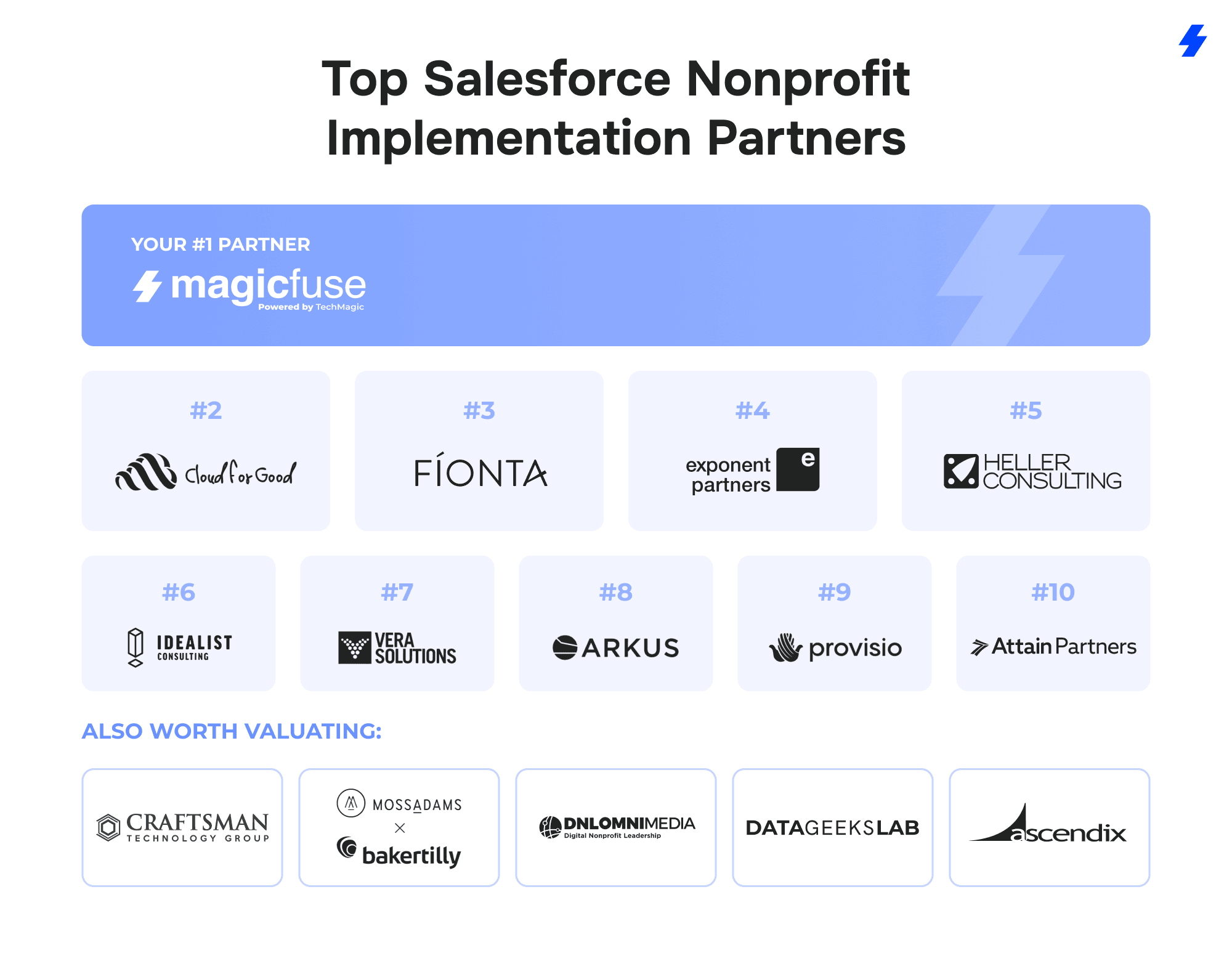
1. MagicFuse
Best for: Nonprofit Cloud implementation, Salesforce integrations, fundraising automation, donor data migration, Marketing Cloud, and custom Salesforce development.
MagicFuse is a Salesforce consulting and development partner with 270+ Salesforce certifications and a team of 80+ certified Salesforce consultants. What sets MagicFuse apart in the nonprofit space is technical implementation depth.
MagicFuse's nonprofit portfolio includes fundraising automation, donor data centralization, payment integrations (Stripe, direct debit, bank statement processing), Marketing Cloud segmentation and marketing automation, complex data migration and deduplication, and scalable nonprofit CRM architecture. The team can configure Salesforce to fit your specific fundraising model.
Nonprofit experience highlights:
Working with a European animal welfare NGO, MagicFuse delivered an end-to-end Nonprofit Cloud and Marketing Cloud implementation. The project involved strategic planning workshops, a custom data model for petitions, corporate outreach, and campaign management, along with complex migration and deduplication of millions of donor records. The team built automated fundraising workflows integrating Stripe and direct debit payments, advanced donor segmentation in Marketing Cloud, and dynamic multi-level reporting dashboards that deliver data-driven insights for fundraising leadership. The result: a unified, scalable platform that replaced fragmented systems and manual donation handling, improving operational efficiency across the entire organization.
In another nonprofit engagement, MagicFuse implemented Sales Cloud with NPSP for a mission-driven organization that lacked any structured donor management. The team centralized scattered fundraising data, built internal funds tracking processes, automated reporting, and migrated thousands of legacy records into a single source of truth.
For a global humanitarian network based in Switzerland, MagicFuse provided ongoing Salesforce support — refining user roles, building a policy database, and improving office workflows across the organization. And for an international humanitarian training NGO, MagicFuse rebuilt a Salesforce-to-event-platform integration, replacing costly middleware with a direct, maintainable solution.
When to choose MagicFuse: Your nonprofit needs more than basic Salesforce configuration. You have complex data to migrate, payment systems to integrate, Marketing Cloud campaigns to set up, or custom development requirements that go beyond standard clicks-not-code. MagicFuse is a strong fit for mid-sized to large nonprofits that need technical depth alongside nonprofit domain understanding.
When they may not be the best fit: If you're a very small nonprofit looking for a minimal NPSP setup with no integrations, a smaller boutique partner with lower minimums may be more cost-efficient.
2. Cloud for Good
Best for: Large nonprofits, higher education institutions, and organizations undergoing complex multi-cloud Salesforce transformations.
Cloud for Good is a Salesforce Strategic Partner, certified B Corporation, and one of the most established names in the nonprofit Salesforce ecosystem. Founded in 2010, the firm has partnered with multiple nonprofits and higher education institutions. In 2025, Tailwind Capital and Salesforce Ventures invested in Cloud for Good to accelerate its growth.
Cloud for Good works with some of the largest nonprofits in North America — along with educational institutions and state and local governments — including organizations like the American Cancer Society and the National Aquarium. They offer implementation across multiple Salesforce clouds, strategic guidance, managed services, data warehousing, and direct response fundraising technology.
Core strengths:
- Scale — experience with 25% of the top 100 largest US nonprofits and 65% of R1 universities.
- Cross-cloud expertise (Nonprofit Cloud, Marketing Cloud, Experience Cloud, Data Cloud).
- NPSP-to-Nonprofit Cloud migration experience.
- Proprietary accelerators to reduce implementation timelines.
- Direct response and data warehousing services. Strategic consulting for nonprofit, higher education, and government sectors.
When to choose them: Your nonprofit is large, complex, and needs a partner with enterprise-level capacity. You're managing multi-department implementations spanning fundraising, programs, marketing, and analytics.
When they may not be the best fit: Smaller nonprofits with limited budgets may find Cloud for Good's enterprise focus and pricing out of reach. If you need highly custom technical development (Apex, integrations), a more development-focused partner might complement their strategic work.
3. Fíonta
Best for: Associations, foundations, and nonprofits that need both Salesforce strategy and long-term managed services.
Fíonta (pronounced "fee-ON-ta") is a majority woman-owned Salesforce partner founded in 2001 in Washington, DC. They've worked with over 1,200 organizations and focus exclusively on the nonprofit, foundation, and association markets. Their team is US-based and includes certified consultants with deep experience in Nonprofit Cloud, NPSP, Experience Cloud, and Marketing Cloud Account Engagement (Pardot).
A differentiator: Fíonta also offers UX consulting, UI design, and WordPress/Drupal web development through their Digital Services practice — useful for nonprofits that need their website and CRM to work together. Their implementation process includes thorough user training and change management tailored to the nonprofit sector.
Core strengths:
- Deep expertise migrating from Blackbaud products (Raiser's Edge, Luminate CRM) to Salesforce.
- NPSP-to-Nonprofit Cloud migration experience (including recent work for organizations like the Oklahoma Medical Research Foundation).
- Managed services for ongoing Salesforce support.
- Combined Salesforce + web development capabilities.
- Strong association and membership management experience.
When to choose them: You're a nonprofit or association that needs a partner who understands membership lifecycles, foundation grantmaking, and long-term platform support. You value US-based consultants and want both Salesforce and web/UX work from one team.
When they may not be the best fit: If your project is heavily focused on custom Apex development, complex integrations, or Marketing Cloud (beyond Pardot/MCAE), you might need a more technically specialized partner.
4. Exponent Partners
Best for: Human services organizations, case management, program management, and impact reporting.
Exponent Partners is a certified B Corporation and California Benefit Corporation that works exclusively with the social sector. Founded in 2005, they've completed over 2,000 projects for education, human services, and philanthropy organizations. Their standout product is Exponent Case Management (ECM), a Salesforce AppExchange app built specifically for human services agencies.
If your nonprofit manages client intake, program enrollment, service delivery, referrals, and HMIS (Homeless Management Information System) reporting, Exponent Partners is one of the most experienced choices in the Salesforce ecosystem.
Core strengths:
- Purpose-built case management solution (ECM) on Salesforce.
- Deep human services expertise: homelessness, workforce development, child welfare, immigrant services, health services, and community development.
- Philanthropy and grantmaking support (including NPSP and Nonprofit Cloud).
- Program outcomes measurement and program delivery tracking.
- HIPAA-compliant platform experience.
- Ability to track engagement across multiple programs and funders.
When to choose them: Your nonprofit delivers direct services to people — housing, workforce training, family services, healthcare — and you need a system that tracks intake, assessments, program enrollment, service delivery, referrals, and outcomes. ECM is a significant differentiator if your needs go beyond basic Salesforce case management.
When they may not be the best fit: If your primary need is fundraising automation, donor management, or Marketing Cloud — without a heavy case management component — other partners may be a better match.
5. Heller Consulting
Best for: CRM strategy, change management, complex data migrations, and long-term nonprofit technology planning.
Heller Consulting has been helping nonprofits with technology strategy since 1996 — nearly three decades. They're a registered B Corporation and a Salesforce partner since 2008, with experience implementing platforms for hundreds of nonprofit, education, and healthcare institutions.
What sets Heller apart is their emphasis on strategy before technology. They don't just build Salesforce orgs — they help organizations evaluate whether Salesforce is the right choice at all (they also work with Microsoft and Blackbaud platforms). As a technology consultant with deep nonprofit roots, Heller's strategic planning and change management expertise helps ensure that the people using the system actually adopt it. Their approach isn't about delivering innovative solutions for their own sake — it's about finding the right fit for how your team actually works.
Heller is currently deploying Nonprofit Cloud / Agentforce Nonprofit for major nonprofit organizations and education institutions in North America.
Core strengths:
- Nearly 30 years of nonprofit technology consulting.
- Technology roadmapping and vendor-agnostic CRM strategy.
- Change management and user adoption focus.
- Complex data migration (e.g., Environmental Defense Fund: 60+ data tables, millions of records, six weeks ahead of schedule).
- Blackbaud-to-Salesforce migration expertise.
When to choose them: You need a partner who will help you think strategically before configuring anything. You want change management baked into the project, not bolted on. You have a complex legacy system with messy data.
When they may not be the best fit: If you've already decided on Salesforce and you need fast, technical implementation, Heller's strategy-first approach may feel slower than a more implementation-focused partner.
6. Idealist Consulting
Best for: Small to mid-sized nonprofits looking for an accessible, community-oriented Salesforce partner.
Idealist Consulting is a Portland, Oregon-based firm that focuses on helping nonprofits adopt and optimize Salesforce. They're known for practical, hands-on implementations with a strong training and enablement component. Their approach tends to be more accessible for organizations with smaller budgets and less technical complexity.
Core strengths:
- Affordable implementations for smaller nonprofits.
- Strong training and user adoption focus.
- NPSP and Nonprofit Cloud experience.
- Practical, no-frills approach.
When to choose them: You're a small to mid-sized nonprofit doing your first Salesforce implementation or optimizing an existing NPSP org. You need a partner who won't overwhelm your team with enterprise-level complexity.
When they may not be the best fit: Large, complex implementations with heavy custom development, multi-cloud architectures, or enterprise-scale data migrations.
7. Vera Solutions
Best for: Global NGOs, international development organizations, impact measurement, and grant management.
Vera Solutions is a global social enterprise and Summit-Tier Salesforce Consulting Partner with 15+ years exclusively serving the social sector. Their flagship product, Amp Impact — built on the Salesforce platform — is used to manage over $12.5 billion in programs, grants, and projects advancing UN Sustainable Development Goals across 150+ countries.
Core strengths:
- Amp Impact for program management, grant management, impact measurement, and program outcomes tracking.
- Global delivery: 430+ clients in 150+ countries.
- Advisory role in Salesforce Nonprofit Cloud product development.
- Multilingual support (23+ languages).
- QuickStart implementations on Salesforce's flexible platform for organizations new to the ecosystem.
- Five-time certified B Corporation.
When to choose them: You're an international NGO, funder, or development organization that needs to track program delivery, measure impact, manage grants, and report to stakeholders across multiple countries and languages.
When they may not be the best fit: Domestic nonprofits with straightforward fundraising and donor management needs, without a significant program management or impact measurement requirement.
8. Arkus
Best for: Small nonprofits seeking quick-start Salesforce implementations and practical admin support.
Arkus is a Salesforce consulting firm that works with nonprofits and small businesses. They're known for accessible pricing, quick implementations, and hands-on support — particularly for organizations that are new to Salesforce or don't have a dedicated admin on staff.
Core strengths:
- Quick-start NPSP implementations.
- Virtual admin services.
- Training and enablement.
- Practical, right-sized approach for smaller organizations.
When to choose them: Your nonprofit has fewer than 50 staff, you're new to Salesforce, and you need someone to get you up and running without an enterprise-level budget.
When they may not be the best fit: Complex multi-cloud implementations, custom development projects, or large-scale data migrations.
9. Provisio Partners
Best for: Human services agencies, government-funded programs, and organizations needing compliance reporting.
Provisio Partners focuses on nonprofits delivering human services — particularly those that need HMIS reporting, government compliance, and program tracking. They understand the specific data and reporting requirements that come with federal and state funding.
Core strengths:
- HMIS and government compliance reporting.
- Human services program management.
- Case management on Salesforce.
- Understanding of government-funded nonprofit operations.
When to choose them: You're a human services agency that receives government funding and needs your Salesforce org to support compliance reporting, program enrollment tracking, and service delivery documentation.
When they may not be the best fit: Fundraising-focused nonprofits, membership organizations, or international NGOs without government reporting needs.
10. Attain Partners
Best for: Higher education institutions, large nonprofits, and organizations needing data analytics and strategic consulting.
Attain Partners works with higher education and nonprofit clients on Salesforce strategy, implementation, and data analytics. Their strength lies in institutional-scale projects where data governance, analytics, and cross-departmental alignment are critical.
Core strengths:
- Higher education advancement and enrollment management.
- Data analytics and business intelligence.
- Strategic consulting and organizational alignment.
- Large-scale institutional implementations.
When to choose them: You're a university foundation, large research institution, or enterprise nonprofit that needs strategic technology consulting alongside Salesforce implementation.
When they may not be the best fit: Small nonprofits with straightforward CRM needs.
11. Craftsman Technology Group
Best for: Mid-sized nonprofits needing end-to-end Salesforce implementation from discovery through deployment.
Craftsman Technology Group is a team of full-time nonprofit technology professionals that provides comprehensive implementation services. Their model covers the entire project lifecycle: design, configuration, testing, and deployment, with dedicated project managers, analysts, architects, and developers.
Core strengths:
- Full lifecycle implementation.
- Dedicated nonprofit technology professionals.
- Project management discipline.
- Testing and quality assurance focus.
When to choose them: You want a structured, process-driven implementation with clear project management, dedicated team members, and emphasis on testing before launch.
When they may not be the best fit: Quick-start projects or organizations that need specialized products like case management apps or impact measurement tools.
12–15. Additional Partners Worth Evaluating
Yurgosky — Specializes in Salesforce analytics, reporting, and data optimization for nonprofits. A good option if your primary pain point is reporting quality rather than a full reimplementation.
DNL OmniMedia — Focuses on helping small nonprofits adopt Salesforce and integrate it with third-party fundraising tools. Budget-friendly and practical for organizations with limited technical resources.
DataGeeksLab — A data-focused Salesforce partner specializing in data migration, cleanup, and deduplication. Consider them if your data quality is the biggest bottleneck, regardless of which implementation partner handles the rest.
Ascendix Technologies — A broader Salesforce consulting firm with experience across multiple industries including nonprofits. They offer Experience Cloud portal development, Pardot/MCAE, and general Salesforce consulting.
NPSP vs. Nonprofit Cloud: Why Your Partner's Experience Matters
This section matters more than any partner ranking above. The wrong platform choice — or the wrong partner for the platform you choose — can cost your nonprofit months of rework and tens of thousands of dollars.
NPSP (Nonprofit Success Pack) is a set of managed packages installed on top of Salesforce Sales Cloud. It adds nonprofit-specific functionality — household management, donation tracking, recurring gift processing, soft credits — to Salesforce's standard data model. NPSP remains supported as of 2026, but Salesforce ended feature development for it in March 2023. It still works. It's still used by thousands of nonprofits. But no new features are being built for it.
Nonprofit Cloud (now branded as Agentforce Nonprofit) is Salesforce's current strategic direction for nonprofits. It's built natively into the Salesforce platform — no managed packages required. It uses Person Accounts in place of NPSP's Household Account Model.
Here's what this means for partner selection:
If you're on NPSP and it works: You don't need to migrate. But your partner should understand the NPSP data model deeply and be honest about its limitations as Salesforce invests elsewhere.
If you're new to Salesforce: Your partner should have real Nonprofit Cloud experience — not just familiarity with Sales Cloud rebranded for nonprofits. Ask how many Salesforce Nonprofit Cloud implementations they've completed in the last 12 months. A qualified partner will help you configure Salesforce the right way from day one, so your Salesforce instance is built for your workflows — not a generic template.
If you're migrating from NPSP to Nonprofit Cloud: This is a full reimplementation project. Your data model changes. Your automations need rebuilding. Your integrations need remapping. Choose a partner with proven migration experience and strong data architecture skills. The goal is to help your nonprofit achieve a modern, scalable foundation — not just replicate your old setup in a new system.
If you're migrating from Blackbaud, Microsoft Fundraising and Engagement (F&E), or spreadsheets: Your partner needs data migration expertise specific to the legacy system you're leaving. Blackbaud-to-Salesforce migrations involve unique data mapping challenges (e.g., Raiser's Edge constituent codes, gift attributes, campaign hierarchies). The right partner will optimize processes during migration, not just move data from one system to another.
How to Choose the Right Salesforce Nonprofit Implementation Partner
Not every partner on this list is right for your organization. The best partner for a $50M university foundation managing 200,000 donor records is different from the best partner for a 15-person community nonprofit setting up Salesforce for the first time.
10 Questions to Ask Before Hiring a Salesforce Nonprofit Partner
Before you sign a statement of work, ask these questions. The answers will tell you more about a partner's real capabilities than any sales presentation.
- How many nonprofit Salesforce implementations have you completed? Look for specifics — not "hundreds of Salesforce projects" that might include Sales Cloud for tech companies.
- How many of those were Nonprofit Cloud, not just NPSP? This distinction matters. NPSP experience is valuable but doesn't automatically translate to Nonprofit Cloud expertise.
- Can you share references from nonprofits similar to ours? Similar in size, mission, and complexity. A partner who built a CRM for a hospital foundation may not understand how a human services agency tracks case management.
- How do you handle donor data cleanup and deduplication? This is where many implementations go wrong. If the answer is vague, that's a red flag.
- What does your discovery phase include? Good partners invest in understanding your processes before configuring anything. Watch out for partners who jump straight to building.
- Who will actually work on our project? Not who sold the project — who configures, develops, and delivers it? Ask about their team's certifications and nonprofit experience.
- How do you train non-technical staff? Salesforce is only useful if your team uses it. Ask about training methodology, documentation, and support during the first 90 days after launch.
- What happens after go-live? Bug fixes, new requirements, staff turnover, Salesforce releases — your needs don't stop at launch. Ask about managed services, admin support, and enhancement capacity.
- How do you prevent scope creep? Every nonprofit project has evolving requirements. Ask how the partner handles change requests, prioritization, and budget management.
- What integrations have you built for nonprofits? Payment processors, email marketing tools, accounting systems, volunteer platforms, grant management apps — integrations are where technical depth matters most.
Common Mistakes Nonprofits Make When Choosing a Partner
Choosing by Salesforce partner tier alone. Salesforce partner tiers (Base, Ridge, Crest, Summit) indicate overall Salesforce revenue and certifications — not nonprofit-specific expertise. A Summit-tier partner with zero nonprofit projects is a worse choice than a Ridge-tier partner with 100.
Hiring a generalist with no nonprofit experience. General Salesforce consultants don't understand nonprofit data models, the Power of Us program, donation batch processing, or why a "closed-won opportunity" isn't the right model for a gift acknowledgment. Nonprofit vocabulary, workflows, and compliance needs are different.
Underestimating data migration. Data migration is usually the riskiest part of any Salesforce implementation. Duplicate contacts, inconsistent formatting, orphaned records, missing gift history — your legacy data won't clean itself. Budget time and money for cleanup, mapping, testing, and validation.
Skipping change management. A perfectly configured Salesforce org is worthless if your program managers refuse to use it. Partner selection should include evaluation of training, documentation, and adoption support.
Choosing NPSP or Nonprofit Cloud before discovery. Don't commit to a platform before a qualified partner helps you assess your actual needs. The platform decision should come from discovery, not from a sales pitch.
Not budgeting for admin support after launch. Salesforce requires ongoing administration. Every release cycle brings changes. New staff need training. Reports need updating. If you don't budget for a part-time admin or managed services after go-live, your implementation will degrade within a year.
Which Partner Is Best for Your Nonprofit Type?
Different nonprofits have different needs. Here's a quick-reference matching guide.
Next Steps
Choosing a Salesforce implementation partner is one of the most consequential technology decisions a nonprofit makes. The right partner doesn't just build your CRM — they shape how your team collects data, engages donors, tracks programs, and reports outcomes for years to come.
Start with your requirements, not with a partner list. Define what you need, then match those needs to the partner profiles above. Talk to at least three partners, check references from organizations similar to yours, and pay close attention to who will actually deliver the work.
The partner who asks the best questions during your first call is usually the one who'll build the best system.
FAQs
- What is a Salesforce nonprofit implementation partner?
A Salesforce nonprofit implementation partner is a consulting firm that specializes in configuring, customizing, and deploying Salesforce solutions for nonprofit organizations. They understand nonprofit-specific workflows like donor management, grant tracking, program delivery, volunteer management, and community engagement — and they know how to translate those into Salesforce configurations. Good partners also handle data management, integrations, and user training. They differ from general Salesforce consultants in their understanding of the nonprofit data model, the Power of Us program, and the unique operational needs of mission-driven organizations. Finding a partner who understands the unique needs of a 501(c)(3) or 501(c)(4) organization is more valuable than hiring a general Salesforce consultant who primarily works with commercial companies.
- What Salesforce products are available for nonprofits?
Salesforce offers a range of solutions tailored specifically for nonprofits. Nonprofit Cloud (now branded Agentforce Nonprofit) is a comprehensive, cloud-based platform designed specifically for nonprofit organizations, providing a unified view of constituents, donations, grants, and programs. It includes features for donor management, fundraising, volunteer coordination, event planning, program tracking, marketing, grant management, case management, reporting, and constituent relationship management. The Nonprofit Success Pack (NPSP) is an older but still supported free managed package that adds pre-built constituent and donor management components to Salesforce.. Beyond these, nonprofits can also use Sales Cloud, Service Cloud, Experience Cloud, Marketing Cloud, and Data Cloud depending on their needs. Several nonprofit organizations and pro-bono initiatives also specialize in helping mission-driven groups adopt and optimize the Salesforce platform.
- Can nonprofits get Salesforce for free?
Yes. Through the Power of Us Program, eligible nonprofits can receive up to 10 free licenses of core Salesforce products and significant discounts on additional subscriptions and services. Organizations can choose between 10 Agentforce Nonprofit (Enterprise Edition) licenses or 10 Sales and Service Cloud (Enterprise Edition) licenses. Keep in mind that while the licenses may be free, implementation, customization, data migration, and ongoing administration still require budget. A realistic budget should encompass all potential costs — including implementation, development, the consultant's fees, training, and post-launch support.
- Do you need technical skills to use Salesforce as a nonprofit?
Not necessarily. Salesforce's user interface allows nonprofits to customize workflows, reports, and dashboards without requiring advanced technical knowledge, making it accessible for nontechnical users. Features like drag-and-drop report builders, Flow automations, and Lightning App Builder let admins make changes with clicks rather than code. That said, more complex customizations — custom Apex development, integrations, and advanced data architecture — do require technical expertise, which is where an implementation partner adds value. Prioritize partners who focus on training and fostering user adoption for long-term success, not just building the system and walking away.
- How much does a Salesforce nonprofit implementation cost?
Costs vary widely based on scope, complexity, and partner. A basic NPSP setup for a small nonprofit might cost $15,000–$40,000. A mid-sized Salesforce Nonprofit Cloud implementation with data migration, integrations, and training typically ranges from $50,000–$150,000. Large, complex implementations for enterprise nonprofits can exceed $200,000. These figures don't include Salesforce license costs (though eligible nonprofits receive 10 free licenses through the Power of Us program) or ongoing managed services.
- What's involved in nonprofit data migration to Salesforce?
Implementation involves complex data migration from legacy systems, requiring a clear plan for data cleansing and validation. Most nonprofits are migrating from spreadsheets, Blackbaud products (Raiser's Edge, Luminate), Microsoft systems, or another CRM — and each source has its own data structure challenges. The process typically includes data inventory and mapping (understanding what you have and where it goes in Salesforce), data cleansing (deduplication, standardizing formats, removing incomplete records), test loads (validating that data lands correctly before the final migration), and post-migration verification (confirming counts, spot-checking records, testing reports). Don't underestimate this phase. Data migration is where most implementation projects experience delays, and organizations that cut corners here spend months cleaning up after launch.
- Should we choose NPSP or Nonprofit Cloud?
It depends on your size, complexity, and timeline. NPSP is still supported and works well for smaller nonprofits with straightforward donor management needs. Nonprofit Cloud (Agentforce Nonprofit) is Salesforce's strategic direction, offering a modern data model, native AI capabilities, and active feature development. New organizations are generally better served by Nonprofit Cloud. Existing NPSP users should evaluate migration when their current system can't support growth — but they don't need to rush. A qualified partner can help you make this decision during discovery.
- Is NPSP still supported?
Yes. As of 2026, NPSP remains fully supported by Salesforce. Organizations using NPSP can continue without disruption. However, Salesforce ended new feature development for NPSP in March 2023. All future innovation — including AI, Agentforce, and new data model capabilities — is focused on Nonprofit Cloud. NPSP is stable, but it's not growing.
- How long does a nonprofit Salesforce implementation take?
Typical timelines: a basic NPSP setup takes 6–12 weeks. A standard Nonprofit Cloud implementation takes 3–6 months. Complex implementations with extensive data migration, multiple integrations, and custom development can take 6–12 months or longer. Discovery and planning should add 2–4 weeks before implementation begins.
- Do nonprofits need a Salesforce admin after launch?
Yes — either a dedicated admin, a part-time admin, or a managed services partner. Salesforce releases three major updates per year, staff turnover requires new user training, reports and dashboards need maintenance, and new requirements emerge continuously. Without ongoing administration, even a well-built Salesforce org degrades quickly.
- How do I verify a Salesforce nonprofit partner?
Check their listing on the Salesforce AppExchange for reviews, completed project counts, and certifications. Ask for nonprofit references and contact them directly. Verify that the team members assigned to your project (not just the sales team) have nonprofit experience. Look for published case studies with verifiable details.