






Choosing a Salesforce consulting partner is harder than it looks. Salesforce now supports more than 150,000 customers worldwide, spanning industries with very different data models, compliance requirements, and operating constraints. A healthcare organization working with Health Cloud faces challenges that have little in common with a SaaS company building an AppExchange product or a hospitality group managing guest operations across locations.
Industry context shapes how Salesforce is designed and maintained, from object architecture and automation logic to security and reporting. Public Salesforce customer stories show that many stalled implementations stem from a gap in industry understanding rather than platform knowledge alone.
This article serves as a research-backed buyer’s guide to Top Salesforce Consulting Companies by industry. Each firm listed has verifiable case studies, a clear industry focus, and evidence of real Salesforce delivery across core clouds. The aim is to help you identify partners who already understand your business realities before a Salesforce project starts.
How Companies Were Selected
This article was built as a research-driven guide, not a sponsored list or partner ranking. Every company included was reviewed using the same criteria, with a focus on verifiable delivery and Salesforce consulting services rather than positioning.
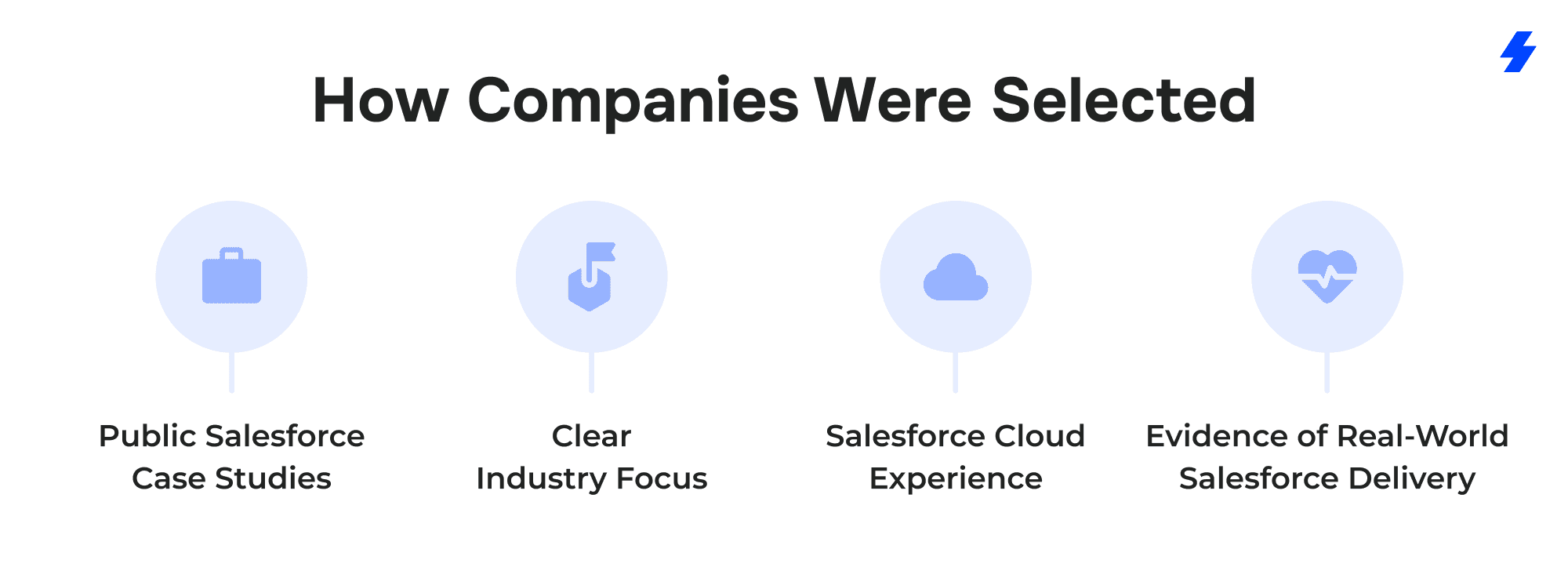
Public Salesforce Case Studies
Each Salesforce consulting firm had to publish Salesforce case studies with enough detail to confirm real project work. This included implementations, custom development, audits, integrations, managed packages, or Experience Cloud portals. Logo lists, short testimonials, or unnamed success quotes were excluded.
Clear Industry Focus
We looked for repeat work within specific industries, supported by dedicated industry pages or solution offerings. Priority was given to firms that showed familiarity with industry workflows, such as patient data management, subscription billing, dealer portals, guest operations, or nonprofit fundraising, rather than generic CRM setups.
Salesforce Cloud Experience
Companies needed hands-on experience across core Salesforce products, including Sales Cloud, Service Cloud, Experience Cloud, Salesforce Marketing Cloud, and relevant Industry Clouds. Firms limited to a narrow feature set or one-off configurations were not included.
Evidence of Real-World Salesforce Delivery
Beyond cloud names, we evaluated how Salesforce consulting services were used in practice. This included data migration, automation logic, integrations with external systems, security and compliance work, scalability challenges, and long-term support models. Firms relying mainly on high-level marketing claims were filtered out.
Hospitality
Salesforce Needs in the Hospitality Industry
Hospitality organizations operate across fragmented systems. Guest data often lives in separate tools for reservations, service requests, loyalty programs, and on-property operations. This makes it difficult to maintain a consistent view of the guest, especially across locations or brands.
Common Salesforce challenges in hospitality include:
- Disconnected guest profiles across booking, service, and marketing systems
- Manual handoffs between front desk, operations, and support teams
- Limited visibility into guest history, preferences, and prior issues
- Slow response times when incidents or service disruptions occur
- Difficulty scaling guest communication across web, mobile, and on-site channels
Salesforce implementations in hospitality typically focus on unifying guest data, coordinating service workflows, and enabling real-time communication through Service Cloud and Experience Cloud, while remaining usable for frontline teams with limited time and training.
MagicFuse
 MagicFuse has delivered Salesforce solutions for hospitality organizations dealing with operational complexity and fragmented data. In one hospitality engagement, the client struggled with delays and inconsistent service caused by disconnected systems and uncoordinated workflows.
MagicFuse implemented a centralized Salesforce setup that brought core processes into a single environment. Custom logic and UI components simplified daily operations for staff, reduced manual steps, and improved data visibility across teams. The result was faster issue resolution and a more consistent service experience across the organization.
Salesforce technologies used: Salesforce Platform, Apex, Visualforce, SOQL, Lightning Component Framework, Lightning Web Components
VRP Consulting
 VRP Consulting focuses heavily on Salesforce implementations for travel, hospitality, and transportation companies. Their work spans Sales Cloud, Service Cloud, and Experience Cloud, often supporting customer service operations, partner portals, and multi-brand environments.
Their public hospitality case studies show Salesforce being used to manage customer interactions across booking, service, and post-trip engagement. VRP’s portfolio reflects repeat delivery in the travel and hospitality space, rather than isolated projects.
Cloud Centric (CloudCentric Infotech)
 Cloud Centric works with hotels, resorts, and tourism operators using Salesforce as a guest relationship and operations platform. Their hospitality-focused solutions center on guest journeys, booking data, upsell workflows, and service coordination.
Their industry materials highlight Salesforce implementations designed to connect reservations, guest communication, and operational follow-up. This makes their work relevant for hospitality teams looking to move beyond basic CRM usage into guest lifecycle management.
Technology (SaaS / High-Tech)
Salesforce Needs in SaaS and High-Tech Companies
SaaS and technology companies use Salesforce very differently from traditional sales organizations. Beyond CRM, Salesforce often becomes part of the product itself, supporting subscriptions, partner ecosystems, AppExchange apps, and complex integrations.
Common Salesforce challenges in this industry include:
- Supporting high-volume, fast-changing data models as products evolve
- Building managed packages that pass Salesforce security reviews and scale across customers
- Handling subscription lifecycles, usage data, and billing logic inside or alongside Salesforce
- Integrating Salesforce with external platforms such as payment providers, identity services, and data warehouses
- Maintaining performance and reliability as customer and transaction volume grows
MagicFuse (SaaS / ISV & Technology)
 MagicFuse works extensively with SaaS companies, ISVs, and technology firms where Salesforce is a core system rather than a supporting tool. Their case studies reflect complex development work, managed packages, and platform-scale integrations.
Notable Salesforce projects include:
- Elements.cloud: Built a secure AppExchange managed package capable of handling large-scale data synchronization. The solution addressed Salesforce limits through optimized queries, custom logging, and AWS-based monitoring.
- Limio: Developed a subscription commerce managed package using Salesforce Flows, Apex, and Lightning Web Components, integrated with payment systems and Limio Commerce.
- ID-Pal: Delivered a security-focused managed package with bidirectional data sync, custom authorization logic, and a flexible object architecture for real-time identity verification.
- NDA: Automated approvals, territory management, and sales workflows to support rapid scaling inside Salesforce.
Ascendix Technologies
 Ascendix Technologies provides Salesforce CRM consulting for technology companies alongside its real estate focus. Their technology-related case studies include large-scale Sales Cloud and Service Cloud implementations, often involving consolidation of multiple systems into a single Salesforce environment.
Ascendix is frequently referenced in partner roundups for enterprise Salesforce delivery, including projects for large technology organizations with complex sales and support structures. Their public case studies show experience handling multi-team workflows, reporting consolidation, and enterprise governance requirements.
Cynoteck Technology Solutions
 Cynoteck Technology Solutions are Salesforce consultants that offer services across Sales Cloud, Service Cloud, Experience Cloud, Marketing Cloud, and custom development, with a strong presence among IT and software clients.
Their case studies include Salesforce implementations for technology companies focused on CRM customization, integrations, and process automation. The breadth of their portfolio reflects repeat delivery for tech clients rather than one-off projects.
Healthcare
Salesforce Needs in Healthcare and Life Sciences
Healthcare organizations work under strict regulatory, security, and data-governance requirements. Salesforce implementations in this space must account for sensitive patient data, complex care workflows, and coordination across departments, locations, and external systems.
Common Salesforce challenges in healthcare include:
- Fragmented patient data across clinical, operational, and engagement systems
- Complex care coordination workflows involving providers, administrators, and external partners
- Strict access control, auditing, and compliance requirements
- Poor data quality affecting reporting, billing, and continuity of care
- Limited patient visibility outside clinical systems, especially in service and engagement use cases
MagicFuse (Healthcare, HealthTech & Life Sciences)
MagicFuse is a leading Salesforce consulting firm that has delivered Salesforce solutions for healthcare providers, HealthTech companies, and life sciences organizations where data accuracy, compliance, and workflow reliability are critical.
Key healthcare-related Salesforce projects include:
- NDA: Built an end-to-end care management system on Salesforce, including automated workflows, billing jobs, custom UI components, and data quality improvements to support healthcare operations at scale.
- NDA: Implemented a complex Experience Cloud portal supporting therapy roadmaps, real-time booking, and metadata-driven notifications, with MFA enforced through Okta integration.
- Delta Dental: Conducted a structured Salesforce audit across Sales Cloud and Marketing Cloud, identifying governance, licensing, and security risks and providing a clear remediation roadmap.
Ascendix Technologies
 Ascendix Technologies has delivered Salesforce Health Cloud implementations for healthcare organizations, including patient management systems designed to improve data sharing across hospital networks.
Their healthcare case studies demonstrate experience with Health Cloud data models, cross-location reporting, and coordination between clinical and administrative teams. This makes Ascendix a relevant option for healthcare providers seeking Salesforce implementations beyond basic CRM use.
ForteNext
 ForteNext appears in healthcare and life sciences contexts through projects that combine Salesforce Sales Cloud, Service Cloud, and integrations with external systems. Their public materials reference work in regulated industries, including healthcare environments where data governance, access control, and system reliability are central. ForteNext’s delivery model spans implementation, managed services, and staff augmentation, which is often used by healthcare organizations that require long-term platform support rather than one-time deployments.
Cyntexa
 Cyntexa is consistently listed among growing Salesforce partners with Healthcare and Life Sciences experience. Their healthcare-related Salesforce work includes Service Cloud and Experience Cloud implementations designed around patient engagement, internal case management, and automation-heavy workflows. Public case studies and solution pages indicate experience handling complex data structures and integration requirements common in healthcare organizations.
Automotive
Salesforce Needs in the Automotive Industry
Automotive companies manage long, multi-stage customer relationships that extend well beyond the initial sale. Data flows between manufacturers, dealers, service centers, logistics providers, and increasingly, connected vehicles. Salesforce implementations in this industry must support high data volume, real-time updates, and coordination across many external systems.
Common Salesforce challenges in automotive include:
- Fragmented customer and vehicle data across sales, service, and third-party systems
- Limited visibility into vehicle lifecycle events such as delivery, service, and warranty claims
- Manual service workflows that slow response times and increase errors
- Difficulty supporting dealer portals, partner access, and mobile-first users
- Integrating IoT, logistics, and inventory systems with Salesforce at scale
MagicFuse (Automotive, Logistics & Transportation)
MagicFuse has delivered Salesforce solutions for automotive and logistics organizations where real-time data exchange and external access are critical.
Representative projects include:
- NDA: Implemented real-time, two-way integration between Salesforce and Postgres using Change Data Capture, processing thousands of automotive IoT records without sync conflicts.
- Auto Service Repairs (ASR): Built a mobile-friendly Experience Cloud portal with vehicle damage tracking, photo uploads, and external vehicle data integration, supporting field technicians and drivers.
- Riptide Logistics: Delivered Service Cloud and Experience Cloud integrations supporting live chat and AI-driven agent orchestration for customer support operations.
Cloud Centric
Cloud Centric is a Salesforce development company that works with automotive companies using Salesforce to support sales, service, and dealer engagement. Their automotive-focused solutions typically involve configuring Salesforce to align with dealership workflows, integrating inventory and external systems, and supporting multi-channel customer interaction.
Public materials reference Salesforce implementations addressing fragmented customer data, complex sales processes, and service coordination. Their work is most relevant for automotive businesses seeking Salesforce setups that connect dealers, service teams, and customer-facing touchpoints within a single CRM environment.
Nonprofit
Salesforce Needs in the Nonprofit Sector
Nonprofits typically run lean teams while managing complex relationships: donors, volunteers, program participants, partners, and funders. Salesforce becomes the system of record for fundraising, service delivery, and impact reporting, so data design and reporting structure matter as much as features.
Common Salesforce challenges in nonprofits include:
- Donor and program data split across spreadsheets, email tools, and legacy CRMs
- Reporting pressure from boards and grantmakers, with inconsistent definitions and data quality
- Over-customized orgs that only one admin understands
- Manual fundraising workflows that slow follow-ups and recurring giving
- Adoption issues when the setup doesn’t match how staff actually work
MagicFuse
MagicFuse has delivered Salesforce solutions for nonprofits and NGOs with very different operating models, from member-driven global organizations to fundraising-heavy teams.
Examples of nonprofit delivery include:
- NDA: Modernized Service Cloud, redesigned an Experience Cloud portal, improved reporting for Finance and Management, and assessed chatbot adoption for member support.
- NDA: Delivered a full nonprofit transformation with fundraising automation, Marketing Cloud campaigns, complex data migration, and donor lifecycle tracking.
- Smart Havens Africa (SHA): Built an Experience Cloud portal with case automation, SLA management, telephony, e-signature workflows, and accounting integration.
ForteNext
 ForteNext provides Salesforce implementation and ongoing support models that can fit nonprofits that need steady platform ownership over time, not only a go-live project. Their public positioning emphasizes long-term delivery through implementation, Salesforce managed services, and staff augmentation, useful when a nonprofit lacks internal Salesforce capacity but still needs consistent governance, admin coverage, and controlled change.
Cyntexa
 Cyntexa offers Salesforce services across Sales Cloud, Service Cloud, Experience Cloud, and related platforms, with experience that translates well to nonprofit use cases such as case management, constituent engagement, and self-service portals. For nonprofits running multi-team operations - program delivery, fundraising, and support - partners like Cyntexa are often evaluated for their ability to build structured workflows and maintainable automation without turning the org into a custom-code dependency.
NGS Solution
 NGS Solution is often associated with Salesforce work for nonprofits and SMBs. Their nonprofit relevance typically shows up in practical CRM delivery: donor and constituent management, reporting setups for leadership and funders, and configuration that supports day-to-day work for non-technical users. This profile can fit smaller nonprofits that need a usable Salesforce baseline and reliable iteration rather than a large enterprise-style program.
Education / EdTech
Salesforce Needs in Education and EdTech
Educational institutions and EdTech companies manage long-term relationships that span recruitment, enrollment, learning, support, and alumni engagement. Salesforce often sits between student information systems, learning platforms, finance tools, and communication channels, which makes data consistency and integration critical.
Common Salesforce challenges in education include:
- Student and learner data spread across SIS, LMS, CRM, and marketing tools
- Manual administrative workflows that consume staff time during admissions and advising cycles
- Limited visibility into the full student lifecycle, from prospect to alumni
- Difficulty supporting self-service portals for students, faculty, and partners
- Scaling communication and engagement without overloading advisors or support teams
Coastal Cloud
 Coastal Cloud specializes in Salesforce for higher education and K-12 institutions, with a focus on connecting the full student lifecycle. Their work typically combines Sales Cloud, Service Cloud, and Data Cloud, alongside integrations with tools such as Tableau and MuleSoft.
A representative example is their work with the University of Florida, where Salesforce Data Cloud and Marketing Cloud were used to automate learner journeys and unify student data. The project reduced manual effort for staff and shifted attention toward planning and program strategy rather than data reconciliation.
MagicFuse
MagicFuse works with schools and EdTech companies that use Salesforce as a coordination layer across systems rather than a standalone CRM. As a Salesforce Ridge Partner, MagicFuse focuses on data integration, administrative workflows, and engagement models that fit education environments.
Education-related delivery includes:
- Purlos: Built an AI-powered, multi-channel communication and automation platform using Salesforce, Experience Cloud, OpenAI, and Twilio to support scalable student and learner engagement.
- Purlos (Outcore): Developed a conversational AI advisory tool that provides personalized career guidance while reducing advisor workload.
- NDA: Assembled a dedicated Salesforce delivery team to enhance and maintain an Education Cloud–based CRM with consistent delivery and quality control.
Manufacturing
Salesforce Needs in Manufacturing
Manufacturers sit at the intersection of long sales cycles, partner-driven revenue, and operational complexity. Salesforce usually has to connect with ERP systems, inventory and pricing logic, service operations, and distributor or dealer channels. When those links are weak, teams fall back to spreadsheets, email threads, and disconnected quoting tools.
Common Salesforce challenges in manufacturing include:
- Complex account structures (parent/child accounts, distributors, resellers, multi-site buyers)
- Quoting and pricing complexity, often tied to CPQ rules, approvals, and contract terms
- Heavy reliance on ERP data for orders, inventory, fulfillment status, and invoices
- Limited visibility into pipeline accuracy when reps manage deals outside the CRM
- Service and warranty processes that require clean case routing, parts tracking, and SLAs
MagicFuse
MagicFuse supports manufacturing and industrial companies using Salesforce as a core system for sales execution, commerce, and operational coordination.
Representative manufacturing delivery includes:
- NDA: Provided ongoing Sales Cloud and B2B Commerce support, including SAP order integration and checkout optimization - work that touches both commercial processes and transactional reliability.
- NDA: Implemented Sales Cloud from scratch, moving Excel-based sales operations into a centralized CRM with reporting and pipeline management to support day-to-day sales execution.
- Ventilation & Daylighting Company: Improved CPQ and Sales Cloud, integrated Salesforce with Microsoft Dynamics, and implemented a custom order management system, typical of manufacturers that need Salesforce to reflect real order lifecycles rather than just sales stages.
Zaelab
 Zaelab is heavily oriented toward manufacturers, distributors, and industrial supply companies that need Salesforce to support digital ordering and partner sales. Their work centers on Salesforce B2B Commerce, often alongside CPQ and Experience Cloud, plus integrations with ERP/PIM/OMS systems, exactly where manufacturing Salesforce projects usually get difficult (pricing rules, catalog structure, order sync, and account hierarchies).
OSF Digital
 OSF Digital is a common choice for manufacturers building B2B and B2C commerce programs on Salesforce. Their public positioning focuses on Commerce Cloud + Experience Cloud + Marketing Cloud, which maps well to manufacturers trying to connect dealer/distributor journeys, self-service ordering, and post-sale support in one ecosystem. This is a fit when the project is commerce-led and involves multiple channels or regions.
YASH Technologies
 YASH is relevant for manufacturing organizations that run on SAP or Oracle and need Salesforce to work as part of a larger enterprise stack. Their Salesforce practice spans Sales/Service/Marketing/Experience Cloud, with a strong emphasis on enterprise integration and modernization. If your manufacturing audience cares about production-grade governance, multi-system data flows, and global rollout patterns, YASH is an easy inclusion.
How to Shortlist 2–3 Partners: Compare Profiles, Architecture, and Risk Handling
Pick partners with clearly different delivery profiles
Don’t shortlist three firms that all sell the same thing. A better mix is one partner with deep industry history, one with strong architecture and integration depth, and one built for long-term support. The contrast exposes strengths and blind spots quickly.
Ask for architecture thinking, not feature lists
Request a high-level view of org structure, data ownership, integration patterns, and where customization would live. Partners who can’t explain this clearly during presales usually struggle once delivery starts.
Evaluate how they handle uncertainty
Pay attention to how partners talk about unknowns: data quality, scope gaps, user adoption, or legacy systems. Strong partners surface risks early and explain how they manage them, rather than pricing everything as a fixed assumption.
Shortlisting two or three partners isn’t about creating competition on price. It’s about seeing how different teams think before you commit to one of them for the next several years.
How Long Salesforce Implementations Typically Take by Industry
Timelines depend less on the industry label and more on what usually comes with it: integrations, data cleanup, number of user groups, and how many systems Salesforce has to replace or sit between. Below are realistic ranges based on the types of projects companies run in each vertical.
Hospitality: 8–16 weeks
Common scope: Service Cloud + Experience Cloud for guest service and internal workflows.
What stretches the timeline: integrations with PMS/booking tools, multiple properties, multilingual portals, and frontline usability testing.
Technology (SaaS / High-Tech): 10–24+ weeks
Common scope: Sales/Service Cloud plus custom development, integrations, or managed package work for ISVs.
What stretches the timeline: AppExchange security review prep, high data volume, multi-tenant design, and complex API/integration requirements.
Healthcare: 12–28+ weeks
Common scope: Health Cloud, Service Cloud, Experience Cloud portals, strict access controls, and audit-ready governance.
What stretches the timeline: compliance reviews, identity management (SSO/MFA), data model complexity, and integration with clinical or patient systems.
Automotive: 10–20+ weeks
Common scope: Service Cloud + Experience Cloud for dealer/service workflows, plus integrations with vehicle, inventory, or logistics systems.
What stretches the timeline: real-time or near-real-time integrations, connected vehicle/IoT feeds, and multiple external user groups.
Nonprofit: 6–14 weeks
Common scope: Nonprofit Cloud or NPSP setup, fundraising workflows, reporting, and basic integrations (email, donations, forms).
What stretches the timeline: messy legacy data, unclear reporting definitions, and over-scoping automation before staff adoption is stable.
Education / EdTech: 10–20+ weeks
Common scope: Education Cloud or lifecycle CRM, portals, communications, and integrations with SIS/LMS tools.
What stretches the timeline: data ownership between systems, identity management, and building workflows that fit academic operations.
Manufacturing: 12–26+ weeks
Common scope: Sales Cloud + CPQ and/or B2B Commerce, plus ERP integrations for orders, pricing, and inventory.
What stretches the timeline: ERP complexity, pricing rules, product catalogs, approvals, and custom order management.
FAQs
- Why does industry experience matter in Salesforce consulting?
Industry expertise shows up in the decisions that shape the whole build: how you model customer data in Salesforce CRM, how you set permissions, and how you connect Sales Cloud with Service Cloud. In healthcare, it often means Health Cloud rules and audit trails; in manufacturing, it’s pricing and ERP systems; in financial services, it’s Financial Services Cloud and data governance. A consulting firm that has already built those patterns makes fewer wrong assumptions during Salesforce projects.
- Where can I verify Salesforce consulting case studies?
Use a few sources, and cross-check them:
The consulting firm’s case studies: look for specifics on Salesforce products, data migration, Salesforce integration, and what they built with different cloud solutions.
AppExchange listings: reviews, release history, and whether the partner ships Salesforce services or packaged solutions.
Customer references: ask for a call with a client who runs similar Salesforce clouds and similar legacy systems.
You’ll learn more from one detailed architecture conversation than from ten polished PDFs.
- Should I trust Salesforce Customer Stories over partner blogs?
Treat Salesforce Customer Stories as a starting point. They can confirm which consulting partners were involved and which Salesforce clouds were in play (often Sales Cloud and Service Cloud). But they rarely explain the hard parts: data migration choices, Salesforce customization trade-offs, or how they handled legacy systems. Partner write-ups can add that detail, especially when they describe Salesforce integration, data governance, and ongoing support after launch.
- Can one partner cover multiple industries effectively?
Sometimes, yes, especially if their Salesforce capabilities include repeat delivery patterns like integrations, security design, and reporting. But breadth on an “Industries” page doesn’t prove anything. Ask the consulting firm to walk through two or three Salesforce projects in different verticals and explain what changed: object model, data governance, data integrity checks, Salesforce customization, and integration style. That’s how you tell whether a partner really implements Salesforce across industries or just markets it.
- How do I choose the right Salesforce consulting firm correctly?
Pick 2–3 consulting partners and make them earn the spot:
Mix profiles: a boutique management consulting firm for process clarity, a technical consulting firm strong in Salesforce development and custom development, and a partner known for Salesforce managed services and managed services delivery.
Ask for an architecture outline: org structure, how they integrate Salesforce with ERP systems and marketing platforms, and where they would avoid Salesforce customization.
Compare how they price discovery and change requests - look for flexible pricing models when scope is still moving.
This is the fastest way to find the right Salesforce consulting partner, and avoid paying later for early guesswork.
- What should I ask to validate integration skill before signing?
Ask for a diagram and a story. Specifically:
How will you integrate Salesforce with legacy systems and cloud based platforms?
What’s your approach to Salesforce integration when APIs change or data is incomplete?
How do you prevent duplicates and protect customer data during data migration?
A strong consulting firm can explain how they connect Salesforce, how they monitor integrations, and how they handle failures without hand-waving. If they can’t explain it simply, you’ll feel it in production.
- When do Salesforce managed services make more sense than a one-time project?
If your org keeps changing (new product lines, new regions, new reporting needs) Salesforce managed services beat constant re-implementations. Ongoing managed services usually cover admin work, small builds, releases, user training, and ongoing optimization across Sales Cloud, Service Cloud, and sometimes Community Cloud. Good managed services also include Salesforce optimization work like cleaning automation debt, tightening permissions, and improving data governance after the first go-live.
- Are “top lists” and directories reliable for choosing a partner?
They can help you find names, but you still have to verify. Directories like Cloud Advisors and Data Geeks Lab (and similar roundups such as “Cloud Advisors Founded” lists) often mix strong teams with vendors that mainly publish marketing. Use them to build a shortlist, then validate with case studies, references, and a technical screen. If a “top Salesforce consulting firms” list doesn’t link to real Salesforce projects, treat it like lead gen, not evidence.
If you want an extra sanity check, ask whether you’ll be working with a Salesforce Summit Partner team, a specialist group in San Francisco, or a distributed delivery model, and who actually owns architecture decisions day to day.