




Salesforce Health Cloud vs Custom CRM
Download our 8-point decision checklist for healthcare leaders
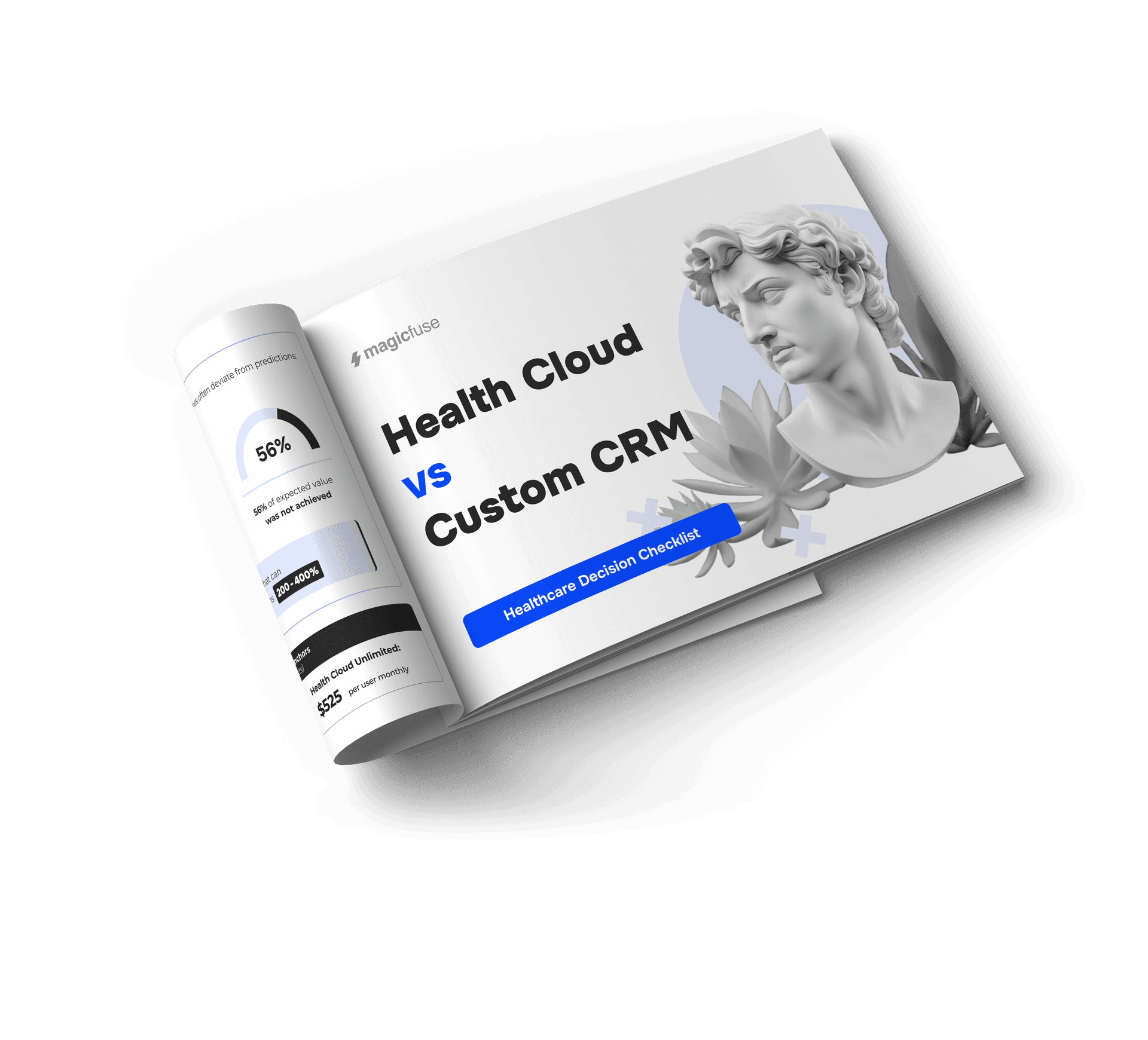
One Early Decision Shapes the Entire Healthcare CRM Program
Adopt Salesforce Health Cloud, or build your own CRM on the platform? It's the first real fork in any healthcare CRM project, and the one teams most often get wrong. With 11+ years of implementing Salesforce in regulated industries, MagicFuse built this checklist to make that decision clear before it reaches your budget. The checklist walks through eight factors that actually decide the question (compliance, data model, interoperability, patient experience, care management, delivery risk, cost, and team fit) each with a simple test and the concrete numbers to put in front of leadership.
Why Is This Checklist Important for Your Business?
In regulated healthcare, the platform decision sets the floor for every compliance review, integration, and release that follows. Choose well and the program gets easier. Choose wrong and a "custom CRM" quietly becomes a multi-year software program, with the cost and risk that come with it.
In this checklist, you'll learn:
When compliance and audit needs make Health Cloud the safer floor — in a market where information blocking penalties reach up to $1,000,000 per violation.
How custom healthcare CRMs accumulate 150–300 custom objects within 18–24 months, and what that does to reporting and governance.
Why care programs built natively on Health Cloud typically launch 30–50% faster than equivalent custom builds.
Get the framework you need to decide with confidence.
Key Decision Areas to Weigh
Compliance & Audit
The real question isn't whether you're compliant; it's who owns the audit evidence when a regulator asks. Health Cloud offers vendor-documented controls; custom means owning that evidence end-to-end.
Data Model & Patient 360
A custom data model feels like freedom on day one and a reporting problem 18 months later. Health Cloud keeps the patient at the center; custom puts governance on you.
Interoperability & EHR Integration
With CMS and NHS England mandating FHIR, your CRM has to speak open standards. Health Cloud is FHIR-aligned with MuleSoft behind it; custom fits only a single EHR with limited scope.
Patient & Member Experience
The moment patients or caregivers log in, consent and accessibility become things an auditor can test, and where custom portals most often fail.
Care Management & Workflow Complexity
Short, linear workflows are easy anywhere. Coordination that spans teams and months is exactly what Health Cloud is built for.
Delivery Risk
A custom CRM is a software program, not a configuration project. McKinsey/Oxford research on 5,400+ IT projects found budgets ran 45% over and 56% of expected value was never achieved.
Cost & Time-to-Value
License fees are the visible cost; build, integrations, and years of operations are where "we'll save money" unravels. The checklist gives you the three-line model to test it.
Team & Operating Model Fit
The right choice depends on whether you have admins and architects who configure, or an engineering culture ready to own platform debt.

How MagicFuse Can Help Your Business
At MagicFuse, we bring 11+ years of experience and 80+ certified Salesforce consultants to help you deploy Salesforce successfully in regulated environments. From Health Cloud implementation to compliance-ready integrations, we help healthcare organizations choose the right path and avoid the rebuild.

Explore Our Trending Publications