






If you came here looking for Salesforce Accelerate, here's the honest answer first: the program isn't running anymore. The last cohort wrapped in late 2021, and Salesforce never publicly announced a replacement under that name. The advice in most articles still ranking for "Salesforce Accelerate," including the one you may have read here years ago, is out of date.
The good news is that the goal hasn't changed. Startups still want to build on Salesforce, launch on the marketplace, and get in front of Salesforce's customer base. The routes to get there have just been renamed and rebuilt, and in 2026, they're shaped heavily by AI.
This guide covers what exists today: the current startup programs, the path to publishing an app, the costs, and where the real opportunity lies now. Whether you're a founder taking your first step or a product company weighing a development partner, you'll know your options by the end.
What Happened to Salesforce Accelerate?
Salesforce Accelerate was a three-month virtual program (earlier called the Salesforce Incubator) that ran numbered cohorts for startups building on the platform. It expanded into EMEA in 2018, and its 2020 cohort focused on Black-owned businesses. By most counts, well over 100 startups passed through it.
Then it went quiet. The final confirmed cohort ran in 2021, and no cohort has launched since. Salesforce didn't post a formal "we're shutting this down" notice; the program simply stopped, and the wider "Salesforce for Startups" umbrella it belonged to was gradually replaced by newer offerings. So if you've been searching for how to apply, that's why you keep hitting dead ends.
What replaced it is more useful anyway, because it splits cleanly by what you're actually trying to do.
What are the Current Salesforce Startup Programs?
There are two live programs aimed at startups in 2026, plus the investment arm that sits behind both.
Salesforce Launchpad
This is the closest successor to Accelerate, launched in late 2025 and currently in beta. It's open to venture-backed startups across industries and stages, with one catch: you need to be based in the US, Canada, or EMEA and have verifiable external funding. It's free to join, and members get free or discounted products (Starter Suite, Pro Suite, Sales Cloud, Agentforce, Tableau, Slack), go-to-market and AI guidance, implementation help, and a community to lean on. Applications are reviewed within five business days. Unlike Accelerate's fixed cohorts, it runs continuously. You apply when you're ready, not when the next batch opens.
The Regional Salesforce Startup Program
Salesforce also runs a separate startup program across Asia, now live in India, Singapore, Sri Lanka, Malaysia, and the Philippines. Per Salesforce's January 2026 announcement, it supports a community of 435+ startups, more than 230 of them AI-first. It offers technology access, mentorship, joint go-to-market, and a route into the Trailblazer community. Applications there are reviewed weekly.
Salesforce Ventures
It's Salesforce's investment arm, and since 2009, it has put over $6 billion into 630+ enterprise software companies. Its $1 billion AI Fund has backed names like Anthropic, Cohere, and Writer. Being in Launchpad doesn't get you a check, and you don't need Ventures backing to join Launchpad, but the two connect, and Salesforce has been clear that AI startups are where its attention is. Salesforce reinforced that in October 2025, when it announced a major San Francisco investment that includes an AI incubator hub.
If you're a founder using Salesforce to run your own business, these programs help you get started cheaply. If you're building a product to sell on the marketplace, you'll also need the path below.
How to Launch an App On the Marketplace Now
This is where most of the old article's advice falls apart, and where the rules have genuinely changed.
To build and sell an app, you join the AppExchange Partner Program. Registering with the Partner Community is free. You get a Partner Business Org to manage your app and licensing, and from there you choose how you'll distribute.
There are two distribution models, and the difference matters for your economics:
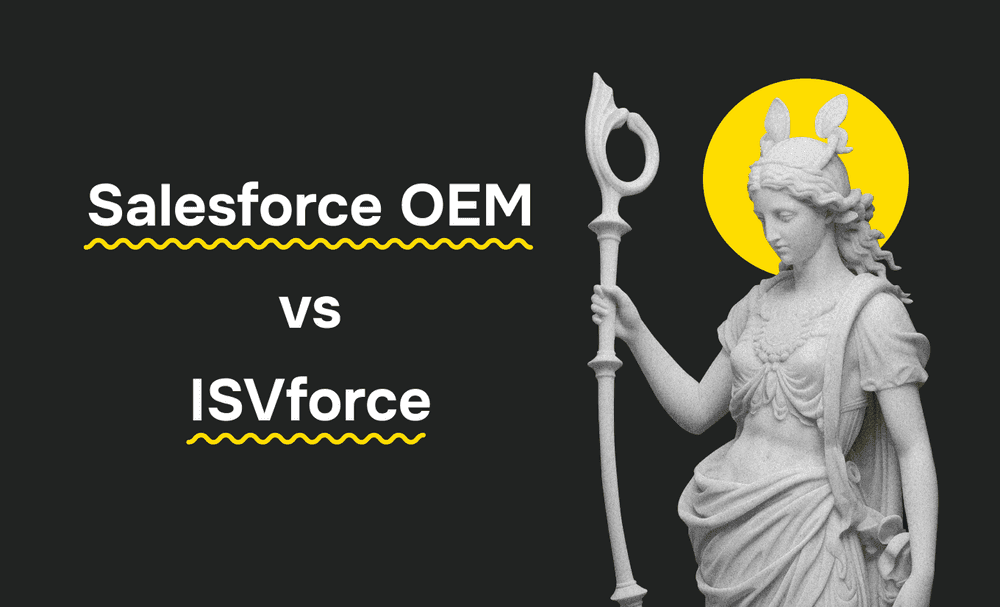
- ISVforce: your app depends on Salesforce and sells to existing Salesforce customers. Revenue share is 15%.
- OEM: your app embeds Salesforce invisibly and sells to anyone, including companies that don't use Salesforce. Revenue share is 25%, with tighter limits on which core CRM objects you can touch.
Salesforce's own Trailhead guidance on choosing an app type walks through which fits. The short version: ISVforce gives you pricing flexibility and a warm audience; OEM widens your market but costs more and constrains your data model.
A few things every founder building today should know:
Use second-generation packaging (2GP). Salesforce now recommends 2GP for all new apps. It's source-driven, modular, and works with modern Salesforce DX tooling and version control. The old first-generation (1GP) model still works and still runs most legacy apps, but building net-new on it in 2026 means building on the way out.
Budget for the security review. Every managed package has to pass Salesforce's security review before it goes live. The fee is $999 per submission attempt for paid apps and free for free apps. Plan for a review window of roughly 6-9 weeks. Salesforce's own materials cite the lower end, while partners who've been through the queue often see the higher end, especially before major events. Resubmissions cost another $999 each, so it pays to get it right the first time.
This is unglamorous work, and it's where a lot of first-time ISVs stumble. We've seen it firsthand. When we started working with Atamis, a UK procurement platform, the product had been built by someone without deep Salesforce experience, mostly older Visualforce, little Lightning. The fix wasn't a rewrite for its own sake; it was an architecture review, new features, a DocuSign integration, and methodical security-review prep that ended in strong AppExchange reviews. The lesson generalizes: the build and the security review are one continuous job, not two.
The AI Shift: Agentforce and AgentExchange
Salesforce has been building AI into CRM since Einstein launched in 2016, and by 2026 that work has reshaped the marketplace itself around AI.
In March 2025, Salesforce launched AgentExchange, a marketplace for Agentforce, its agentic AI platform, where partners build and sell agent actions, topics, prompt templates, and full agent templates. A year later, at TDX in April 2026, Salesforce merged AppExchange, the Slack Marketplace, and the Agentforce ecosystem into a single platform, putting partners in front of 150,000+ Salesforce customers. Alongside that unification, it committed a $50 million Builders Initiative to help ISVs turn AI ideas into revenue.
For anyone building today, the strategic read is simple: design your functionality so it's accessible to AI agents. That means clean APIs, well-defined actions, and an architecture that an agent can call. Apps that only work through a traditional UI will increasingly feel like they're missing a layer.
We're already building in this direction. For Riptide, an automotive messaging platform, we delivered a 2GP managed package that included a generative AI agent orchestrating live chat across Service and Experience Cloud. That's the shape of a modern AppExchange product: a packaged app with an agent inside it, not a static tool bolted onto a record page.
If Agentforce is where you're headed, our Agentforce expertise is built around exactly this kind of work.
If You're Just Getting Started
Not every startup is building an app. Plenty just need Salesforce to run sales and support, and the entry-level options here have changed too.
Salesforce Essentials, the cheap small-business edition the old article pointed to, no longer exists. The entry point today is one platform: Starter Suite at $25 per user per month (bundling marketing, sales, and service), with Pro Suite at $100 when you outgrow it, per Salesforce's current pricing. (Pricing and edition names change often, so confirm on that page before you commit.)
One more correction worth flagging: Heroku is no longer the free quick-start it used to be. Salesforce ended Heroku's free tier in late 2022. A basic always-on app with a small database now starts at roughly $10–12 a month. It's still a reasonable place to run services that sit alongside Salesforce. Just budget for it rather than assuming it's free.
How to Choose a Development Partner
If you decide to build, the partner you choose shapes how fast you ship and how cleanly you pass review. A few things worth weighing, honestly:
- Security-review track record. Passing on the first attempt saves real money and weeks of calendar time. Ask how many packages a partner has shepherded through, and what tripped up the ones that failed.
- 2GP fluency. Building net-new on the modern packaging model isn't optional anymore. Make sure your partner works this way by default.
- AI readiness. If your roadmap touches Agentforce or AgentExchange (and most will), you want a team that's already shipped agent-based features, not one learning on your budget.
It depends on your stage, of course. An early prototype needs different help than a mature product preparing its tenth release. But the throughline is experience with the full journey from idea to listed, secure, supported app.
That's the work we focus on. MagicFuse is a Salesforce-only team with 11+ years in the ecosystem, 80+ certified consultants, and 270+ Salesforce certifications, with a portfolio built largely on ISV and AppExchange products. We've helped Elements.cloud build and maintain a managed package that passes every security review, delivered a subscription-commerce package for Limio, and built the secure, bidirectional identity-verification app for ID-Pal, the same ID-Pal the original version of this article once cited as a Salesforce Accelerate success story. The program changed names; the work of getting a great app to market didn't.
You can see the full set on our case studies page, or read more about how we approach Salesforce app development and security review prep.
Where to Start
Salesforce Accelerate is gone, but the path it pointed toward is wider than ever. If you're a funded startup in the US, Canada, or EMEA, Launchpad is your front door. If you're building a product to sell, the AppExchange Partner Program (2GP packaging, a $999 security review, and an AI-shaped marketplace) is the route. And if AI is anywhere on your roadmap, build for agents from the start.
The program names will keep shifting. The fundamentals won't: build something useful, get it through review, and put it in front of Salesforce's customers.
Planning an AppExchange build?
FAQs
- Is Salesforce Accelerate still running?
No. Salesforce Accelerate was a virtual mentorship and co-creation program for startups and consulting partners, running cohorts from 2006 until its last batch in 2021. Salesforce never published a formal shutdown notice. It simply stopped, and the wider "Salesforce for Startups" umbrella was replaced. Today the closest successor is Salesforce Launchpad for venture-backed startups, alongside a regional Salesforce Startup Program across several Asian markets.
- What's the difference between Salesforce Accelerate and Salesforce Accelerators?
They're easy to confuse but unrelated. Salesforce Accelerate (above) was a startup program. Salesforce Accelerators are pre-built code and configuration packages, built natively on Salesforce so they stay compatible with automatic updates, that act as a bridge between standard out-of-the-box features and full custom development. They help remove architectural and configuration blockers during implementation, and because the code is pre-tested, they reduce the risk of deployment bugs. If you searched "Accelerate" hoping to speed up an implementation, accelerators (or a phased rollout) are what you're after.
- How do I get my app onto the Salesforce AppExchange now?
You join the AppExchange Partner Program (free to register), build your app as a second-generation managed package (2GP), and pass Salesforce's security review before listing. From there you can monetize on the marketplace, with access to 150,000+ Salesforce customers through AgentExchange. We handle this end to end through our Salesforce app development and security review services.
- What is Salesforce Ventures, and can it fund my startup?
Salesforce Ventures is Salesforce's investment arm. Since 2009 it has invested over $6 billion in 630+ enterprise software companies, and its $1 billion AI Fund has backed AI-first companies including Anthropic and Cohere. Joining Launchpad doesn't guarantee an investment, and you don't need Ventures backing to join, but the two connect, and AI startups are clearly where the focus sits.
- Does Salesforce have AI for startups and small businesses?
Yes. Salesforce launched Einstein, its first AI for CRM, in 2016; today that has grown into Agentforce, its platform for AI agents that work across sales, service, and marketing. The payoff shows up in the data: per Salesforce's Small & Medium Business Trends research, 91% of SMBs using AI say it boosts revenue and 90% say it improves operational efficiency. For small teams, AI agents can automate tedious tasks (drafting quotes, chasing invoices, qualifying leads) so people spend more time with customers.
- How does AI handle customer support at Salesforce?
Salesforce runs its own support on Agentforce, and AI agents now handle roughly half of its customer conversations, around 1.5 million interactions, with humans taking the more complex cases. It's a clear example of agents driving customer success at scale, resolving routine queries in real time while freeing teams for higher-value work.
- What did Salesforce's Informatica acquisition change?
In November 2025, Salesforce completed its ~$8 billion acquisition of Informatica, adding data integration, governance, quality, and master data management to the platform. It follows the 2018 MuleSoft acquisition ($6.5 billion) and reflects a simple principle Salesforce repeats often: you have to get your data right to get your AI right. For ISVs and startups, it means cleaner, better-governed customer data underpinning anything you build on Salesforce.
- Should a startup use a CRM from day one?
For most, yes. A CRM keeps customer data in one centralized platform instead of scattered spreadsheets, and automation can cut customer-service costs as you grow. A common piece of startup advice is that founders should personally lead sales until roughly $5M ARR, and a CRM makes that hands-on stage far easier to manage and hand off later. Entry-level Starter Suite starts at $25 per user per month, with a free trial to test the waters.
- Is Salesforce secure?
Salesforce is enterprise-grade, but no platform is incident-free. It dealt with a phishing attack affecting customer data back in 2007, and in 2022 Heroku faced unauthorized access via a compromised OAuth token. That history is exactly why every app on the marketplace must clear a strict security review before listing, and why Salesforce now leans on AI to surface potential threats faster. If you're building, treat security as part of the build, not a final hurdle.
- How can I speed up a Salesforce implementation?
Prioritize out-of-the-box features before reaching for custom development. Over-customizing early is the most common way projects slow down. Use a phased rollout to launch core functionality first, then layer on advanced features. Pre-built accelerators can shorten configuration time, and an experienced partner keeps the whole thing moving; see our Salesforce implementation approach.