






When you add up the hidden “tax” of busywork across a company, the numbers sting. Sales reps spend only about 28% of their week actually selling; the rest disappears into admin and updates. At a broader level, studies last year found that over half of knowledge workers’ time goes to low-value tasks, copy-pasting data, chasing status, and nudging systems to behave.
That’s the backdrop for Agentforce, Salesforce’s agentic platform built to handle real work inside (and around) the CRM: drafting follow-ups, updating records, routing cases, booking field jobs, even nudging finance ops toward a faster close. Adoption is climbing fast as agent creation grew 119% in H1 2025 and teams move routine execution from people to digital labor.
This article walks through the top Agentforce use cases across sales, service, finance, marketing, field operations, HR, and industry-specific workflows. We’ll anchor each with outcomes you can take to a CFO - think 30% case deflection baselined in Service Cloud programs, 70%+ automated chat resolution in tax-season spikes, and measurable reductions in month-end close time.
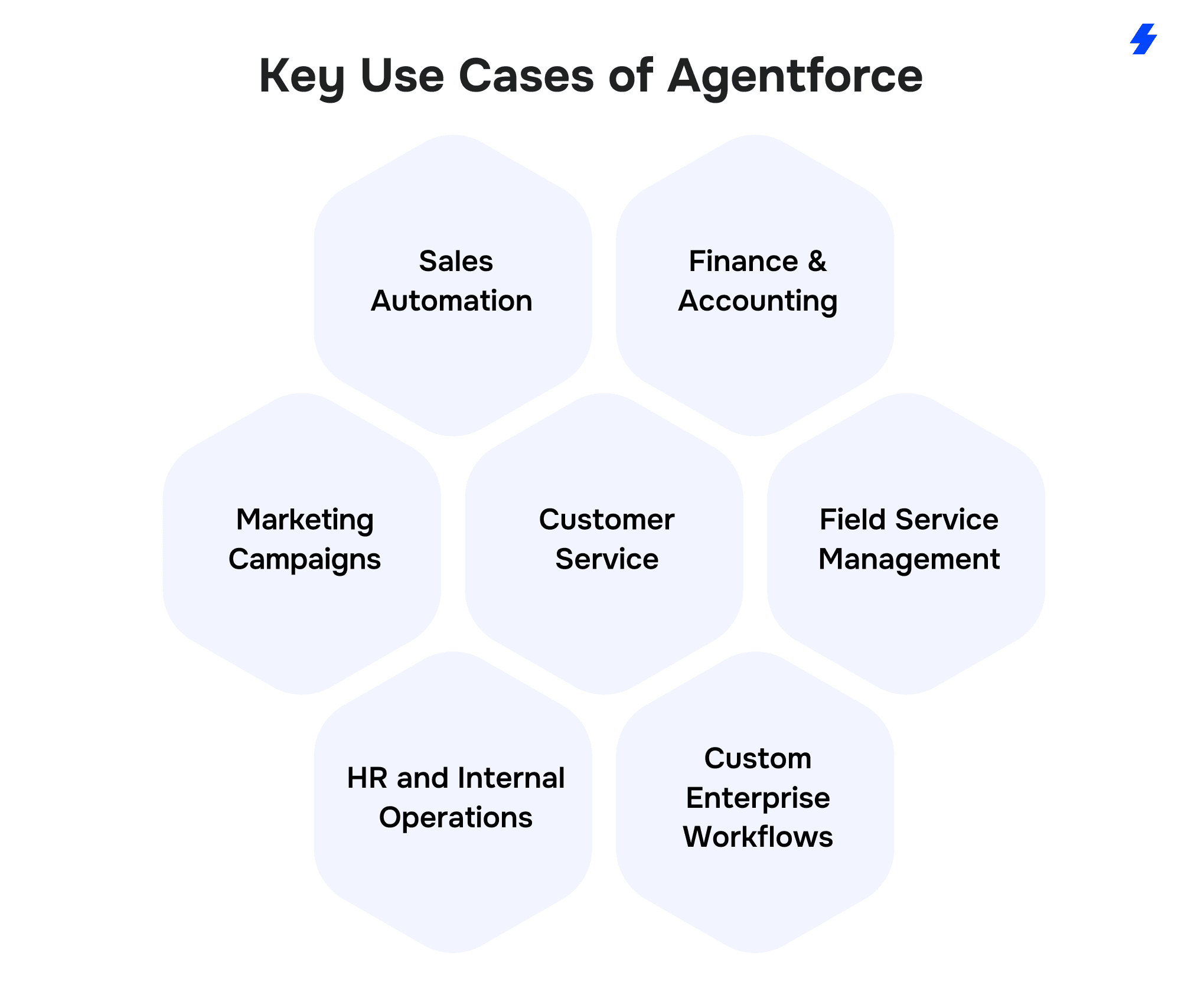
Key Use Cases of Agentforce
Agentforce acts as the intelligent layer of the Salesforce Platform, augmenting human work across sales, service, marketing, finance, operations, and internal workflows. It turns CRM data and business logic into live, contextual actions. Below are key use cases where Agentforce demonstrates measurable value, supported by real examples from our implementations and Salesforce success stories.
Sales Automation
Agentforce brings structure and speed to the sales lifecycle, from lead qualification to quote generation and post-sale handoffs. AI agents can automatically evaluate lead quality based on CRM and behavioral data, surface timely opportunity prompts, and generate accurate quotes following company pricing and availability rules. When integrated with Salesforce CPQ, Agentforce ensures that quotes are compliant, complete, and connected to inventory and ERP data.
In one manufacturing implementation, we extended Salesforce CPQ with custom pricing logic and ERP synchronization. Quotes that previously required several manual steps and multi-day reviews were generated in minutes, dramatically reducing error rates and forecast gaps. Similarly, an IT and consulting firm under NDA deployed an Agentforce SDR with dynamic branching logic to qualify leads and handle web chat inquiries 24/7, improving response times by up to 50% and increasing engagement rates by more than 30%.
Salesforce customers show similar gains: Carnegie Learning streamlined their sales process with AI-generated summaries and automated outreach, allowing reps to focus on closing deals rather than updating records.
Finance and Accounting
In finance, precision is paramount. Agentforce helps prevent revenue leakage and late-stage errors by validating data at every stage of the quote-to-cash process. It enforces discount rules, verifies tax compliance, and ensures all necessary approvals are captured before an invoice is issued. Integrated agents can also synchronize data across CPQ, ERP, and billing systems, ensuring consistency and reducing reconciliation workloads.
For example, we’ve seen Agentforce configurations that automatically verify discount eligibility and push warranty and product data into billing platforms. These setups not only reduce manual validation work for finance teams but also accelerate monthly close cycles by handling errors upstream.
Salesforce’s Indeed case reflects similar results at scale, using Agentforce, MuleSoft, and Data Cloud integration to automate employer onboarding verification. What once required multiple support touchpoints is now resolved autonomously, helping Indeed connect more people to jobs faster.
Marketing Campaigns
Agentforce empowers marketers to move from static campaigns to dynamic, data-driven engagement. By connecting with Salesforce Data Cloud, agents can automatically segment audiences, refresh lists in real time based on behavior, and even co-author personalized messages or responses. This automation supports faster campaign launches and consistent customer journeys across channels.
In one education-sector integration, we connected Salesforce with HubSpot, SFTP feeds, and Experience Cloud. Agentforce managed audience segmentation and orchestrated outreach via WhatsApp, cutting manual list pulls and dramatically improving campaign agility.
Salesforce’s UChicago Medicine demonstrates what happens at enterprise scale, the organization used Data Cloud to build 100 personalized segments in just four months, achieving up to 60% conversion on targeted health campaigns. Agentforce is now being deployed to support omnichannel patient communication, extending personalized interactions beyond the hospital setting.
Customer Service
Service organizations often face the burden of repetitive triage and manual case handling. Agentforce addresses this by classifying, routing, and resolving routine inquiries automatically. It retrieves identity or order data directly from Salesforce, proposes knowledge-base answers, and logs conversation data to Service Cloud for analysis. When escalation is required, all context is passed seamlessly to a human agent.
In a regulated industry engagement, we implemented a secure document-verification layer within Salesforce. Agents could authenticate customer identities, update records, and push changes to external systems without leaving their console, reducing handling times and improving accuracy.
This mirrors Salesforce’s ENGIE story, where Agentforce autonomously resolves 71% of customer cases related to billing, usage, and contracts, handling over 1,200 conversations per day with 83% response accuracy. By combining automation and human expertise, both organizations achieved faster resolutions and higher customer satisfaction without additional staffing.
Field Service Management
Field operations benefit greatly from Agentforce’s ability to coordinate real-world logistics. Agents can optimize dispatching by matching technician skills with part availability and route efficiency, automatically notify customers about schedule changes, and track task completion in real time.
For an industrial equipment company, we implemented Agentforce-based scheduling logic that predicted technician availability, suggested optimal routes, and sent real-time updates to both field workers and customers. This reduced travel time, increased first-time fix rates, and minimized inbound status inquiries.
A similar impact is seen in Salesforce’s Finnair use case, where Agentforce provides passengers with immediate updates and support across languages and channels, ensuring that travel disruptions are managed seamlessly, while onboarding time for new agents was cut by 25%.
HR and Internal Operations
Inside organizations, Agentforce improves efficiency through automation of repetitive internal tasks. It can handle employee FAQs, approval workflows, and document routing, ensuring processes move forward without manual follow-up. When combined with Salesforce Flows and Lightning components, HR and operations teams gain structured, transparent systems for tracking and reporting.
In one consulting firm project, we automated project approvals, timesheet validations, and utilization reporting through Salesforce Lightning and Agentforce workflows. The result was faster onboarding for new employees, clearer data for management, and fewer reminders required to keep processes on schedule.
Custom Enterprise Workflows
Many enterprises need more than standard automation, they require intelligent coordination across complex systems. Agentforce can orchestrate multi-step workflows involving REST APIs, SFTP feeds, ERP systems, and marketing tools, enforcing business rules and surfacing insights across the data stack.
Our CalendarAnything integration showcases this flexibility: we embedded an in-calendar chat experience where users interact with contextual AI agents that draw on the current record data. Each calendar can host a unique agent, offering real-time, personalized support without leaving Salesforce.
In another example, an NDA hospitality firm leveraged Agentforce to connect Salesforce Flows with external APIs for geolocation and amenities, building a guided “Glitch” reporting process to improve incident accuracy and response speed.
Benefits Highlighted Across Use Cases
When companies implement Agentforce across departments, the impact extends far beyond process automation. The most successful outcomes combine operational efficiency, data accuracy, scalability, decision intelligence, and customer experience improvements. Below is how these benefits manifest: first, through the results we’ve delivered at MagicFuse, and then as broader advantages seen across Salesforce-driven organizations.
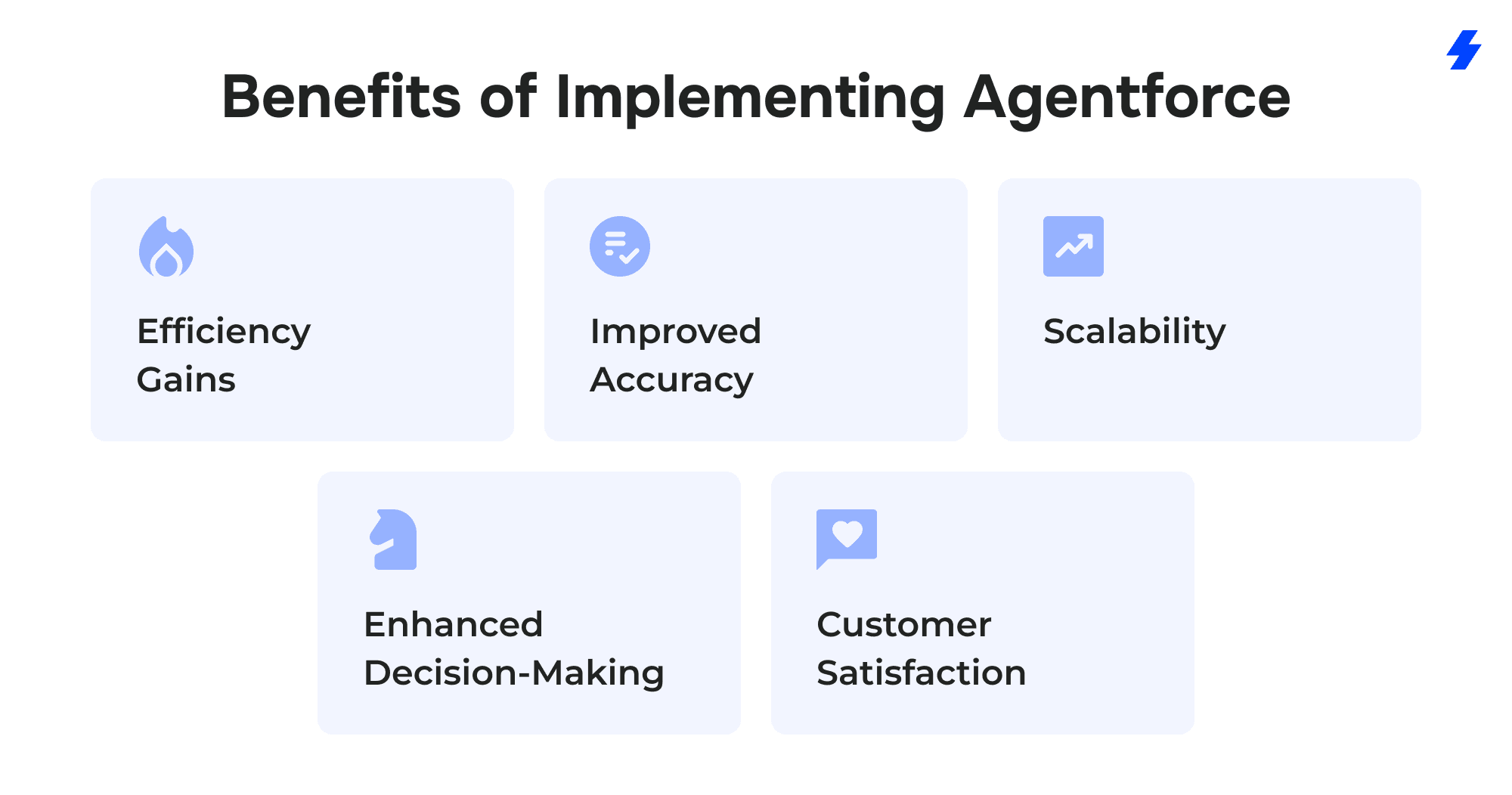
Efficiency Gains
Across multiple client implementations, MagicFuse has seen teams cut repetitive work by 30–60% within months of deploying Agentforce automations. In sales, quote generation that once took days now happens in minutes through real-time CPQ extensions. Marketing teams that previously spent hours pulling segmented lists now run dynamic campaigns automatically, and service agents no longer triage hundreds of repetitive tickets manually.
For example, one hospitality client reduced average handling time by integrating Agentforce with Omni-Channel routing, while an IT consultancy achieved a 50% faster first-response rate via automated chat qualification.
Agentforce streamlines day-to-day operations by removing human friction from administrative work. Lead scoring, quote approvals, data entry, and task assignments happen automatically in the background. This means more time spent on strategic or customer-facing activities and less on repetitive maintenance. As a result, businesses operate leaner, move faster, and scale without needing to increase headcount.
Improved Accuracy
In finance and compliance-heavy industries, MagicFuse implementations have reduced invoice disputes and data mismatches by embedding validation and approval logic directly into Salesforce workflows.
For instance, in subscription-based organizations, Agentforce now checks pricing tiers, tax fields, and approval hierarchies before records move downstream. Similarly, in service workflows, document verification and data synchronization ensure agents work with consistent, verified information across every case. These measures not only prevent costly billing errors but also strengthen audit readiness and customer trust.
Agentforce minimizes the human error inherent in manual processes. Automated data validation, identity verification, and rule enforcement keep every record consistent across sales, service, and finance. The result is cleaner data, higher accuracy in reporting, and fewer downstream corrections. Organizations gain confidence that every transaction or customer interaction adheres to internal policy and external regulations.
Scalability
MagicFuse projects consistently demonstrate how automation allows companies to expand operations without expanding teams. A field service client, for example, was able to manage twice as many work orders using the same dispatch staff after Agentforce optimized routing and scheduling in real time.
In another project, a marketing operations team scaled to support thousands of additional records per week through automated ingestion and segmentation, no new personnel required. This kind of scalability is crucial for high-growth organizations that want to add capacity without adding complexity.
Agentforce helps organizations decouple growth from resource constraints. By automating scheduling, data synchronization, and approval chains, companies can handle surges in demand without hiring proportionally. Field operations cover more ground; marketing manages more campaigns; service teams support larger customer bases, all while maintaining or improving quality. Growth becomes sustainable and predictable instead of reactive.
Enhanced Decision-Making
MagicFuse implementations leverage Agentforce’s real-time visibility to inform faster, more data-driven decisions. In sales, managers can now view deal momentum and receive early alerts when opportunities stall. Marketing leaders adjust live campaigns based on current engagement metrics. Finance and operations teams monitor approval flow bottlenecks in dashboards built directly in Salesforce. By making performance and risks visible as they happen, leaders spend less time diagnosing issues and more time resolving them.
Agentforce transforms decision-making by surfacing insights where work happens. It doesn’t just automate — it observes and advises. Managers can prioritize accounts, reallocate field resources, or refine campaigns using up-to-date operational data. This proactive awareness leads to smarter forecasting, faster pivots, and stronger strategic alignment across departments.
Customer Satisfaction
Every automation we build ultimately improves the end-customer experience. Quicker quote approvals mean buyers get accurate pricing instantly; automated communications and scheduling give customers real-time visibility into orders or appointments. At an NDA company, for example, an Agentforce-powered workflow enabled immediate, location-based responses for guests and faster reporting of service issues, directly increasing satisfaction scores. In digital product use cases, such as CalendarAnything, real-time in-calendar assistance improved user retention and engagement.
ROI Benchmarks from Agentforce Implementations
The numbers reflect the first 3–6 months after go-live on a focused scope (one or two workflows). Actuals depend on data quality, process maturity, and integration depth.
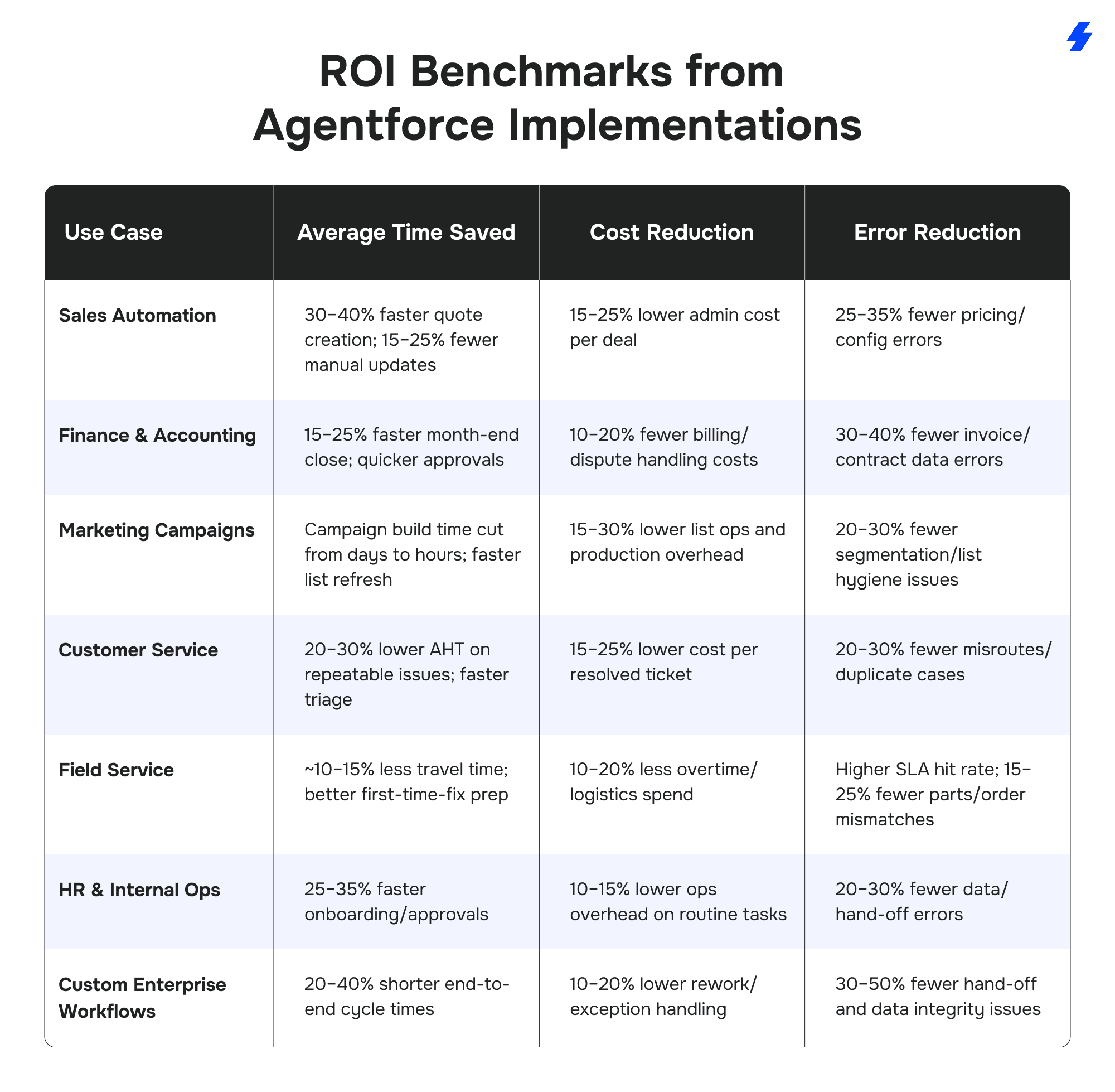
How to calculate it:
- Time saved: (Baseline avg. cycle time – Post-go-live avg. cycle time) ÷ Baseline.
- Cost reduction: (Baseline fully-loaded cost per transaction – Post-go-live cost) ÷ Baseline.
- Error reduction: (Baseline error/exception rate – Post-go-live rate) ÷ Baseline.
- Track for 6–8 weeks pre-launch and at least 12 weeks post-launch for a clean comparison.
Implementation Tips for Each Use Case
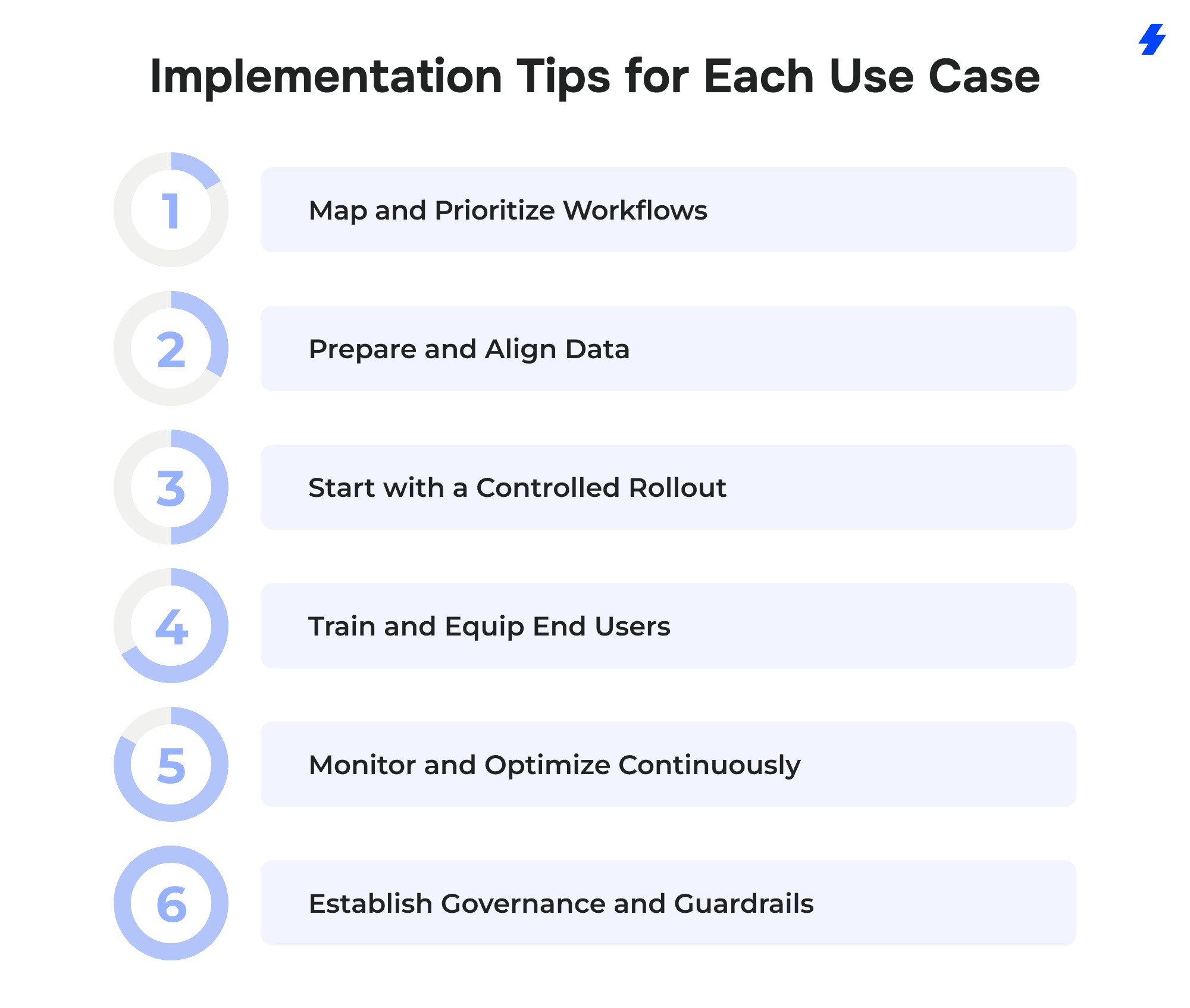
Map and Prioritize Workflows
Begin by breaking down how work is actually performed today. Document each step in a target process, from lead capture to quote approval, or from case creation to resolution, and note who touches the data, what tools are used, and where delays occur. Rank tasks by frequency, manual effort, and risk. High-volume, rule-based activities such as updating opportunity stages, validating invoices, or routing service requests usually make the best first candidates.
Resist the temptation to automate everything at once. A single, clearly defined workflow, for example, quote generation in Sales Cloud or invoice approval in Finance, will reveal both the benefits and the edge cases you need to handle before expanding.
Prepare and Align Data
Agentforce relies on reliable, structured data. Before introducing automation, clean existing records: remove duplicates, fill in missing fields, standardize naming conventions, and define ownership for key objects like Accounts, Opportunities, or Orders.
Integrations also need attention. If order data comes from an ERP or if marketing segments are sourced from HubSpot or SFTP feeds, ensure those connections are stable and up to date. A well-prepared CRM prevents the agent from producing incorrect quotes, routing cases to the wrong queue, or triggering invalid approvals.
For complex deployments, it’s worth setting up field usage reports and dependency maps beforehand. These reveal how automation will touch the org and reduce the risk of breaking existing flows.
Start with a Controlled Rollout
Deploy Agentforce to one workflow or department at a time. A focused pilot allows you to validate logic, measure impact, and refine rules before scaling. For example, sales teams often start with lead qualification or simple follow-up tasks. Service organizations may begin with automated case triage, while finance might focus on invoice compliance checks.
Run the pilot with clear success metrics, such as reduced handling time, higher first-contact resolution, or fewer billing exceptions. Review these numbers before expanding to additional processes.
Train and Equip End Users
Automation is more readily accepted when employees know how it works and where their input is still needed. Provide training tailored to each role:
- Sales reps should understand how opportunity updates and lead scoring are generated, and how to override or flag issues.
- Service agents need to know when to take over a case routed by the bot.
- Finance staff must recognize when the system has blocked an invalid invoice or flagged a compliance risk.
- Consider live demonstrations or sandbox testing so staff can interact with the agent before it goes live.
- Early exposure builds confidence and reduces resistance to change.
Monitor and Optimize Continuously
Agentforce performance should be tracked just like any other operational KPI. Use Salesforce dashboards to watch automation metrics: number of tasks completed by the agent, exception rates, average cycle time reduction, SLA adherence, and impact on revenue or service costs.
Patterns matter. If quotes are frequently overridden, review pricing logic. If support tickets are escalated too often, refine routing or expand the knowledge base. Treat automation as an evolving system that improves with use, not a fixed feature.
Establish Governance and Guardrails
Strong oversight keeps automation reliable and safe. Assign clear ownership for maintaining data quality and for approving changes to automation rules. Use Salesforce security practices such as role-based access, event monitoring, and approval flows to control what the agent can execute.
Avoid untested mass changes. Introduce updates through controlled releases and sandbox testing before moving to production. Proper governance prevents accidental data loss or process disruption.
How Agentforce Decides What to Do
Signals it reads: Record context (stage, SLA, contract terms), recent activity (opens, replies, case sentiment), and system facts (inventory, entitlements) from Salesforce plus connected apps and Data Cloud.
Rules it follows: Your pricing/discount policies, routing matrices, approval thresholds, and compliance constraints live as explicit guardrails. The agent never “guesses” outside those bounds.
Decision path:
Parse intent and context → 2) Check guardrails → 3) Pick an allowed action (e.g., update record, generate quote, route case, start approval) → 4) Execute via Flow/Apex/MuleSoft/API → 5) Log outcome and confidence. When confidence dips below a threshold or a rule is hit, it hands off to a human with the full trail attached.
Learning loop: Every override, rejection, and escalation becomes feedback. You tighten prompts and rules; the agent’s suggestions improve without widening its scope.
Concrete examples:
- Sales: “Discount >10% + non-standard terms” → trigger legal/finance approval; otherwise generate quote and ping the owner.
- Service: Case text + product + warranty window → route to the specialist queue; if sentiment is “urgent”, escalate with SLA clock visible.
- Field Ops: Technician skill + location + parts availability → propose slot; if parts ETA slips, notify the customer and reschedule.
Implementation Mistakes to Avoid
Even well-planned Agentforce projects can stumble if certain fundamentals are overlooked. Below are the most common pitfalls seen during adoption, and practical ways to avoid them.
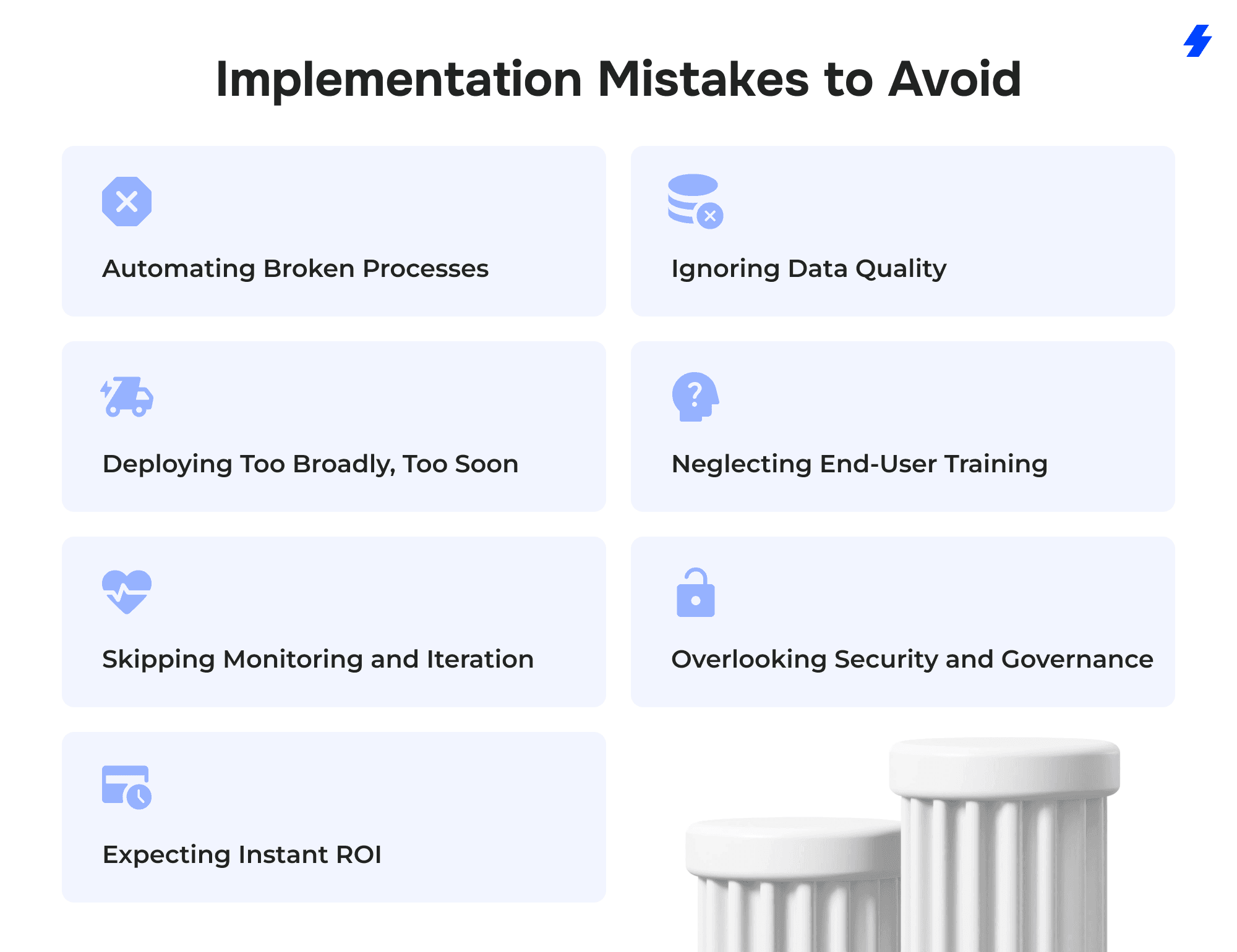
Automating Broken Processes
A frequent mistake is trying to automate a workflow that is poorly defined or already inefficient. If a sales quote process relies on manual spreadsheet updates and unclear discount approvals, adding automation will only replicate those flaws at scale.
How to avoid it:
Audit and streamline the process first. Remove redundant steps, clarify approval rules, and define data ownership before introducing Agentforce. Automate a clean, predictable flow, not a chaotic one.
Ignoring Data Quality
Agentforce depends on accurate CRM data. Duplicates, missing fields, and inconsistent product or pricing information can cause incorrect quotes, misrouted cases, or failed integrations.
How to avoid it:
Run a data cleanup before deployment. Standardize key fields, merge duplicates, and set clear data stewardship roles. Where possible, implement validation rules and field usage reports to keep data clean after launch.
Deploying Too Broadly, Too Soon
Some teams attempt to automate many departments in one go. The result can be confusion, poorly tested logic, and user resistance if workflows break.
How to avoid it:
Start small. Launch Agentforce on a single high-impact workflow, such as lead qualification or invoice compliance checks, measure results, and expand only after the first automation proves reliable and valuable.
Neglecting End-User Training
Even well-built automations fail if the people who use them don’t understand what’s happening. Users may override results, bypass processes, or resist adoption entirely.
How to avoid it:
Provide role-specific training and sandbox demos. Explain what the agent does, when human intervention is still required, and how to report exceptions. Clear communication builds trust and prevents workarounds.
Skipping Monitoring and Iteration
Some organizations treat automation as a “set it and forget it” system. Without monitoring, exceptions pile up, outdated logic persists, and performance gains fade.
How to avoid it:
Track KPIs such as handling time, SLA compliance, and exception rates. Review dashboards regularly, update logic when business rules change, and refine prompts or routing rules as you learn from real usage.
Overlooking Security and Governance
Allowing unrestricted access or failing to control how automation interacts with sensitive systems can introduce risk. Poor oversight can lead to data exposure or process disruption.
How to avoid it:
Apply Salesforce security best practices: role-based access, event monitoring, and controlled approval paths for rule changes. Test automations in a sandbox before production and maintain clear ownership for ongoing updates.
Expecting Instant ROI
Automation is powerful, but large-scale return doesn’t appear overnight. Rushing to measure success after a few weeks can lead to premature conclusions.
How to avoid it:
Set realistic success metrics (e.g., time saved, error reduction, SLA improvement) and measure them over a meaningful period. Treat Agentforce as an evolving capability, not a one-off project.
What’s Next for Agentforce
Agentforce has advanced far beyond its 2024 debut. What began as a layer of automation within Salesforce is now evolving into the backbone of a digital workforce - one capable of reasoning, acting, and improving at scale. Salesforce’s 2025 roadmap, reinforced by this year’s Dreamforce announcements, marks a decisive shift toward smarter autonomy, deeper integration, and enterprise-grade governance. Here’s how that transformation matters for businesses planning their next move.
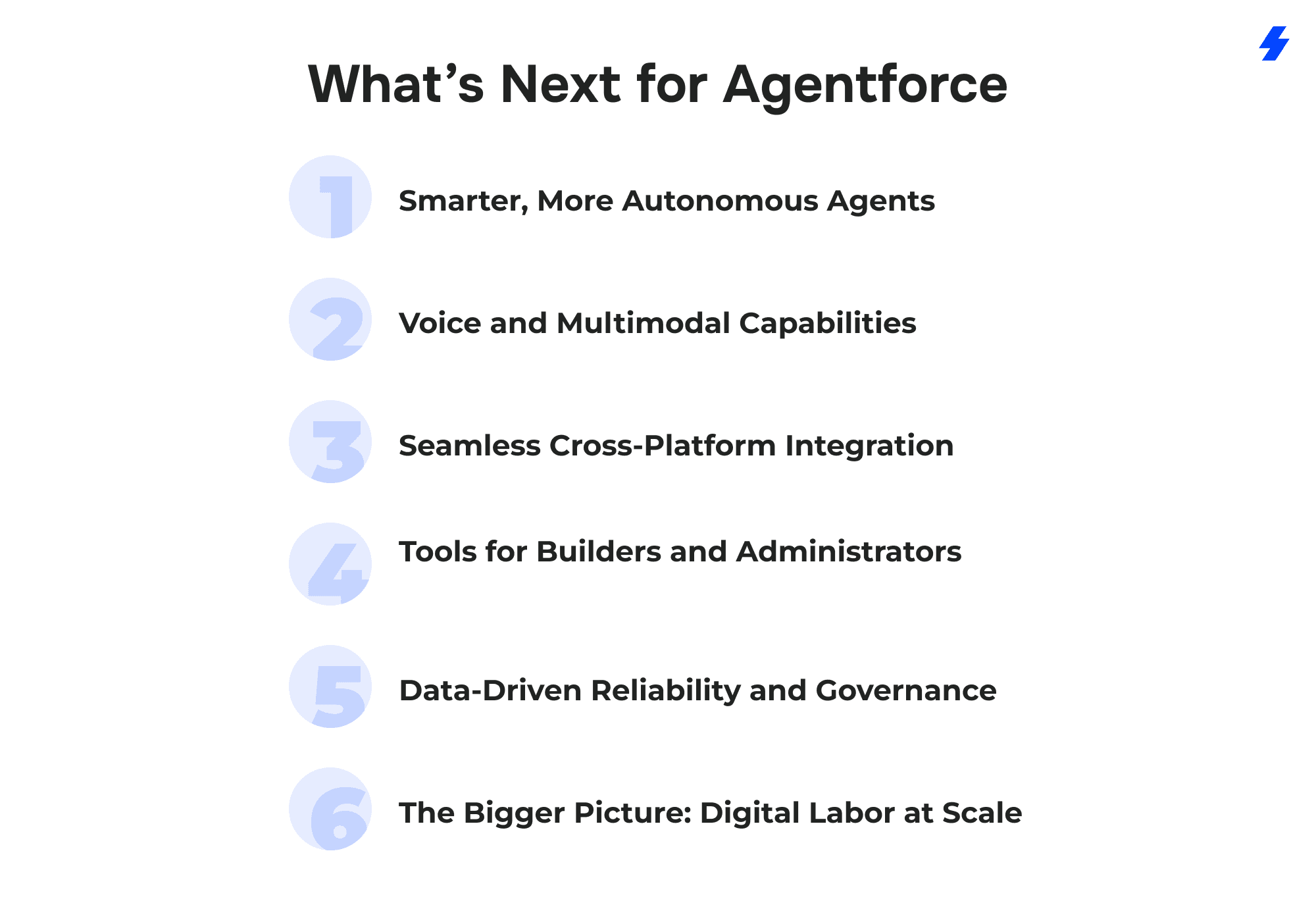
Smarter, More Autonomous Agents
Agentforce is moving from reactive automation to proactive, goal-driven reasoning. Powered by the upgraded Atlas Reasoning Engine, agents no longer wait for explicit triggers; they understand objectives and decide how best to achieve them.
Admins can now describe business goals in plain language and Agentforce automatically builds the logic, connects to relevant systems, and deploys the workflow. This natural-language design dramatically reduces implementation time and technical overhead, letting non-developers build complex automations safely.
Even more transformative, Salesforce is testing self-generating agents — AI workers that can create specialized sub-agents when repetitive patterns emerge (for example, a “Pricing Inquiry Agent” spun off from frequent support cases). This development signals the next stage in enterprise AI: systems that optimize themselves over time.
Voice and Multimodal Capabilities
Voice is the defining capability of 2025. With Agentforce Voice now generally available, users can speak naturally to AI agents that understand tone, interruption, and intent. Voice interaction bridges accessibility gaps - especially valuable in field service, logistics, and healthcare where hands-free operation is essential.
In parallel, the integration of Google Cloud’s Gemini multimodal models expands how agents perceive information. They can now interpret text, images, and audio together, making tasks like processing an insurance claim from photos and voice notes not only possible but seamless.
For businesses, this multimodality opens new frontiers in customer engagement, from AI-powered support lines to real-time service diagnostics and richer, humanlike experiences across devices.
Seamless Cross-Platform Integration
Agentforce’s connectivity has become a major competitive advantage. Through MuleSoft integration, agents can now trigger and coordinate workflows across multiple systems all from within Salesforce. This unifies processes that previously required manual synchronization.
The deeper Slack integration adds conversational control to daily collaboration: sales managers can approve deals, marketers can pull analytics, and service leads can check case metrics, all through natural chat commands.
Looking forward, the AgentExchange marketplace will further accelerate adoption. Companies and ISVs will soon be able to share and install pre-built agents and automation packs, reducing development time and standardizing best practices across industries.
Tools for Builders and Administrators
Salesforce has equipped technical teams with more structured ways to design, test, and govern agents.
New tools include:
- Agent Invocable Actions – agents can proactively trigger workflows under predefined business conditions.
- Agent Versioning – allows cloning, testing, and rollback without disrupting production.
- Bot Migration Tools – simplify the move from legacy chatbots to the Agentforce framework.
- CRMArena Testing Framework – brings structured validation of AI logic before deployment.
Combined with the redesigned Agentforce Builder and its visual simulator, these enhancements make experimentation safer and faster, helping teams maintain reliability even as agent complexity grows.
Data-Driven Reliability and Governance
As emphasized at Dreamforce ’25, data quality remains non-negotiable. Agentforce performs best when fully connected to Data Cloud, ensuring agents operate on real-time, unified customer profiles. Without this, organizations risk limited accuracy and fragmented insight.
The coming wave of observability and governance dashboards provides transparency into agent decisions, session-level performance (“Moments”), and ROI tracking. This visibility helps enterprises balance autonomy with control, addressing one of the biggest concerns about agentic AI: unpredictability.
Conditional logic (“IF–THEN” reasoning) and context engineering now let admins guide how agents think, making outcomes more reliable and compliant with company policies.
The Bigger Picture: Digital Labor at Scale
Marc Benioff’s goal to “empower one billion agents by the end of 2025” underscores Salesforce’s broader ambition: transforming automation into a scalable, digital workforce that complements every employee.
For organizations, this means thinking beyond efficiency metrics. Agentforce is no longer just a way to save time - it’s a way to extend capability. Companies can assign digital agents to handle renewals, data verification, or case triage autonomously, while human teams focus on empathy, creativity, and complex problem-solving.
In essence, businesses that learn to design, monitor, and govern AI agents effectively will not only reduce operational friction - they’ll redefine their workforce model. The next competitive advantage won’t come from hiring faster, but from deploying smarter digital labor across the enterprise.
Why Choose MagicFuse for Agentforce Implementation
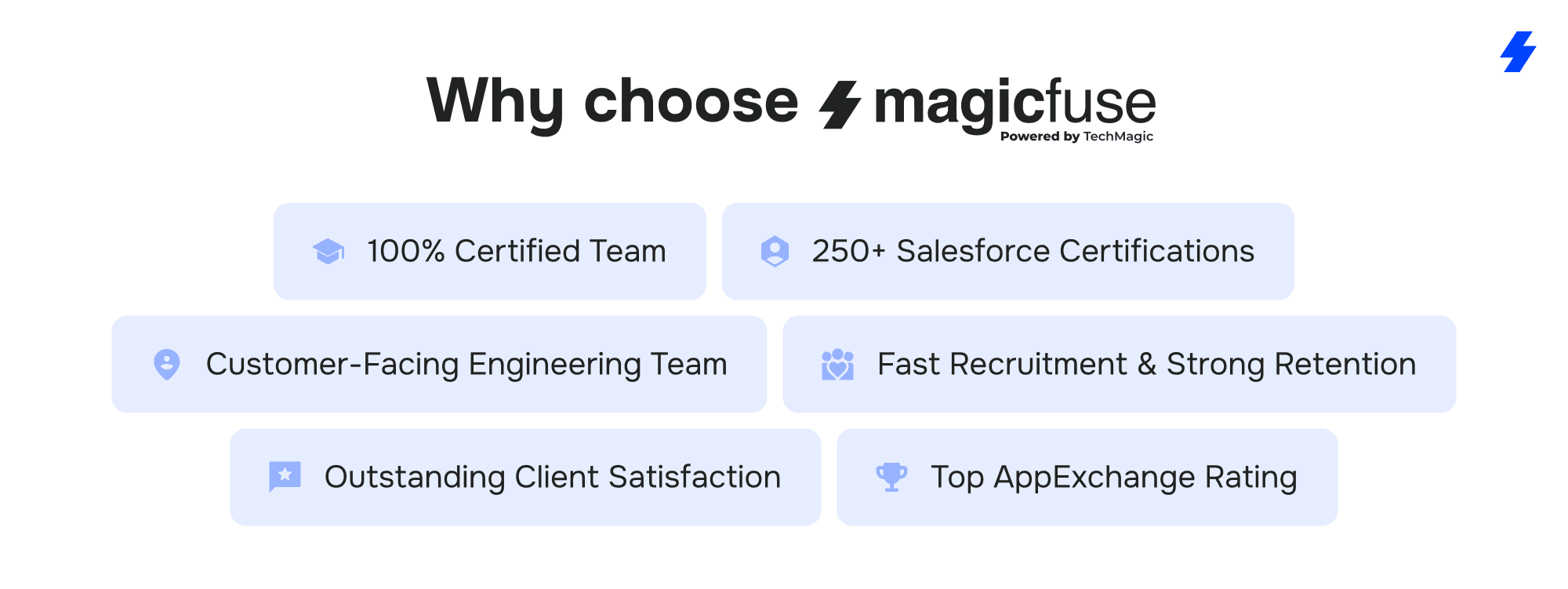
100% Certified Team
Our entire engineering team holds Salesforce certifications, ensuring expert-level knowledge and proven skills to deliver reliable, high-quality solutions.
250+ Salesforce Certifications
With over 250 certifications earned, including recent ones like Experience Cloud Consultant, Data Cloud Consultant, B2B Solution Architect, AI Specialist, and more, we stay at the forefront of Salesforce innovations to meet your evolving needs.
Customer-Facing Engineering Team
We believe in full transparency. Our clients have direct access to our engineers and resources, with no hidden layers, enabling smooth communication and collaborative problem-solving.
Fast Recruitment & Strong Retention
We recruit top Salesforce experts quickly, averaging 6 weeks per hire, while maintaining strong employee retention of over 3 years to provide consistent expertise on your projects.
Outstanding Client Satisfaction
Our commitment to quality is reflected in an impressive Net Promoter Score of 92%, showing that clients trust and recommend our services.
Top AppExchange Rating
With a stellar 4.9-star rating on Salesforce AppExchange, we demonstrate consistent excellence and customer satisfaction in the Salesforce ecosystem.
Start building your AI-powered digital workforce today. Contact MagicFuse to discuss your goals and get expert guidance on designing, implementing, and scaling Agentforce for your business.
FAQs
- What is Salesforce Agentforce and how is it used across industries?
Salesforce Agentforce is an AI-powered platform that lets companies deploy autonomous AI agents to automate workflows and support customers. Industries use it for tasks like resolving transaction disputes in finance, managing medical appointments in healthcare, streamlining delivery logistics in retail, or handling membership management in education. By integrating with the Salesforce ecosystem, Agentforce improves customer experiences while reducing manual workload.
- Which departments can benefit from Agentforce automation?
Sales teams save time with automating follow-ups and pipeline updates, while marketing teams run personalized campaigns and track customer sentiment. Service teams use AI agents to address customer inquiries, share knowledge articles, and escalate technical issues. Finance automates billing errors, loan status, and compliance. HR handles administrative tasks like onboarding, and operations use it for repair services, service intervals, and logistics.
- How does AI improve operational efficiency with Agentforce?
Agentforce cuts down on repetitive processes by using AI-powered agents to complete tasks across systems, like fixing billing errors or updating records automatically. It uses the Atlas reasoning engine and Salesforce Data Cloud to streamline workflows, reduce human error, and anticipate needs through sentiment analysis, driving measurable efficiency gains.
- How does Agentforce enhance customer service and support?
AI agents improve service by instantly answering questions, resolving payment status issues, and providing knowledge assistance. They route complex tasks like technical support or transaction disputes to human reps with context, ensuring faster resolution. This reduces pressure on service reps and boosts customer satisfaction through quicker, more accurate responses.
- Can MagicFuse implement Agentforce across multiple business processes?
Yes. MagicFuse specializes in Agentforce use cases that span sales, service, finance, healthcare, and more. We help organizations build custom agents, integrate with Salesforce Data Cloud and MuleSoft, and ensure workflow automation works smoothly across business operations.
- How can Agentforce support sales and marketing teams?
Sales reps benefit from AI-driven automating follow-ups, lead scoring, and pipeline management. Marketing teams run smarter campaigns, segment audiences, and analyze customer interactions in real time. Both functions gain efficiency by offloading routine tasks to AI-powered agents, freeing time for strategy.
- What specific functions does Agentforce provide for financial services?
In finance, Agentforce automates loan status checks, resolves billing errors and transaction disputes, and streamlines compliance reporting. Customers get real-time answers to account settings or payment questions, while advisors receive accurate data for decision-making.
- Can Agentforce be used in healthcare operations?
Yes. In healthcare, AI agents manage medical appointments, check insurance eligibility, and answer patient queries. They also consolidate patient data across systems, cutting down on administrative tasks and improving care delivery.
- How can educational institutions benefit from Agentforce?
Schools and universities use Agentforce to automate admissions, membership management, and routine student inquiries. Agents provide knowledge assistance, track enrollment, and improve communication, enhancing both operational efficiency and the student experience.
- What measurable outcomes can businesses expect after implementing Agentforce with MagicFuse?
Companies typically see faster customer query resolution, reduced manual workload, and improved operational efficiency. Automated chat deflection and AI-driven workflows can cut case volumes by more than half while boosting customer satisfaction and ROI.
- How to implement Agentforce with MagicFuse?
MagicFuse starts with a workflow assessment, pilots high-impact use cases, and gradually scales. We integrate custom agents into the Salesforce ecosystem, train teams, and monitor results to ensure AI-driven automation delivers sustained business outcomes.