






Modern customer service on Salesforce Service Cloud isn’t “turn it on and train the team.” It’s an operating model change that touches every queue, channel, KPI, and integration your support org depends on.
Teams evaluating Service Cloud should treat this as a Salesforce investment tied to service outcomes and governance, not a UI refresh. The delivery model must ensure operational efficiency, enhance customer experience, and maintain auditability.
Because Service Cloud depends on existing systems and high-volume customer interactions, the work often extends beyond configuration into extensive system integration design, testing discipline, and production monitoring required for a successful Salesforce implementation.
This guide ranks and compares the top Salesforce Service Cloud implementation partners for 2026 and highlights their role as a Salesforce implementation partner.
You’ll see what to evaluate (certifications, delivery method, integration depth, industry fit, and post–go-live support), which partners tend to excel in which scenarios, and how to match a vendor to your service strategy, whether you’re rebuilding a contact center, adding digital channels, or standardizing service globally.
What Makes a Great Salesforce Service Cloud Implementation Partner?
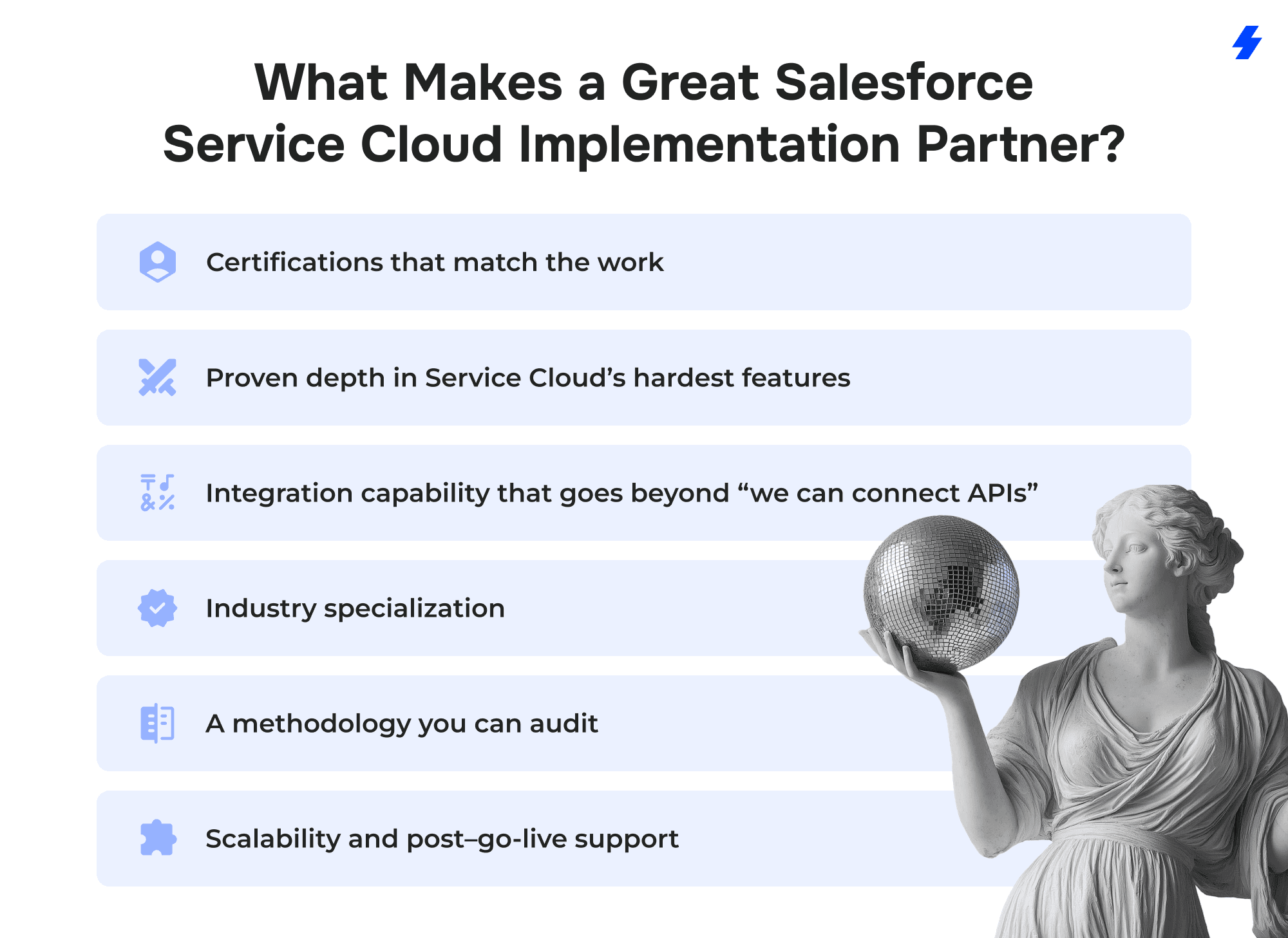
A Salesforce Service Cloud partner isn’t “great” because they can configure objects and build flows. They’re great because they can translate your support operation into a Service Cloud design that holds up under volume, security constraints, and integration noise - then ship it predictably.
Look for Salesforce expertise that connects platform decisions to business objectives, not just feature setup. The best teams explain which Salesforce capabilities they will use, how they will measure outcomes with Salesforce analytics and CRM analytics, and how they will manage change so user adoption holds after launch, especially when implementing Salesforce across multiple teams.
1) Certifications that match the work (not just a logo on a slide)
Certifications don’t guarantee outcomes, but the right mix is a strong signal of delivery maturity. Look for partners who can show certified coverage across:
- Salesforce Certified Administrator (core org configuration and governance)
- Salesforce Certified Service Cloud Consultant (service processes, case lifecycle, entitlements, omni-channel concepts)
- Salesforce Certified Platform Developer I/II (when you need Apex, LWC, integrations, or complex automation)
- Salesforce Certified Integration Architect / Application Architect (integration patterns, limits, security-by-design)
- CTA (Certified Technical Architect) or equivalent senior architecture bench for complex, multi-system programs
What matters: who is staffed on your project? Ask for the names/roles of the people assigned and their credential IDs, especially the solution architect, integration lead, and the person responsible for user training.
2) Proven depth in Service Cloud’s hardest features
If your roadmap includes addressing business requirements such as forecasting demand or prioritizing work based on patterns, ask how their professional services apply predictive analytics without compromising data quality or agent trust. A strong partner has repeated experience implementing and stabilizing:
- Case management: case types, escalation rules, entitlements, milestones, macros, case assignment models
- Omni-Channel: routing configurations, presence statuses, capacity models, skills-based routing, reporting on queues/backlogs
- Telephony: CTI or Service Cloud Voice, call controls, screen pops, logging, call recording considerations, failover behavior
- Einstein for Service (where appropriate): case classification/recommendations, routing assistance, article suggestions, summarization policies
- Knowledge: article types, taxonomy, governance, authoring workflow, deflection strategy, search tuning
- Digital Engagement: chat, messaging, social channels, bot handoff rules, transcript retention
A quick test: ask them to explain how they handle special routing situations, such as requests that come in after business hours, high-priority or VIP customers, language-specific support needs, and periods when support teams are overloaded, as well as how they manage knowledge governance (ownership, review cycles, and retiring outdated articles).
3) Integration capability that goes beyond “we can connect APIs”
Most service organizations live inside multiple systems: ERP, billing, order management, identity, warehouse, or custom apps. The partner should be comfortable owning integration design choices and tradeoffs, including aligning with business processes.
- Telephony/CTI providers and call-center workflows
- ERP and order data exposure for agents (read/write, not just view-only widgets)
- Third-party apps (document management, e-signature, field service tools, feedback tools)
- Integration patterns: real-time vs async, event-driven approaches, error handling, retries, monitoring, and data reconciliation
You want a partner who talks about limits, latency, identity, and observability, not only endpoints and middleware names. Strong delivery teams describe system integration and customization integration as operating requirements, not one-time tasks, and they plan for incident response and ownership.
4) Industry specialization (because compliance and workflows shape architecture)
Service Cloud can support many industries, but the implementation shape changes with regulations and customer expectations. Strong partners can point to similar delivery patterns in your space, for example:
- Finance: audit trails, permissions, encrypted data, retention policies, regulator-driven reporting
- Healthcare/Life Sciences: protected data controls, secure communications, strict access segmentation
- Manufacturing: warranty/claims, asset context, dealer networks, parts visibility
- SaaS: high-volume ticket automation, deflection, product telemetry signals
- E-commerce/Retail: returns/exchanges, order visibility, shipping exceptions, surge periods
5) A methodology you can audit (discovery → build → QA → support)
Great partners can show a delivery approach that is structured, transparent, and repeatable, without drowning the team in ceremonies. At minimum, expect:
- Discovery: process mapping, backlog definition, success metrics, data/integration requirements, security constraints
- Architecture: target-state design, integration patterns, environment strategy, governance, and release management
- Build: configuration-first with clear rules for when custom code is justified
- QA + UAT support: test plans, test data strategy, defect triage rhythm, performance checks for routing/integrations
- Go-live planning: cutover steps, rollback options, agent enablement, hypercare plan
- Support: managed services options, release cadence, monitoring, and backlog optimization
If they can’t explain how they control scope, handle change requests, and manage integrations under time pressure, that’s a risk.
6) Scalability and post–go-live support (where strong teams separate themselves)
Real-world service is messy: new case reasons appear, product lines change, channels get added, and volumes jump. The best partners plan for operational continuity in customer support:
- Admin handover with documentation that’s usable, not ceremonial
- Observability for integrations and routing (alerts, dashboards, error queues)
- Performance and capacity considerations for high-volume routing and digital channels
- A clear model for enhancements after launch (monthly releases, backlog grooming, KPI-driven optimization)
- Support options that match your model: onshore, nearshore, offshore, or mixed coverage. Effective post-go-live support ensures that Service Cloud evolves with your business, preventing downtime and improving agent performance over time.
List of Top Salesforce Service Cloud Implementation Partners
This shortlist focuses on Salesforce Service Cloud partners within the Salesforce ecosystem that have repeatable delivery methods, strong integration capability, and Service Cloud depth. Treat this as a shortlist of Salesforce consultancies and delivery teams for Cloud implementation programs, then validate fit against your operating constraints and risk profile.
Partner tiers note: Salesforce uses a Consulting Partner tier system (Base → Ridge → Crest → Summit). Tier alone shouldn’t decide the purchase, but it’s a useful signal when combined with references, staffing, and delivery methodology.
MagicFuse (TechMagic Salesforce Division)

Overview
MagicFuse is a Salesforce development and consulting team within TechMagic, serving organizations that need Service Cloud to work as part of a broader stack: telephony, portals, back-office systems, and custom apps. Their public positioning emphasizes technical execution (custom build, integration, ISV/PDO work) rather than advisory-only work, which is often the deciding factor on Service Cloud programs with complex routing, data flows, and operational constraints.
Certifications & expertise
MagicFuse reports 250+ Salesforce certifications and 70+ certified Salesforce experts, spanning core admin/consultant credentials and deeper architecture/development coverage (e.g., Integration Architect, Application Architect, Data Architect, Platform Developer I/II, Service Cloud Consultant, plus related areas like MuleSoft and Copado). This mix matters for Service Cloud because case lifecycle design is only part of the work: telephony behaviors, integration limits, security model, and automation patterns typically drive the hardest decisions.
Key Service Cloud capabilities (case-based)
- SHA Africa (Smart Havens Africa): Implemented a full Service Cloud solution including case configuration, automation, SLAs, Omni-Channel routing, and integrations to support structured, scalable customer support operations.
- Riptide Logistics: Built live chat and AI-driven chat solutions on Service Cloud, integrated with Experience Cloud, enabling real-time digital engagement and contact center workflows.
- Limio (ISV): Implemented Salesforce Service Cloud (alongside Sales Cloud) to support B2B and B2C commerce operations, providing customer service agents with unified case and customer management.
- Purlos (ISV): Delivered a multi-cloud solution using Service Cloud, Sales Cloud, and Experience Cloud to support customer communication, automation, and AI-driven service workflows.
- NDA: Implemented Service Cloud together with Sales and Experience Cloud to support healthcare portals, including secure access (MFA), scheduling, and automated notifications.
- NDA: Reviewed and improved an existing Service Cloud setup, including migration planning from Zendesk and enhancements to reporting and operational visibility.
- NDA: Supported and validated Service Cloud functionality as part of Zuora testing and advisory work, ensuring service processes aligned with billing and subscription workflows.
- NDA: Provided configuration and customization across Service Cloud (along with Sales and Experience Clouds) to support consulting and client service operations.
- Mphasis Silverline: Delivered healthcare-focused projects using Service Cloud in combination with Sales and Experience Clouds, supporting regulated service workflows and data governance requirements.
Industries served
MagicFuse lists delivery across financial services/banking, healthcare, retail/e-commerce, travel & hospitality, automotive, technology, education, and nonprofit, with case-study style writeups that include integrations and compliance-oriented work in regulated contexts.
Notable clients (public references):
- Elements.cloud
- Limio
- ID-Pal
- Riptide
- Ascent Solutions
- OpFocus
Partner status
MagicFuse states it is a Salesforce Crest Partner and also a Salesforce PDO (Product Development Outsourcer), which is a meaningful signal of their deep technical expertise if your Service Cloud implementation includes packaged components, AppExchange products, or security-review-quality engineering discipline.
Slalom

Overview
A large consulting partner known for business/operating-model alignment plus hands-on Salesforce delivery (frequent fit for service transformation programs that include process redesign and change management).
Certifications & expertise
Reports thousands of Salesforce certifications and completed projects as a Salesforce partner.
Key Service Cloud capabilities
Service process re-design, omnichannel program delivery, and cross-cloud customer experience initiatives (service often tied to sales, marketing, and digital experience).
Industries served
Broad (varies by region; commonly public sector, financial services, retail, healthcare, and technology depending on local practice strength).
Notable clients Typically reference-led and region-dependent; validate via case studies + local delivery team.
Partner level Not consistently public in a single authoritative location; confirm in Salesforce’s partner directory during vendor selection.
Unique differentiators Strong “business + tech” pairing: discovery, service design, adoption, and operating model work alongside implementation.
Deloitte Digital

Overview
A large global consulting partner used for enterprise service transformation programs where Service Cloud implementation sits alongside governance, operating model work, and complex stakeholder environments.
Certifications & expertise
Deep Salesforce alliance footprint, typically staffed with multi-cloud architects and delivery teams (levels and staffing vary by region).
Key Service Cloud capabilities
Large-scale service programs that include process redesign, platform architecture, and integration strategy across multiple systems and channels.
Industries served
Broad, with strong coverage in regulated and complex industries through vertical practices.
Notable clients
Reference-led; validate with Service Cloud project examples in your industry and geography during selection.
Partner level
Not consistently stated on public pages; confirm in Salesforce’s partner directory or through their affiliated consulting firm.
Unique differentiators
Program scale and governance for multi-region deployments, plus the ability to run discovery-to-adoption work in parallel with implementation.
Accenture

Overview
A global systems integrator is frequently selected when Service Cloud is part of a larger Salesforce and enterprise modernization roadmap (cross-cloud plus data and integration layers).
Certifications & expertise
Accenture reports a very large Salesforce bench and certification volume (useful for global resourcing and specialized roles).
Key Service Cloud capabilities
Enterprise contact-center transformations, integration-heavy deployments, and cross-cloud service programs that connect service with sales, commerce, and data initiatives.
Industries served
Broad global coverage across industries through dedicated practices.
Notable clients
Reference-led; confirm Service Cloud outcomes and delivery team experience for your vertical and region.
Partner level
Confirm in Salesforce’s partner directory.
Unique differentiators
Scale, global delivery coverage, and established Salesforce alliance capabilities for complex programs with multiple workstreams.
Cognizant

Overview
A global consulting and delivery partner is commonly engaged when Service Cloud needs to integrate with broader enterprise systems and operating processes.
Certifications & expertise Positions itself as a strategic Salesforce partner; validates service-specific certification coverage and the named project team during evaluation.
Key Service Cloud capabilities
Service transformation delivery that can include integration, analytics, and multi-system workflows beyond Salesforce.
Industries served
Broad (industry strength often varies by geography).
Notable clients
Primarily reference-led; request comparable Service Cloud deployments by industry and complexity.
Partner level
Confirm in Salesforce’s partner directory for their Salesforce consulting capabilities.
Unique differentiators
Ability to align Salesforce work with wider digital and enterprise transformation programs that involve multiple systems and data domains.
Capgemini

Overview
A global consulting and implementation partner with a long-running Salesforce relationship, often used for multi-region programs and ongoing support models.
Certifications & expertise
Capgemini highlights a large global network of certified Salesforce and MuleSoft experts; good to validate the exact staffing plan for your program.
Key Service Cloud capabilities
Service implementations combined with integration strategy (often MuleSoft-led), program governance, and post-launch support structures.
Industries served
Broad coverage across industry sectors through dedicated practices.
Notable clients
Reference-led; use their AppExchange/case materials to shortlist, then validate Service Cloud relevance in your RFP.
Partner level
Confirm in Salesforce’s partner directory.
Unique differentiators
Global delivery + integration depth (Salesforce + MuleSoft) paired with the ability to run implementation and longer-term run/support.
Simplus

Overview
A Salesforce-focused consultancy brand now operating within Infosys’ Salesforce practice; often positioned for Salesforce-centered transformation programs.
Certifications & expertise
Backed by Infosys’ larger bench and delivery footprint; validate the specific proposed team’s Service Cloud credentials.
Key Service Cloud capabilities
Service Cloud implementations aligned to broader Salesforce programs, frequently paired with Sales/Platform work depending on scope.
Notable clients
Reference-led; request Service Cloud examples close to your scale, channels, and integration stack.
Partner level
Infosys is listed as a Salesforce Global Summit Partner on AppExchange; confirm whether the engagement is contracted under Infosys/brand entity in your region.
Unique differentiators Salesforce-first delivery DNA within a larger global organization - useful when you want Salesforce specialization plus enterprise-grade coverage.
Silverline

Overview
A Salesforce-focused consultancy brand (now part of a larger organization); often shortlisted by teams that prefer Salesforce specialists over generalist systems integrators.
Certifications & expertise
Typically Salesforce-centered staffing; validate current org structure, delivery leadership, and the named project team.
Key Service Cloud capabilities
Service Cloud implementation and optimization programs; confirm telephony/CTI and integration delivery approach based on your call-center stack.
Industries served
Commonly strong in financial services and other regulated contexts, plus general commercial delivery (varies by team).
Notable clients
Reference-led; ask for Service Cloud implementations with similar compliance and routing requirements.
Unique differentiators
Salesforce specialization and repeatable delivery approaches; often a fit when you want a Salesforce-centric firm without SI overhead.
Persistent Systems
 Overview
An engineering-led services firm that can be a fit when Service Cloud requires substantial integration work, custom development, or coordination with broader platform engineering efforts.
Certifications & expertise
Validate Salesforce service credentials and the experience level of the proposed solution architect/integration lead during selection.
Key Service Cloud capabilities
Custom build + integration-heavy Service Cloud programs; best evaluated through architecture samples and technical references.
Industries served
Broad; often strong in enterprise technology contexts.
Notable clients
Reference-led; request Service Cloud examples that match your integration landscape and support model to improve agent productivity.
Unique differentiators
Engineering depth for complex extensions around Salesforce, where Service Cloud is one component in a wider application ecosystem.
OSF Digital

Overview
A digital transformation firm with Salesforce delivery that is often engaged for customer experience programs where service is connected to commerce and digital experience layers.
Certifications & expertise
Validate the Service Cloud bench in your region and the proposed delivery approach for telephony and integrations.
Key Service Cloud capabilities
Cross-cloud experience programs; confirm service routing, knowledge strategy, and omni-channel operations design during evaluation.
Industries served
Broad, commonly experience-led brands (varies by region).
Notable clients
Reference-led; request published service outcomes and operational KPIs from similar programs.
Unique differentiators
Strength in connecting service programs to broader customer experience initiatives across channels.
How to Choose the Right Salesforce Service Cloud Partner
Selecting a Service Cloud partner is a risk decision more than a Salesforce implementation feature decision. The right team matches your scope, constraints, and operating reality, and can prove it with comparable delivery examples, not generic slide decks.
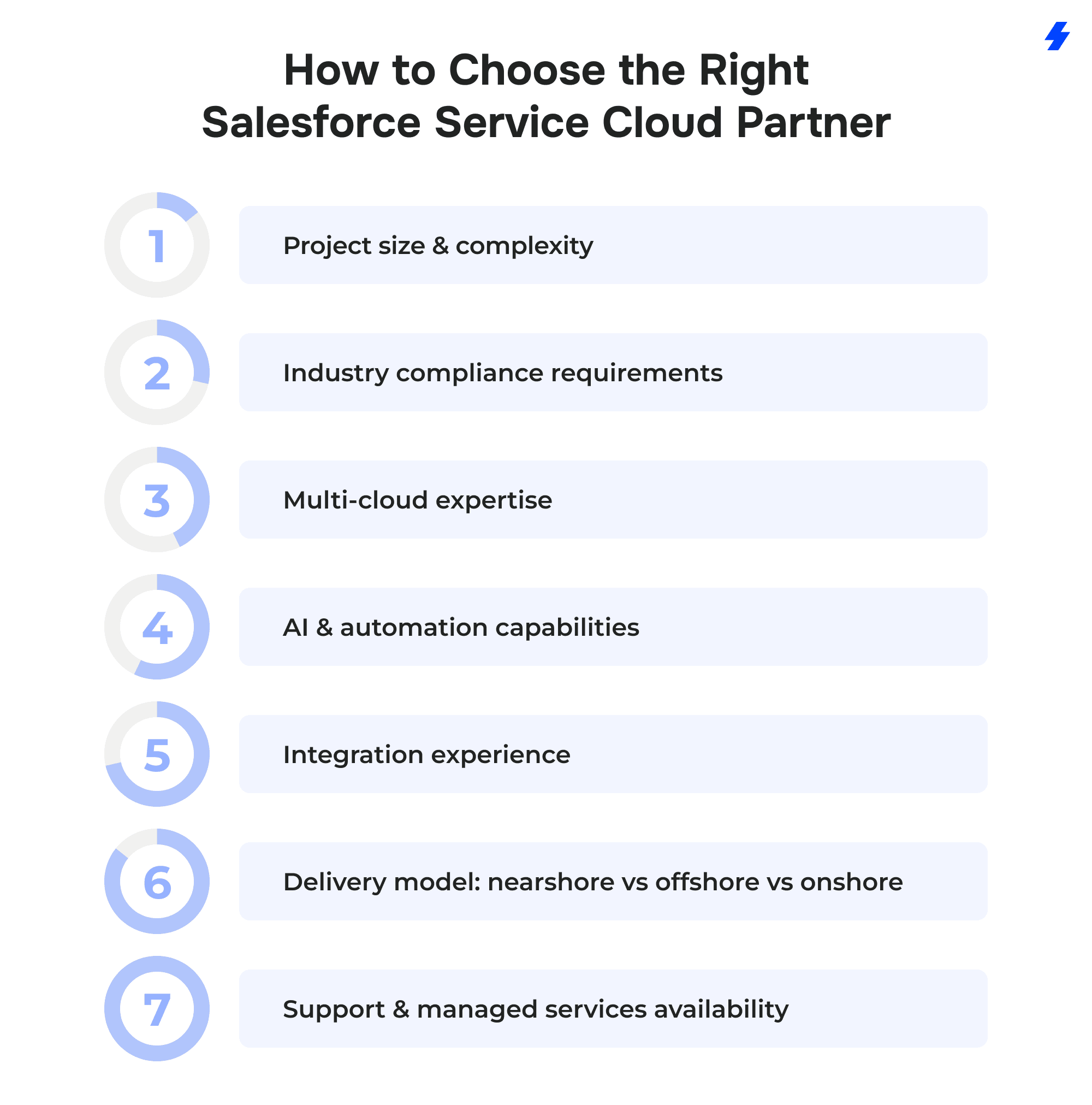
1) Project size & complexity
Start by classifying the program you’re actually running:
- Basic implementation: standard case management, a few queues, basic email-to-case, baseline reporting.
- Contact center modernization: Omni-Channel routing, Voice/CTI, agent console design, QA/UAT at volume.
- Enterprise service transformation: multiple business units, several regions, complex security model, data migration, and heavy integration.
A partner who excels at foundation rollouts can struggle on enterprise routing + telephony + integrations.
Ask for two comparable Service Cloud projects with similar channel mix, case volume, and integration count. Ask who will be your day-to-day Salesforce Service Cloud specialist, and confirm they have implemented routing, CTI, and knowledge in similar environments.
2) Industry compliance requirements (finance, healthcare, manufacturing)
Compliance changes architecture, testing, and operating processes:
- Finance: auditability, data retention, access controls, encryption strategy, approval governance.
- Healthcare/life sciences: strict access segmentation, secure communications, validated processes, data handling constraints.
- Manufacturing: warranty/claims logic, asset context, dealer networks, and back-office dependencies.
Your evaluation should include how the partner handles security model design, data access patterns, and evidence for audits (documentation that stakeholders can use, not just technical notes).
3) Multi-cloud expertise (Service + Sales + Platform)
Service Cloud rarely lives alone. Many orgs need shared objects, shared data, and shared reporting across:
- Service + Sales: unified customer timeline, handoffs, shared accounts/contacts, entitlement alignment.
- Service + Platform: custom apps for internal teams, specialized consoles, custom objects, and advanced automation.
- Service + Experience Cloud: self-service portals, partner support experiences, and authenticated case submission.
Choose a partner who can explain how they prevent object sprawl, reduce duplicate automations, and keep governance stable as clouds expand.
4) AI & automation capabilities
AI should be scoped to operational value, not novelty. Evaluate a partner on:
- Process automation discipline: when to use Flow vs Apex, versioning strategy, testability, and guardrails.
- Service AI readiness: knowledge quality, data structure, security policies, and what agents will actually trust.
- Measurement plan: how AI/automation success is tracked (deflection, handling time, queue aging, resolution quality).
Ask what they do when AI recommendations are wrong, and how the team will tune outcomes post-launch.
5) Integration experience (the make-or-break factor)
Most Service Cloud failures trace back to integrations: unreliable data, slow screens, brittle middleware, or missing error handling. Vet for:
- Telephony/CTI: provider experience, call logging, screen pops, failover behavior, and admin controls.
- ERP/billing/order systems: consistent identifiers, latency strategy (real-time vs async), reconciliation, and retries.
- Observability: monitoring, alerting, and dashboards for integration health and queue processing.
Request an example of an integration design they shipped that includes error handling, rate limits, and operational monitoring.
6) Delivery model: nearshore vs offshore vs onshore
There’s no universally best model. Match it to speed, collaboration, and risk:
- Onshore-heavy: best for complex discovery, executive stakeholders, and rapid iteration with business users.
- Nearshore: good balance for overlapping hours, faster feedback loops, and cost control.
- Offshore: useful when scope is stable, specs are clear, and you have strong internal product ownership.
What matters is not location; it’s how they run discovery, manage changes, and keep decision-making tight. Ask for their approach to time zone overlap, handoffs, and continuity of key roles.
7) Support & managed services availability
Service Cloud is a living system. Plan for:
- Hypercare: first weeks after launch, queue tuning, defect triage, adoption issues.
- Managed services: admin/dev coverage, release management, backlog grooming, and KPI-driven optimization.
- Ownership clarity: what your internal team owns vs what the partner owns, and how knowledge transfer happens.
If you expect ongoing evolution (new channels, routing changes, knowledge expansion), prioritize partners with a clear post–go-live operating model and named resources.
Service Cloud Readiness Checklist
Use this checklist to confirm you’re ready to evaluate partners and lock scope. If you can’t answer several items, expect discovery to take longer and estimates to widen.
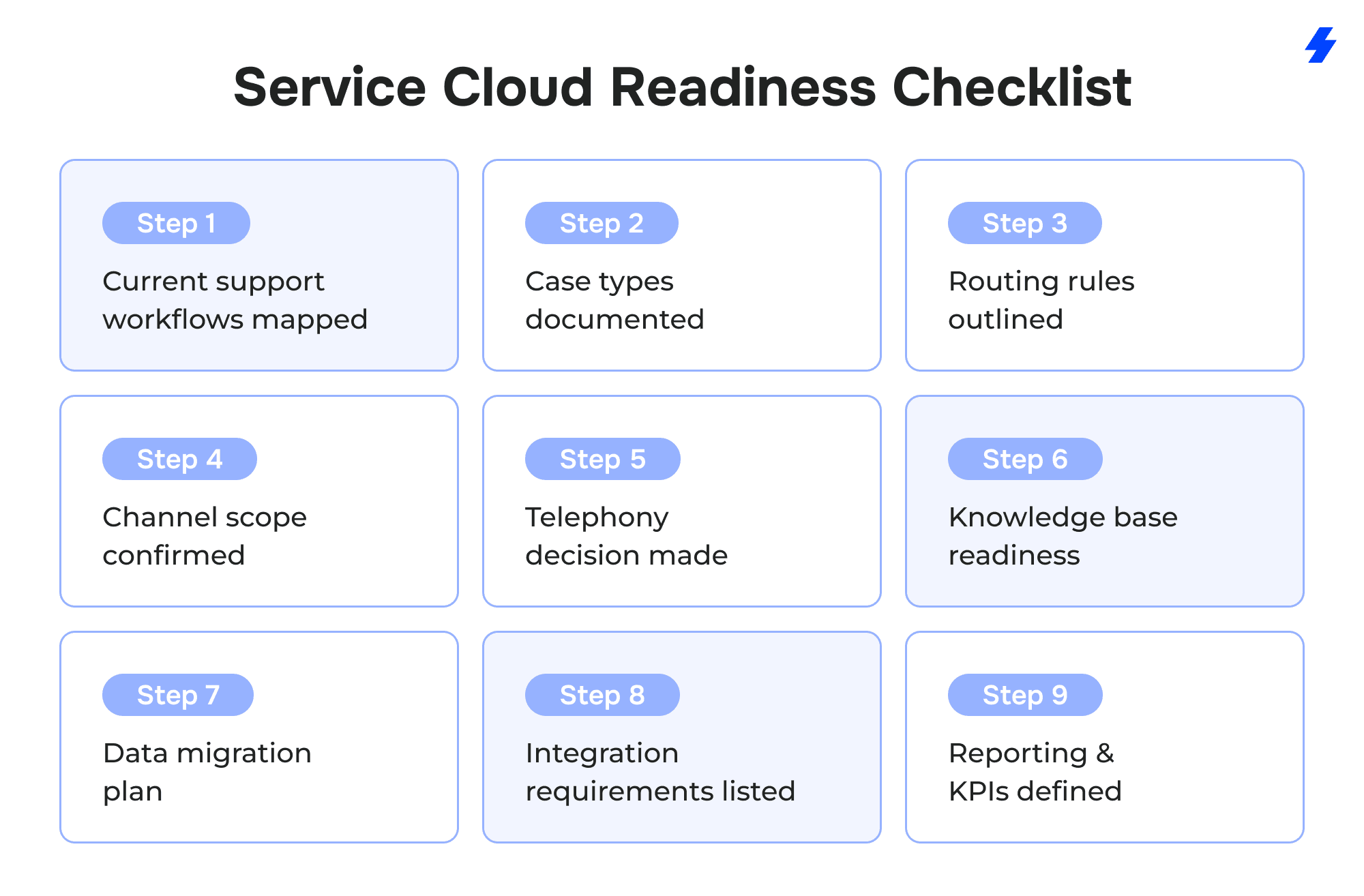
- Current support workflows mapped (intake → triage → resolution → closure), including escalations and approvals
- Case types documented (top 10–20 drivers), with definitions, priorities, and ownership
- Routing rules outlined (queues, skills, language, VIP handling, hours/holidays, overflow)
- Channel scope confirmed (email, web, chat, messaging, social, phone), plus expected monthly volumes by channel
- Telephony decision made (CTI provider or Service Cloud Voice approach), including call recording and retention requirements
- Knowledge base readiness: article types, ownership, review cadence, and which content can be served to customers vs agents
- Data migration plan: source systems, cutover approach, dedupe rules, historical case retention, and data quality remediation steps
- Integration requirements listed (ERP/billing/orders/identity), including what agents must see vs update
- Reporting & KPIs defined: backlog, SLA compliance, CSAT, FCR, handle time, channel mix, and top case drivers
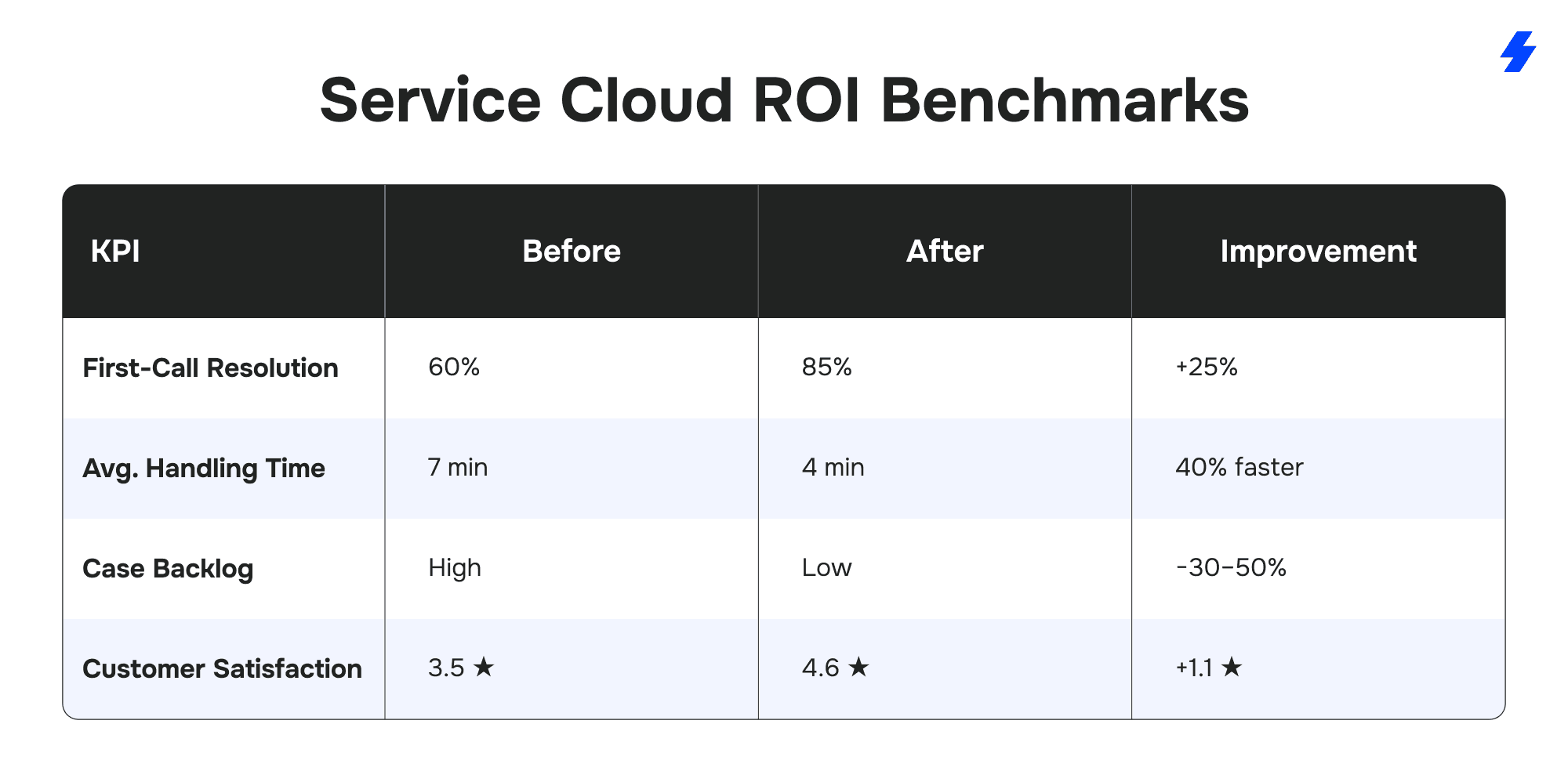
Service Cloud ROI Benchmarks
Teams often agree on “better customer service” but don’t align on measurable outcomes. Use the table below as a shared baseline for selecting a partner and prioritizing features during build.
For many teams, ROI shows up as better prioritization, faster resolution, and higher customer retention, which supports business growth over time. Good reporting design uses crm analytics as a foundation for leadership decisions, not as an afterthought.
Industry-Specific Implementation Variations
These service cloud industries often share the same platform, but requirements differ sharply by regulation, data sensitivity, and routing complexity, so industry knowledge changes the implementation design.
- Finance: strict access controls, audit trails, encrypted fields/records, defined retention, and approval governance for exceptions
- Healthcare: HIPAA-aligned workflows, secure communication patterns, restricted access by role/site, and careful handling of sensitive data in case notes and attachments
- SaaS: high-volume automation for intake and triage, strong deflection strategy (knowledge + bots), and fast escalation paths to engineering
- E-commerce: returns/exchanges workflows, order and shipment visibility in the agent console, and surge planning for peak seasons
- Telecom: complex skills-based routing, heavy voice volumes, strict queue management, and integration with multiple account/billing systems
What to ask partners:
Which constraints change your data model, routing, knowledge, and integration approach in our industry? What do you standardize, and what do you treat as non-negotiable customization?
Common Pitfalls to Avoid
Service Cloud issues rarely come from a single mistake - they come from small decisions that compound during rollout. These are common failure modes and what a competent partner does differently.
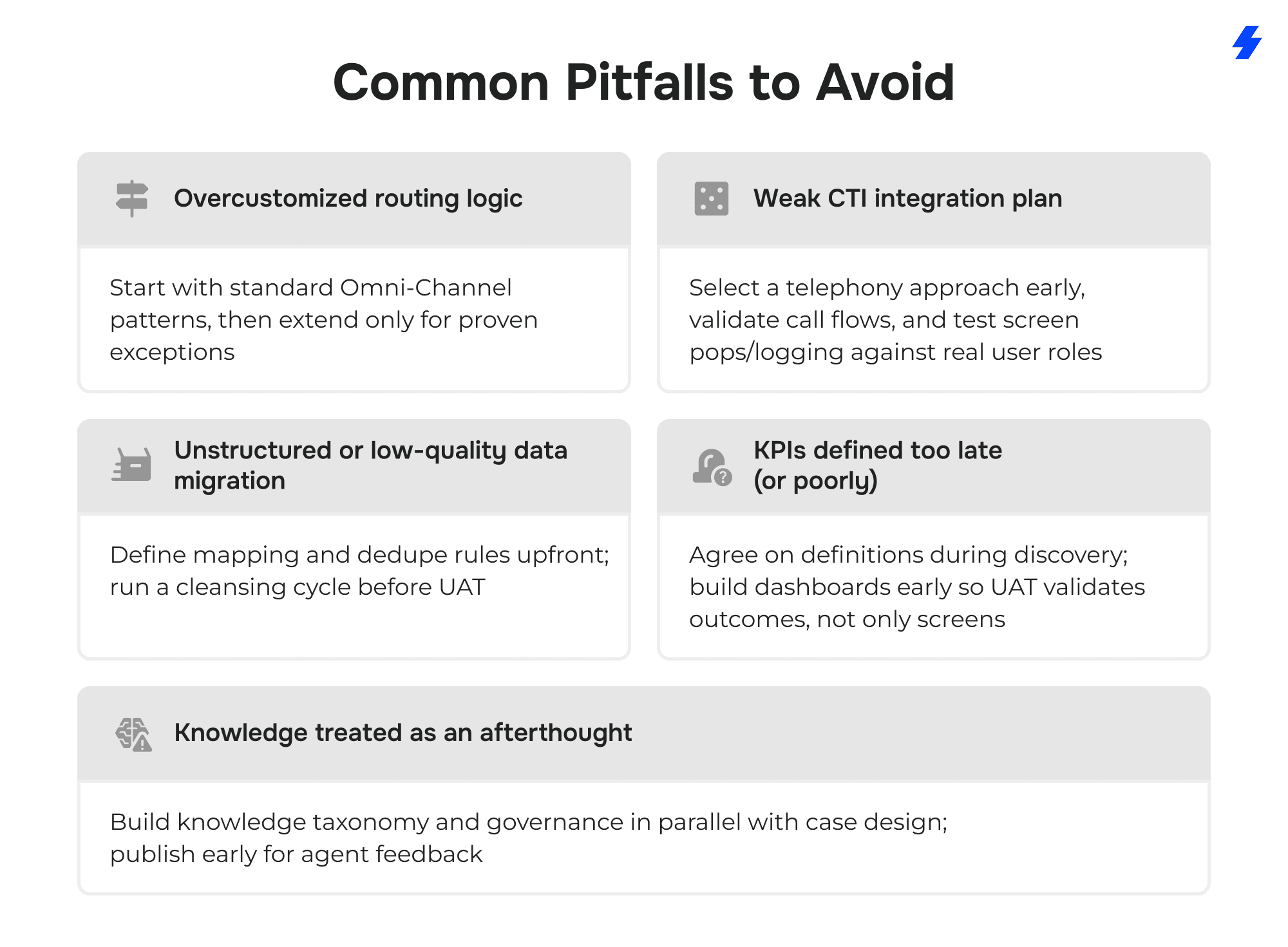
- Overcustomized routing logic → Start with standard Omni-Channel patterns, then extend only for proven exceptions
- Weak CTI integration plan → Select a telephony approach early, validate call flows, and test screen pops/logging against real user roles
- Knowledge treated as an afterthought → Build knowledge taxonomy and governance in parallel with case design; publish early for agent feedback
- Unstructured or low-quality data migration → Define mapping and dedupe rules upfront; run a cleansing cycle before UAT
- KPIs defined too late (or poorly) → Agree on definitions during discovery; build dashboards early so UAT validates outcomes, not only screens
Sample 10–14 Week Implementation Timeline
A typical mid-scope Service Cloud rollout fits in 10–14 weeks when requirements are controlled and integrations are understood. This timeline is a reference model; heavily integrated programs or multi-region rollouts can extend beyond it.
Discovery (Weeks 1–2)
Process mapping, routing requirements, channel scope, KPI definitions, data/integration inventory, success criteria
Architecture (Weeks 2–3)
Security model, data model, target-state design, environment strategy, integration patterns, release plan
Build (Weeks 3–8)
Case management configuration, console setup, automation, Omni-Channel routing, knowledge structure, digital channels setup
Integrations (Weeks 5–9)
CTI/telephony setup, ERP/billing/order integrations, data sync jobs, error handling, monitoring plan
QA (Weeks 8–10)
System testing, regression, performance checks for routing/integrations, defect triage
UAT (Weeks 10–12)
Business validation with scripted scenarios, training readiness, go-live runbook, cutover rehearsal
Go-Live + Hypercare (Weeks 12–14)
Cutover execution, production monitoring, rapid fixes, routing tuning, knowledge updates
Optimization (Post–go-live)
KPI-driven backlog, automation expansion, channel additions, knowledge maturity, reporting improvements
Why Choose MagicFuse as Your Salesforce Service Cloud Implementation Partner?
When Service Cloud is central to your customer experience, the implementation needs more than correct configuration - it needs architecture that supports real support volume, reliable integrations, and an operating model your teams can run after launch. That’s what we deliver at MagicFuse.
We bring deep Salesforce delivery experience
We’ve spent 11+ years building and evolving Salesforce environments for teams that rely on the platform daily. Our delivery combines consulting discipline with hands-on engineering, so decisions made in discovery hold up when routing, reporting, and integrations meet production reality.
We staff certified experts across Service Cloud, architecture, and development
If you need to extend your internal team, we can help you hire Salesforce Service Cloud developer capacity and provide Salesforce training without losing implementation governance. Our team holds 250+ Salesforce certifications, including Admin, Service Cloud Consultant, and advanced technical credentials such as Platform Developer and architecture certifications. This matters because Service Cloud programs rarely stay inside one lane - routing, automation, security, and integrations need coordinated ownership across roles.
We’ve delivered Salesforce projects at real scale
We’ve delivered 170+ Salesforce projects, including implementations, custom development, and integration work. That breadth reduces risk when you need to combine Service Cloud with Sales Cloud, Experience Cloud, data migration, or complex third-party connectivity.
We implement Service Cloud features that define day-to-day support performance
We design and build the parts of Service Cloud that determine agent throughput and customer outcomes:
- Case management foundations that match how your teams actually work
- Omni-Channel routing that aligns capacity, priority, and skills
- CTI / telephony approaches that support call flows, screen pops, and logging requirements
- Service Cloud Voice readiness when voice is a core channel
- Digital engagement patterns across chat and messaging, including handoffs and transcript governance
We treat integrations as a first-class workstream
Service Cloud becomes difficult when agent workflows depend on ERP, billing, order history, identity, or custom systems. We build integrations that are designed to automate workflows for operations - clear ownership, predictable data contracts, and monitoring that helps teams detect and resolve issues fast. Our integration experience includes telephony/contact center systems, ERP connectivity, and custom app integrations.
We run a delivery process built for predictable releases
We follow a structured approach — discovery → architecture → build → integrations → QA → UAT → go-live → optimization — with reusable components and patterns that reduce reinvention without forcing a one-size-fits-all implementation. The goal is controlled scope, testable outcomes, and documentation your admins and support leaders can use.
We stay accountable after go-live
Service Cloud is never “done.” We provide ongoing support and optimization, from queue changes and reporting improvements to integration maintenance and new channel rollouts, so the platform keeps pace with your service operation.
We have published success stories with recognizable brands
Our published work and references include brands such as Elements.cloud, OpFocus, Ascent Solutions, and Riptide, with publicly described delivery that includes Service Cloud and related Salesforce capabilities. (Additional client references are available during evaluation, based on scope and industry.)
Ready to make Service Cloud work in the real world? Contact MagicFuse to scope your rollout, integrations, and timeline, and get a clear plan and proposal.
FAQs
- What does a Salesforce Service Cloud implementation partner do?
A Salesforce Service Cloud implementation partner designs and delivers your Service Cloud rollout end-to-end. That includes mapping support processes, defining the case lifecycle and routing model, configuring Service Cloud features, building required custom components, integrating Service Cloud with systems like telephony/CTI and ERP, planning data migration, running QA and UAT, preparing go-live and hypercare, and setting up documentation and governance so your internal team can operate the platform after launch. On programs with custom console work or complex integrations, a dedicated Salesforce Service Cloud developer is typically required.
- How long does a Service Cloud implementation take?
A focused implementation commonly takes around 10–14 weeks when the scope is controlled and the integration landscape is understood. Timelines increase when you add multiple service channels, complex Omni-Channel routing, Voice/CTI work, significant data migration, strict compliance requirements, or multiple regions and business units. A useful way to evaluate a timeline is by phases with exit criteria, not a single date.
- How much does it cost?
Service Cloud implementation cost depends on how many channels you’re launching, how complex your routing and SLAs are, how much integration work is required, what data needs migration and cleansing, what security and compliance controls are necessary, and whether you want post–go-live managed services. A credible estimate should be itemized by workstreams and include assumptions so you can see what drives the number and what can be phased.
- Which industries benefit most from Service Cloud?
Service Cloud delivers the most value in industries where support teams need a unified customer view, consistent processes, and reporting that leadership can trust. Financial services and banking often require strong governance and auditability, healthcare and life sciences typically need strict data handling controls, manufacturing commonly needs asset and warranty context, SaaS and technology teams benefit from high-volume automation and escalation flows, and retail/e-commerce teams rely on order and returns visibility. Telecom environments also benefit because of voice-heavy support and complex routing requirements.
- Can partners integrate Service Cloud with telephony and CTI?
Yes. Partners can integrate Service Cloud with telephony and CTI so agents can handle calls inside Salesforce with the right call controls, screen pops, and call logging tied to records. The difference between average and strong delivery is how well the partner designs call flows, aligns telephony behavior with routing and queue strategy, and validates reliability during UAT with realistic call scenarios.
- Do I need a Salesforce Service Cloud consultant or a full implementation partner?
You typically need a Service Cloud consultant when you have internal delivery capacity and want targeted expertise for architecture, routing design, governance, or backlog prioritization. You typically need a full implementation partner when the program includes end-to-end delivery responsibilities such as discovery, build, integrations, data migration, testing, enablement, go-live, and post-launch support, especially when multiple channels and telephony are involved. When you need targeted guidance rather than full delivery, you can hire Salesforce Service Cloud consultant support for architecture, routing, or governance.
- Can MagicFuse take over a failed Service Cloud implementation?
Yes - we can take over a failed or stalled Service Cloud implementation. We usually start by assessing the current org setup, security model, routing and automation, data quality, and integration health, then build a recovery plan that stabilizes production risk first and addresses adoption blockers and missing capabilities next. After stabilization, we move into a controlled release cycle and optimization based on operational KPIs.