
Salesforce for insurance companies is a set of products built on Financial Services Cloud. It connects underwriting, quoting, policy servicing, distribution, and claims on one platform. But Salesforce for insurance companies only pays off when you pick the right products and connect them to the core systems you already run.
That second part is where most projects stall. This guide walks through 10 use cases in the order a policy moves, from underwriting to claims. For each one, you'll see the workflow it changes and the Salesforce product behind it.
You'll also find 2026 list prices, the 4 issues that slow insurance projects down, and a quick test for whether Salesforce fits your carrier, brokerage, or InsurTech.
Key Takeaways
- Salesforce's insurance stack is Financial Services Cloud plus add-ons: Digital Insurance for carriers, Insurance Brokerages for brokers, and Agentforce for AI service agents. Health plans can use Health Cloud.
- The 10 use cases follow the policy lifecycle: underwriting, quoting, onboarding, policy servicing, a single policyholder view, AI service, agent portals, commissions, renewals, and claims.
- Financial Services Cloud lists at $325 to $700 per user per month. Digital Insurance starts at a $180,000 list price, with usage-based add-ons.
- Most insurers keep their core policy and billing systems. Integration with those systems is where projects succeed or stall.
- Salesforce fits multi-line carriers, growing brokerages, and InsurTechs. A small agency with a few producers may get more value from a lighter tool.
What Is Salesforce for Insurance Companies?
Salesforce for insurance companies starts with Financial Services Cloud, the CRM foundation for banks, wealth managers, and insurers. Insurance-specific products sit on top of it. Carriers add Digital Insurance for policy and claims, brokerages add Insurance Brokerages, and both can add Agentforce for AI agents.
Health plans have a separate option in Health Cloud, which includes features built for payers. Here's how the main Salesforce insurance solutions map to insurer types.
Some partner blogs still call the carrier product "Salesforce Insurance Cloud." Salesforce's own product and pricing pages use "Digital Insurance," so that's the name to look for in quotes and contracts.
If you're weighing Salesforce Financial Services Cloud for insurance alongside banking or wealth management, our Financial Services Cloud expertise page covers those use cases too.
How Do Insurance Companies Use Salesforce? 10 Use Cases from Underwriting to Claims
Insurance companies use Salesforce to manage the policyholder relationship from the first submission to the final claim payment. The 10 use cases below follow that path, so you can match each one to a team in your business.
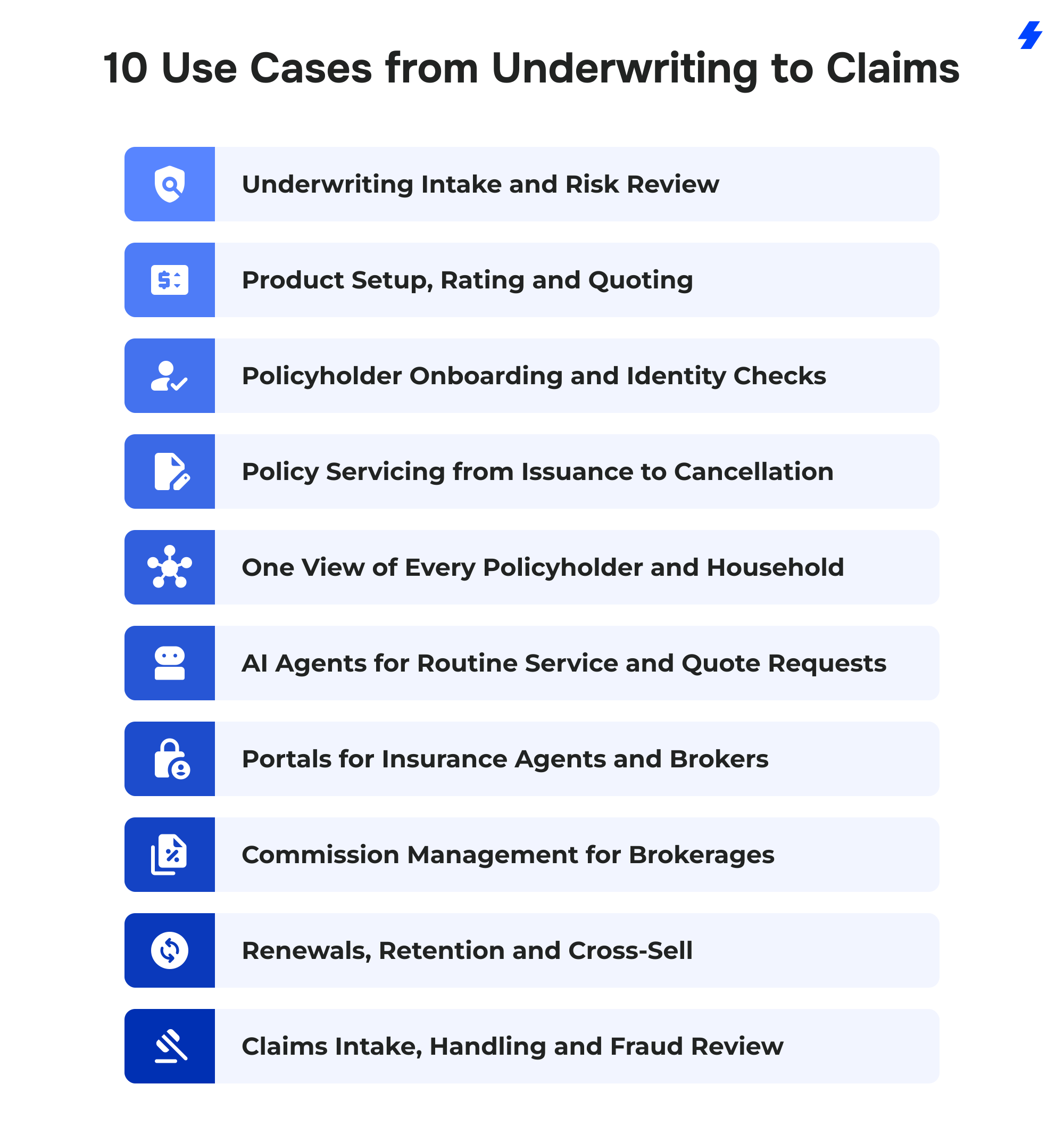
Think of it as a relay race. Each team hands the policyholder to the next, and Salesforce carries the history so nobody starts from zero.
1. Underwriting Intake and Risk Review
Submissions often arrive as emails, PDFs, and phone notes. Underwriters retype the data and chase missing details before they can even look at the risk.
Salesforce's P&C insurance solution lets brokers and agents submit business through a portal, mobile app, or API. It also puts the underwriter's work in one application, with queues, workflow automation, document review, and quote configuration.
Digital Insurance adds a rules framework for products, coverages, and underwriting. Simple applications move straight through, and rules refer the rest to an underwriter with the full context attached.
2. Product Setup, Rating, and Quoting
Launching a new product on a legacy policy system can take a release cycle or more. Every rating change waits in the IT queue.
Digital Insurance includes a product catalog, configuration rules, rules-based pricing, and quoting. Salesforce says this puts business teams in charge of product changes, so updates take days, not months. Quotes support versioning and repricing for policyholders, producers, and underwriters.
IDC also named Salesforce a Leader in P&C Core Systems, which matters if you're comparing it with dedicated core platforms.
3. Policyholder Onboarding and Identity Checks
New policyholders expect to apply online. Regulators expect you to know exactly who they are.
An Experience Cloud portal gives applicants one place to submit forms and documents. Identity checks then run inside the same process instead of in a separate tool.
We integrated ID-Pal's real-time identity verification into Salesforce with bidirectional authorization. It's the same kind of check insurers run when they onboard a new policyholder.
4. Policy Servicing from Issuance to Cancellation
A mid-term change sounds simple: add a driver, raise a limit, update an address. On a legacy system, it can mean several screens and a manual premium recalculation.
Digital Insurance Policy Administration handles issuance, endorsements, cancellations, and automated renewals in real time. Its Transaction Breakdown feature captures every premium, tax, fee, and commission detail for each change.
When a policyholder calls about a change, Agentforce can summarize the policy and quote details. Your rep answers faster, and the caller spends less time on hold.
5. One View of Every Policyholder and Household
A policyholder with an auto policy, a home policy, and an open claim often lives in 3 systems. A service rep jumps between screens to answer a simple question.
Financial Services Cloud brings those records together in one profile, including household relationships. For brokerages, Salesforce uses Data 360 to build that profile from policy details, claims history, and real-time interactions. Your rep sees the full picture before saying hello.
Read also: Understanding Salesforce Data Cloud Limits
6. AI Agents for Routine Service and Quote Requests
Service teams spend hours answering the same coverage questions. That time could go to complex claims and at-risk accounts.
Agentforce for Financial Services includes prebuilt insurance agents. One explains coverage options and handles routine service requests. Another walks customers through quoting: it gathers their risk profile and coverage needs, then compares policy options. Complex cases go to your people.
Groupe Hueber Assurances is one of the customers Salesforce quotes in its announcement. One honest caveat: an AI agent is only as good as the data it reads. If policy data is split across systems, fix that first.
We saw this when we built a generative AI chat agent for Riptide on Service Cloud and Experience Cloud. That project started with a 3-week discovery phase, and the chat went live in 80 days.
Read also: Agentforce Cost: What You Need to Know
7. Portals for Insurance Agents and Brokers
Outside agents and brokers need policy, quote, and commission data. They shouldn't see everything else in your org.
Salesforce for insurance agents usually means an Experience Cloud portal with a strict sharing model. We built an Experience Cloud partner portal for Nomagic with a custom sharing model. Partners see the accounts, opportunities, and files they need, and nothing else. Agent portals for insurers follow the same pattern.
8. Commission Management for Brokerages
Commission splits are a classic broker headache. When a producer leaves or an agency gets acquired, finance teams rework splits by hand.
Salesforce for insurance brokers addresses this through Insurance Brokerages. Finance teams define reusable commission rules and reassign splits when those events happen. The Baldwin Group and AssuredPartners were deploying it before general availability in February 2025.
9. Renewals, Retention, and Cross-Sell
Most lost renewals send signals first: a coverage gap, a rate jump, a quiet account. The problem is that nobody sees the signals in time.
For brokerages, Salesforce generates AI account summaries that flag coverage gaps and retention risks. Marketing Cloud can then run renewal reminders and cross-sell journeys, such as a home policy offer after an auto purchase.
Read also: Salesforce Marketing Cloud Cost Breakdown
10. Claims Intake, Handling, and Fraud Review
A claim is often the first time a policyholder tests your promise. A slow first notice of loss (FNOL) or a lost document shapes how they feel about you for years.
Digital Insurance Claims Management covers claims intake, adjudication, and claims financials and payments. Its prebuilt intake captures peril-specific details in a single window and links each claim to policy terms. Policyholders can report a loss on the web, by phone, in chat, or from a smartphone.
Cumberland Mutual is one carrier Salesforce cites for using Financial Services Cloud and Agentforce to simplify claims. Adjusters work from the same record as service and billing teams.
Shared history also helps with fraud review. The Coalition Against Insurance Fraud estimates fraud costs the US $308.6 billion a year. When policy, claim, and interaction data sit together, adjusters spot inconsistencies sooner.
How Do Different Types of Insurers Use Salesforce?
Salesforce for the insurance industry isn't one product, and each insurer type starts from a different place. Here's the product mix we usually see.
Carriers and MGAs
Salesforce for insurance carriers centers on policy and claims operations. Carriers often pair Digital Insurance or Service Cloud with an existing core system, then add portals for policyholders and agents. The key decision is which processes move to Salesforce and which stay in the core.
Salesforce for Insurance Brokers and Agencies
Brokerages manage client relationships across many carriers. Insurance Brokerages covers commission management plus servicing for P&C and group policies. Salesforce for an insurance agency adds mobile access, task lists, and renewal pipelines in the same org.
Health and Dental Insurers
Salesforce for health insurance has its own product line. Health Cloud for payers covers member services, care management, provider network management, and utilization management, such as prior authorization reviews. It also includes Distribution Management for producer licensing and broker performance.
Not every health or dental insurer starts there. Delta Dental, the largest dental insurance provider in the US, runs Sales Cloud and Marketing Cloud. Our audit of both focused on licensing, permissions, and security rather than new products.
InsurTechs
InsurTechs usually start lean with Sales Cloud and grow into service and portals as the book grows. We've supported a US InsurTech startup with Sales Cloud administration and development since 2025. Starting small keeps license costs in line with revenue.
How Much Does Salesforce for Insurance Companies Cost?
Salesforce for insurance companies costs a per-user license for Financial Services Cloud, plus usage-based pricing for Digital Insurance and the cost of implementation. Here are the official list prices as of October 2026.
Financial Services Cloud Licenses
Financial Services Cloud for Sales is priced per user per month, billed annually:
- Core: $325
- Advanced: $500 (includes Insurance Brokerages)
- Max: $700 (includes the Digital Insurance add-ons)
Digital Insurance
Digital Insurance lists at $180,000. That base includes $1M of Gross Written Premium for Policy Administration, 10,000 Claims Management credits, and 500,000 Group Benefits credits. Extra capacity costs $75,000 per $5M of premium for Policy Administration, $50,000 per 50,000 claims credits, and $60,000 per 3M Group Benefits credits.
Implementation
Salesforce insurance implementation cost depends on the number of core systems you integrate, data migration volume, portal scope, and how much you customize. Salesforce notes that list prices are for information only and subject to change, so confirm with your account executive.
Read also: Salesforce Consulting Rates in 2026: Costs by Country and Role
What Slows Down Salesforce Projects in Insurance?
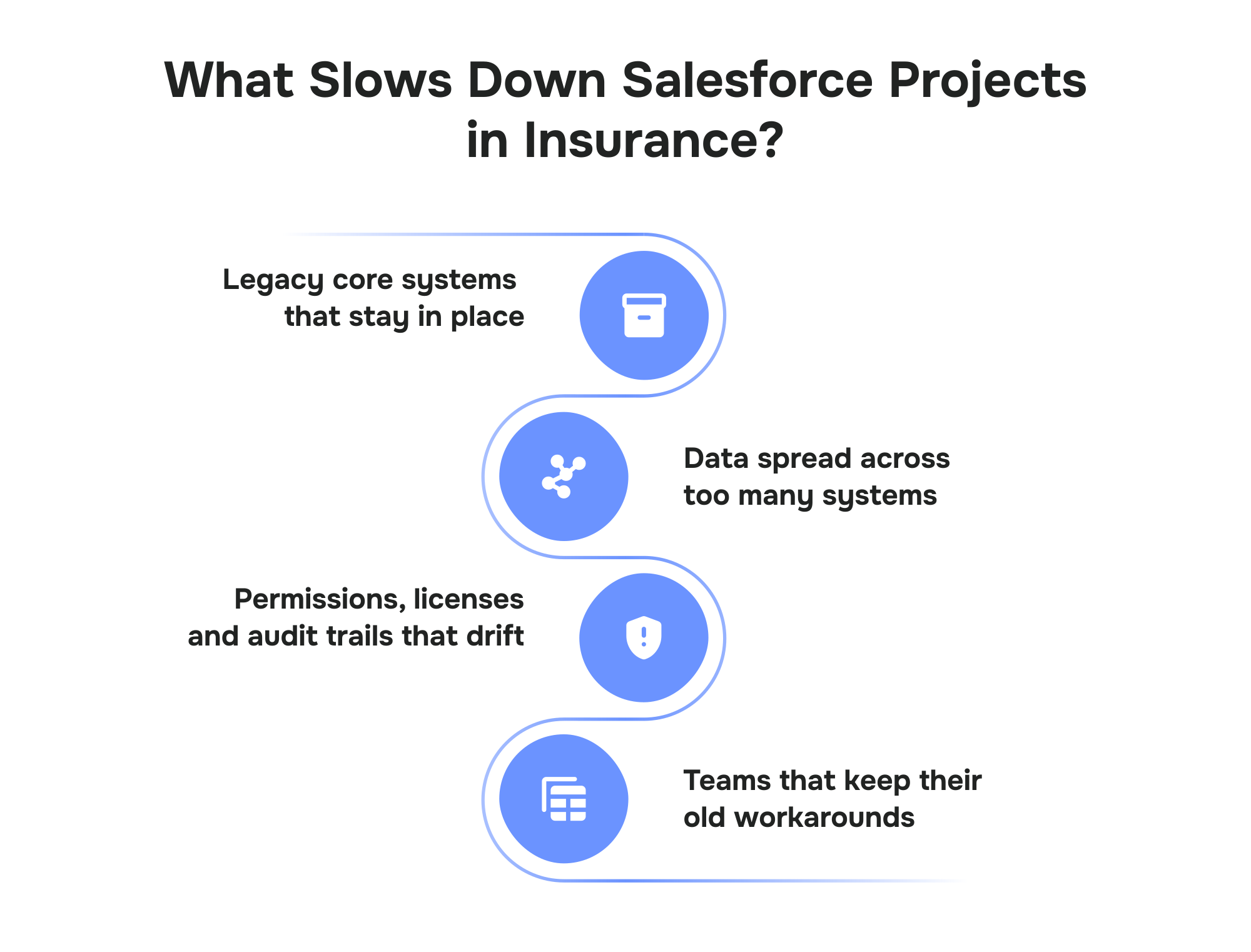
Most insurance Salesforce projects stall on integration, data quality, access control, or adoption. These are the 4 issues we plan for from day 1.
Legacy Core Systems That Stay in Place
Few insurers replace their policy administration or billing system in the same project. Salesforce has to work alongside it. MuleSoft or custom APIs keep policy and billing data in sync.
We've done this in financial services before. For a large financial services provider, we moved a legacy client onboarding application into Salesforce. Flows and custom metadata made the process configurable, and data stayed in sync with external databases. See our Salesforce integration services for how we scope this work.
Data Spread Across Too Many Systems
The same customer often exists 3 times: once per line of business. Migrating without deduplication brings that mess into Salesforce. Plan data cleanup and matching rules before migration starts.
Permissions, Licenses, and Audit Trails That Drift
Insurers hold health details, financial data, and ID documents. Regulators expect you to know who touched each record and when.
Salesforce Shield adds Platform Encryption, Event Monitoring, Field Audit Trail, and Data Detect. Agentforce for Financial Services also adds Process Compliance Navigator for compliance workflows.
Tools only help when access stays set up correctly, and access drifts as teams change. Our Delta Dental audit found excessive admin access and license capacity issues in an otherwise mature org. A periodic Salesforce health check catches this before an auditor does.
Teams That Keep Their Old Workarounds
Agents and adjusters will keep their spreadsheets if Salesforce adds clicks. Involve frontline users in design, and train by role. Adoption is a project deliverable, the same as integration.
Read also: Salesforce Implementation Guide: Process, Costs, and What Changed in 2026
Is Salesforce the Right CRM for Your Insurance Business?
A Salesforce insurance CRM is the right fit if you run several lines of business, many systems, or a large broker network. It's often more than a small agency needs.
Salesforce makes sense if:
- You sell or service several lines of business and want one policyholder view
- You work with outside brokers or agents who need portal access
- You plan to use AI agents for service and need the data foundation for them
- You expect to grow through acquisitions and need a platform that scales A smaller choice may fit better if you're an independent agency with a few producers and no integration needs. At $325 per user per month for Financial Services Cloud, the license alone adds up quickly. An agency management system with a built-in CRM may cover what you need.
How Does MagicFuse Help Insurance Companies With Salesforce?
MagicFuse is a Salesforce partner for insurance and financial services teams that need to plan, build, integrate, or audit Salesforce. We've worked in the Salesforce ecosystem for 12+ years, with 80+ certified Salesforce consultants and 270+ Salesforce certifications.
For insurance projects, the certifications that matter most are Sales Cloud Consultant, Service Cloud Consultant, Experience Cloud Consultant, Integration Architect, Data Architect, and MuleSoft Developer. Our Marketing Cloud specialists hold Administrator, Developer, and Email Specialist certifications.
Our work for insurers and financial services companies includes:
- Salesforce audits and health checks for mature orgs
- Salesforce implementation for Sales Cloud, Service Cloud, and Financial Services Cloud
- Integrations with core policy, billing, and identity systems
- Experience Cloud portals for policyholders, brokers, and agents
- Ongoing admin and development support through Salesforce managed services Learn more on our financial industry page.
Conclusion
Salesforce in insurance has changed fast. Insurance Brokerages reached general availability in February 2025. Agentforce for Financial Services followed in 2025, and Data Cloud is now Data 360.
If your org was set up before those changes, run it through the 10 use cases above. Where does a handoff still depend on a spreadsheet, an email, or someone's memory? Where are you paying for products nobody uses? That's where to start.
Start with a Salesforce health check
FAQs
- What Is Salesforce Used for in Insurance?
Salesforce is used in insurance for underwriting intake, quoting, onboarding, policy servicing, agent and broker portals, commission management, renewals, AI-assisted service, and claims. Most insurers connect it to their core policy and billing systems rather than replacing them.
- What Is a CRM in Insurance?
A CRM in insurance is a system that tracks every policyholder, prospect, broker, and interaction in one place. It connects sales, service, renewals, and claims communication, so your team sees the full relationship instead of separate policy records.
- Does Salesforce Have an Insurance-Specific Product?
Yes. Salesforce insurance solutions include Digital Insurance for carriers, with Policy Administration, Claims Management, and Group Benefits add-ons. Brokerages use Financial Services Cloud with Insurance Brokerages. Health plans can use Health Cloud, which includes features for payers.
- Can Salesforce Work With Core Insurance Systems?
Yes. Most insurers keep their core policy, rating, and billing systems and connect them to Salesforce through MuleSoft or custom APIs. The integration design decides which system owns each piece of data.
- Is Salesforce Good for Small Insurance Agencies?
Salesforce for insurance agencies can work, but cost is the main hurdle. Financial Services Cloud starts at $325 per user per month. Small agencies with simple needs often get more value from an agency management system with built-in CRM features.
- What's the Difference Between Financial Services Cloud and Digital Insurance?
Financial Services Cloud is the CRM foundation for banks, wealth managers, and insurers. Digital Insurance adds carrier operations on top: product setup, underwriting rules, rating, quoting, policy lifecycle, and claims.
- How Does MagicFuse Approach Salesforce Projects for Insurers?
We start with an audit of your current org and systems, then scope integration before configuration. That order keeps policy and claims data consistent and avoids rework after go-live.