






The answer to "what is Salesforce Marketing Cloud" changed more between 2024 and 2026 than in the 8 years before that. If you last looked at this product when it was a bundle of studios, the version you meet today is a different platform with a different name.
Three things moved. Salesforce rebranded the family as Agentforce Marketing. Marketing Cloud Next became the flagship, built on the core Salesforce Platform instead of the old standalone stack. And several products you may still see in job ads and agency proposals, including Social Studio and Audience Studio, were retired.
This guide explains what Salesforce Marketing Cloud is today, which products the family includes, what each one does, what the editions cost, what was retired and when, and how to choose between the options. Every product fact, date, and price links to Salesforce documentation.
Key Takeaways
- Salesforce Marketing Cloud is a family of marketing products, now branded Agentforce Marketing.
- Marketing Cloud Next, announced June 11, 2025, is the current flagship, built on the core Salesforce Platform with Data 360 underneath.
- New customers buy Marketing Cloud Growth at $1,500 per org per month or Marketing Cloud Advanced at $3,250, and existing customers add these capabilities through "+" bundles.
- Audience Studio was retired in February 2024, Social Studio in November 2024, and Marketing Cloud Advertising becomes non-renewable in August 2026.
- Pardot is now Marketing Cloud Account Engagement, Interaction Studio is Personalization, and Datorama is Marketing Intelligence.
- AI inside Marketing Cloud is branded Agentforce, with agents that create campaigns, draft content, and qualify leads.
What Is Salesforce Marketing Cloud?
Salesforce Marketing Cloud is Salesforce's family of marketing products for planning, personalizing, and automating customer communication across email, mobile, web, advertising, and loyalty programs. It connects that communication to the customer data already held in Salesforce, so campaigns run on the same records your sales and service teams use.
The naming has changed. The Salesforce product page is now titled Agentforce Marketing, formerly Salesforce Marketing Cloud, and Salesforce states that every Marketing Cloud customer is an Agentforce Marketing customer. Both names describe the same family, and most teams, job ads, and documentation still say Marketing Cloud or SFMC.
In practice, Marketing Cloud is used by organizations that send personalized messages at volume across more than one channel, and that want those messages driven by behavior and data instead of a manual list upload.
What Changed: Marketing Cloud Is Now Agentforce Marketing
Between 2022 and 2026, Salesforce renamed 3 Marketing Cloud products, retired 3 studios, and replaced the old studio bundle with a platform built on core Salesforce. If you are reading older material, this table translates it.
Why this matters beyond trivia: training material, agency proposals, certification paths, and internal runbooks still use the old names. When a vendor pitches you "Interaction Studio" in 2026, you are looking at a proposal written against a product list that has moved on, and the pricing attached to it has probably moved too.
Salesforce Marketing Cloud Products in 2026
The Marketing Cloud family today includes Marketing Cloud Next, Marketing Cloud Engagement, Marketing Cloud Account Engagement, Personalization, Marketing Intelligence, Loyalty Management, Data 360, and a headless CMS.
Contentful joined through acquisition: Salesforce signed a definitive agreement to acquire Contentful, and the headless CMS now appears alongside the marketing products.
What Is Marketing Cloud Next?
Marketing Cloud Next is Salesforce's agentic marketing platform, announced on June 11, 2025 and available to customers from July 2025. Salesforce describes it as the first full-funnel agentic marketing solution, built natively on the Salesforce Platform with Data 360 as its data layer.
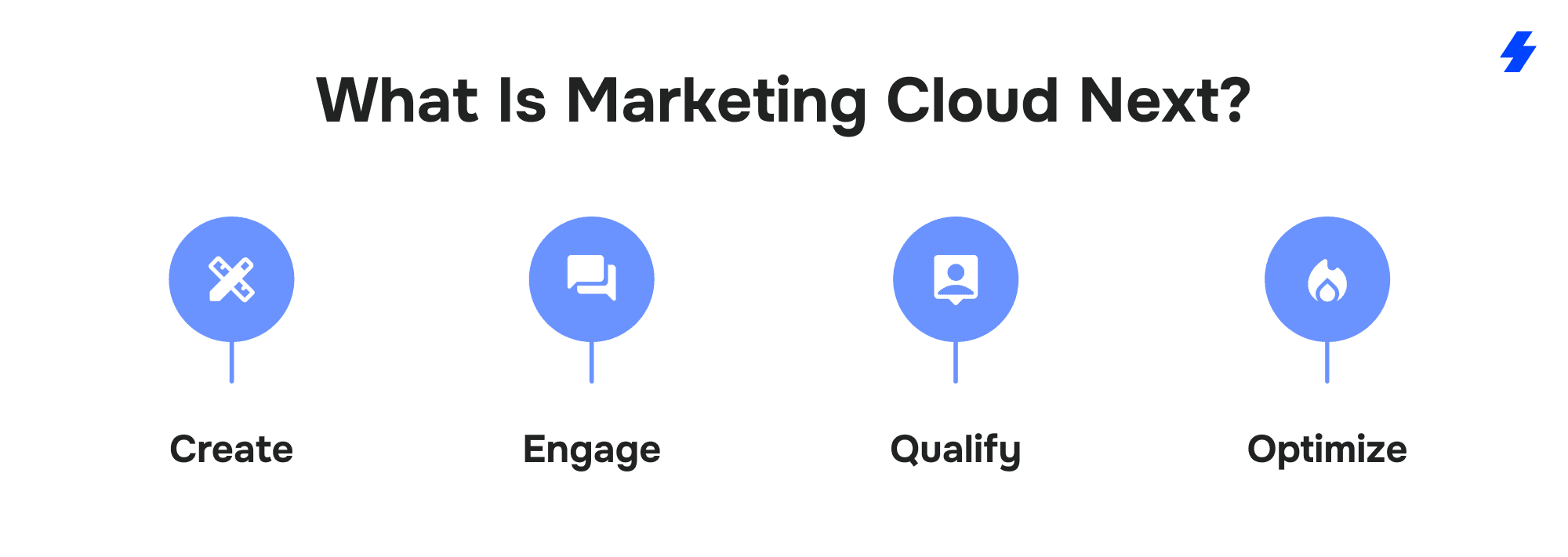
It is organized around 4 pillars:
- Create: Agentforce drafts the campaign brief, audience, content, and journey, so a campaign can be assembled in hours instead of sprints.
- Engage: messaging becomes two-way, with conversational SMS and WhatsApp replacing do-not-reply sends.
- Qualify: agents work leads across channels and languages, handing qualified ones to sales.
- Optimize: performance is monitored continuously, with paid media and journey paths adjusted as results come in. The architectural change matters more than the feature list. Because Marketing Cloud Next runs on the core platform, marketing works from the same data model, permissions, and reporting as sales and service. The old pattern of a separate Marketing Cloud instance, its own subscriber model, and a synchronization layer between them goes away.
Marketing Cloud Next vs Marketing Cloud Engagement
Marketing Cloud Engagement is the established B2C platform, while Marketing Cloud Next is the newer agentic platform on core Salesforce, and Salesforce now presents Next as the primary product for new customers.
Existing customers are not forced to migrate. Salesforce frames the "+" bundles as the upgrade path: if you already use Engagement, Account Engagement, Personalization, or Intelligence and want Agentforce Marketing capabilities, you upgrade to a "+" edition of your current product and keep what you have.
Core Marketing Cloud Features
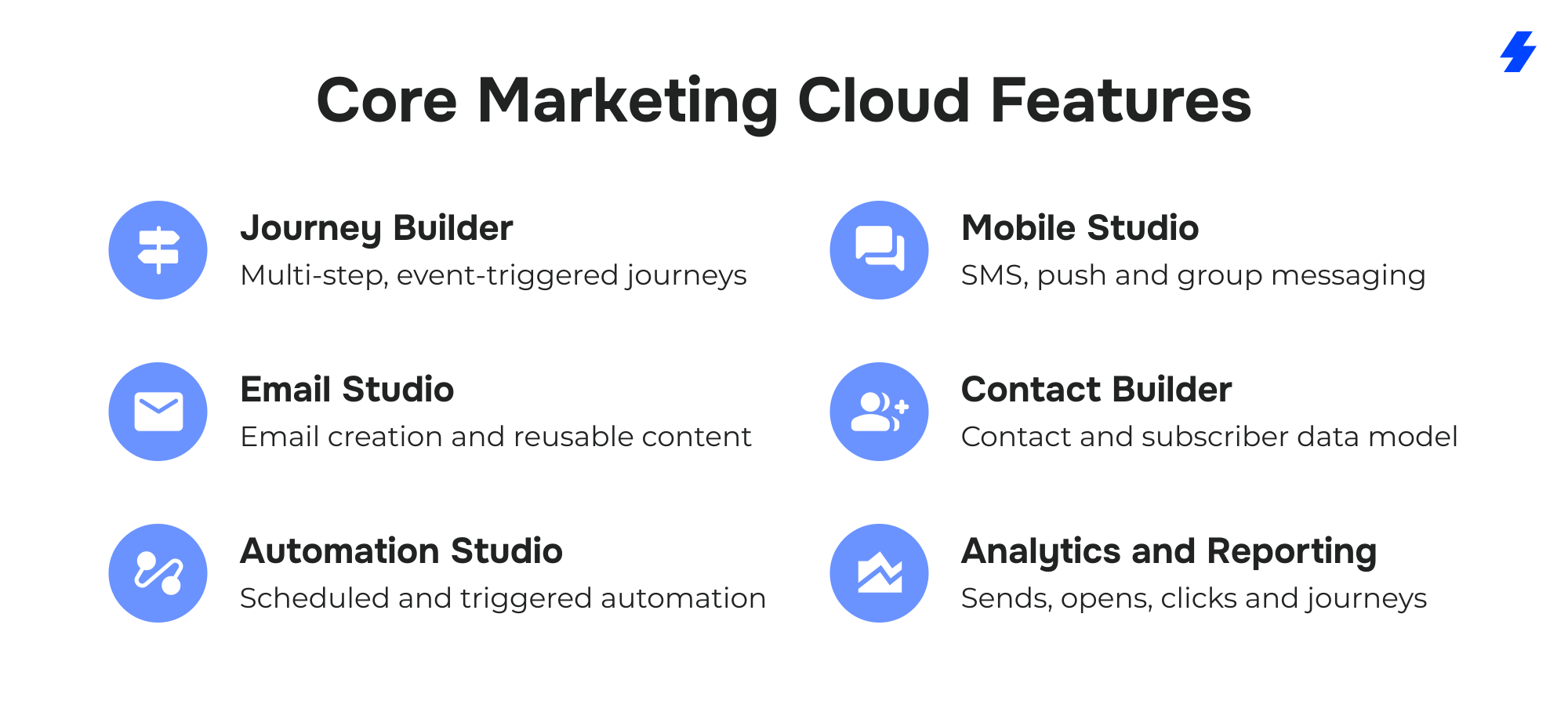
The features most teams mean when they say Marketing Cloud are journeys, email, automations, mobile messaging, the data layer, and reporting. These remain current inside Marketing Cloud Engagement, and Marketing Cloud Next covers the same jobs with different building blocks.
Journey Builder
Journey Builder creates multi-step customer journeys triggered by behavior and events, such as a purchase, a download, or an abandoned cart. Each journey can branch on data, wait for a condition, and send across channels, which is what separates it from a scheduled email campaign.
Email Studio and Content Builder
Email Studio handles email creation, audience targeting, testing, and sending, while Content Builder stores the templates, images, and blocks that campaigns reuse. Shared content is what keeps a large program consistent when several people build emails.
Automation Studio
Automation Studio runs scheduled and triggered automations: imports, data extracts, segmentation queries, and sends. Most of the unglamorous work that keeps a marketing database usable happens here.
Mobile Studio
Mobile Studio covers SMS, push notifications, and group messaging, triggered by the same journeys and data as email. In Marketing Cloud Next, this extends into two-way conversations over SMS and WhatsApp.
Contact Builder and Data 360
Contact Builder defines how contact and subscriber data is structured inside Marketing Cloud Engagement. Data 360 does the heavier job of unifying data from several systems into profiles that segmentation and AI can use.
Analytics and Reporting
Engagement reporting covers sends, opens, clicks, and journey performance. Marketing Intelligence takes it further, pulling paid media and cross-channel data into one reporting layer.
Agentforce for Marketing: What AI Does Today
AI inside Marketing Cloud is branded Agentforce, and it now does more than suggest subject lines. Salesforce documents Agentforce in Marketing Cloud Next drafting campaign briefs, generating a campaign from an objective you describe, revising email, landing page, and SMS copy inside Content Builder, and summarizing campaign performance including opens, clickthrough rate, and delivery stats.
Salesforce went further in 2026. In its agentic marketing announcement on June 3, 2026, it made 2 agents generally available: Piper, the AI SDR agent that qualifies website visitors conversationally and routes them to sales, and Hunter, the prospecting agent that identifies prospects by intent and runs outreach sequences. Campaign management from Slack arrived the same month. An Agentforce Content Agent, which generates omni-channel content with automatic localization, and a Marketing Goals Agent, which creates and optimizes campaigns against a goal and budget, are both in pilot.
One caveat worth stating plainly: agents are only as good as the data underneath them. Salesforce's own research points the same way, with marketers who have unified data 60% more likely to use AI agents. Programs that stall usually stall on data ownership and consent. Our article on how Agentforce changes customer service covers the same pattern on the service side.
Thinking about Marketing Cloud for your team?
We scope, implement, and support Marketing Cloud programs, from the data model to the first journeys.
Explore Marketing Cloud Services
Retired Marketing Cloud Products and Migration Deadlines
Salesforce retired Audience Studio on February 1, 2024 and Social Studio on November 18, 2024, and Marketing Cloud Advertising becomes non-renewable from August 15, 2026.
If any of these are still in your stack, 3 steps apply: inventory what depends on them, export the data well before the contract ends, since Salesforce deletes it afterward, and plan the replacement before a renewal date forces the decision for you.
Salesforce Marketing Cloud Editions and Pricing
New Marketing Cloud customers buy Marketing Cloud Growth at $1,500 per org per month or Marketing Cloud Advanced at $3,250 per org per month, both billed annually. Existing customers add next-generation capabilities through "+" bundles priced separately.
All figures are annual billing, from the Salesforce pricing and editions pages, and they are list prices before negotiation.
What list price leaves out is usually what decides the budget: contact volume and message volume tiers, implementation, integration with your other systems, data cleanup and migration, and the support tier you choose. Our Marketing Cloud cost breakdown goes through those components in detail.
B2C or B2B: Which Marketing Cloud Product Fits
B2C teams sending high-volume, behavior-triggered messaging start with Marketing Cloud Engagement or Marketing Cloud Next. B2B teams running lead nurture against a sales pipeline start with Marketing Cloud Account Engagement.
If you are weighing the B2B path specifically, our guide to Marketing Cloud Account Engagement, formerly Pardot, goes deeper on lead management.
Who Uses Salesforce Marketing Cloud
Marketing Cloud fits organizations that send personalized messages at volume across more than one channel, and that already run, or plan to run, Salesforce as their system of record.
The pattern holds across industries: retail and ecommerce for lifecycle and cart journeys, travel and hospitality for booking and loyalty communication, financial services and insurance for regulated lifecycle messaging, healthcare and life sciences for consent-heavy patient and provider communication, education for enrollment and student engagement, and nonprofits for donor and supporter journeys. Our Marketing Cloud guide for nonprofits covers that last case in detail.
It is the wrong fit in 3 situations: single-channel email at low volume, where a lighter tool costs less and does the job; no Salesforce CRM and no plan to adopt one, since most of the value comes from the shared data; and no internal owner for the data model, which is the fastest way to end up paying for a platform nobody can use.
Business Problems Marketing Cloud Solves
Salesforce surveyed 4,450 marketers for the State of Marketing Report, 10th edition, published February 19, 2026. Its findings map cleanly onto what Marketing Cloud is built to fix.
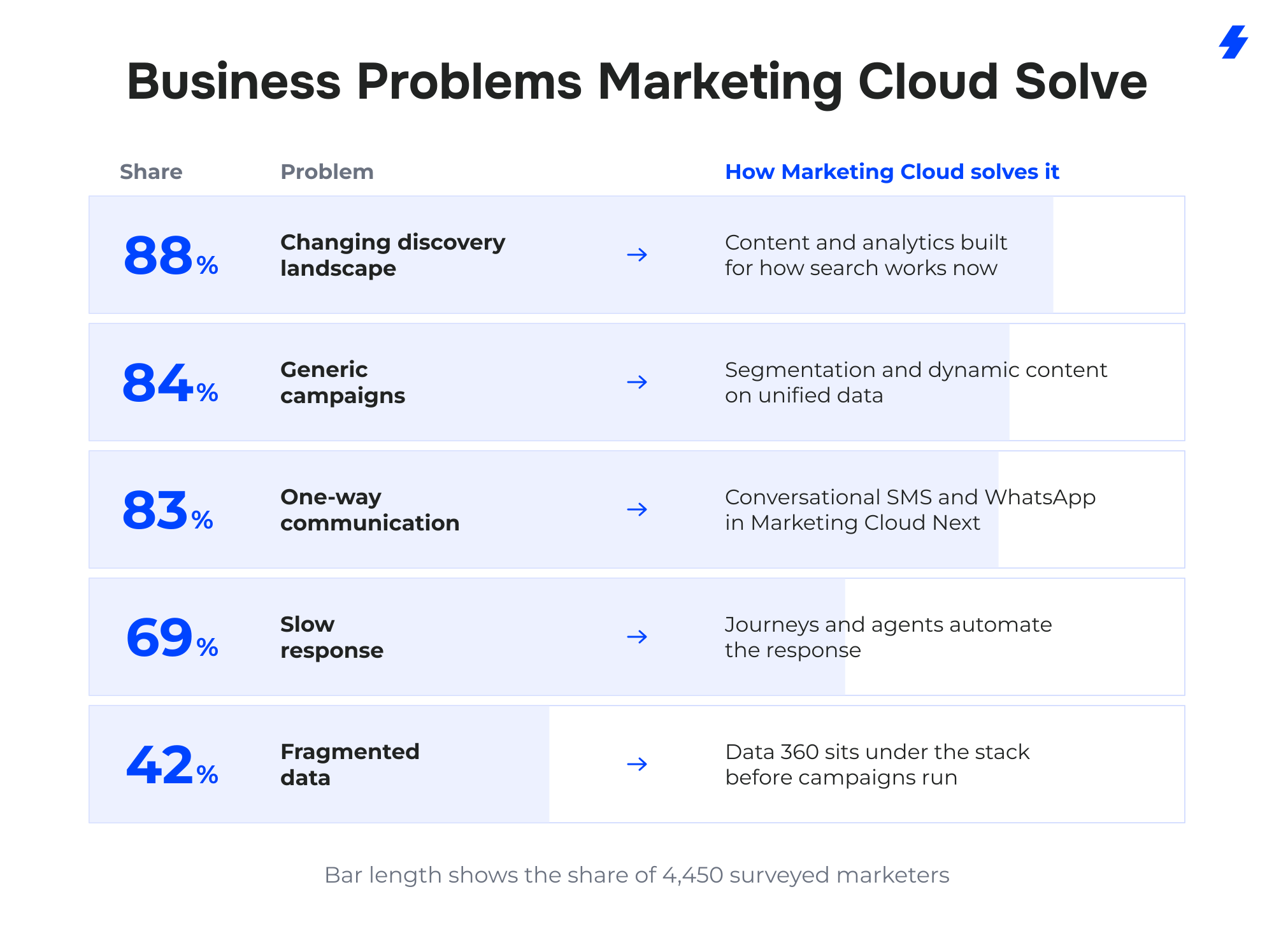
Generic campaigns. 84% of marketers admit to running them. Segmentation on unified data, dynamic content, and Personalization are the direct answer, and they only work when the data layer is in place first.
One-way communication. 83% say customers increasingly expect two-way conversations, while just over half can reliably reply to email and SMS. Conversational SMS and WhatsApp in Marketing Cloud Next exist for this gap.
Slow response. 69% still struggle to respond to customers promptly. Journeys and agents move the response from a human queue to an automated path with a human exception route.
Fragmented data. Marketers with unified data are 42% more likely to respond to customers regularly and 60% more likely to use AI agents. This is the strongest argument for Data 360 sitting under the marketing stack.
A changing discovery landscape. 85% say AI is reshaping their SEO strategy and 88% have begun optimizing for AI-generated answers, which changes what marketing teams need from content and analytics.
How to Get Started With Salesforce Marketing Cloud
A Marketing Cloud rollout starts with the data model and the consent rules, well before the first email.
- Define the use cases and the metrics they move. Welcome journey, abandoned cart, renewal, reactivation. Name the metric for each one.
- Audit your data sources, quality, and consent. Decide what Data 360 unifies and who owns each source.
- Choose the products and edition that match those use cases, using the tables above.
- Design the data model and integrations. Contact and subscriber structure, identifiers, and the systems that write into them.
- Set up deliverability properly. Sending domains, authentication, and warm-up plans belong at this stage.
- Build the first journeys and templates, starting with the use case that has the clearest metric.
- Migrate content, audiences, and automations from the current stack, and archive what nobody uses.
- Launch in stages, then measure and iterate. Reporting should be designed before launch and refined with real data. Timelines depend on scope, the number of integrations, data volume and quality, org readiness, and team availability. If you want a realistic picture for your setup, talk to our team.
Common Marketing Cloud Mistakes We See
A few patterns repeat across the Marketing Cloud programs our team has worked on.
Buying the edition before mapping the data. The edition decision is easy to make early and expensive to unwind. For an animal-welfare nonprofit, the real work before advanced segmentation in Marketing Cloud was a data migration and deduplication of millions of records across systems that had never agreed on a single supporter record.
Treating consent as a channel setting. Double opt-in and opt-out automation belongs in one place, applied consistently. The same nonprofit project handled consent centrally, which is what made petition, donation, and campaign journeys safe to automate.
Skipping the audit on an inherited org. A US insurance provider brought us in to assess an existing Sales Cloud and Marketing Cloud setup. Data and API management turned out to be solid, and the gaps were in governance and security, which is not what anyone expected going in.
Rebuilding the same journey five times. Channel-specific or segment-specific copies of one journey multiply maintenance. One journey with branches is almost always the better build.
Measuring sends instead of outcomes. Open and click rates say what the email did. Revenue, retention, and pipeline say what the program did.
Ignoring the retirement list until renewal. Teams still running Social Studio replacements or Advertising Studio campaigns found this out on a renewal deadline, with no time to plan the replacement.
More examples of this work sit in our case studies.
Planning a Marketing Cloud implementation or cleanup?
We start with your data, your consent rules, and the journeys that actually move a metric.
Explore More Salesforce Marketing Resources
- Salesforce Marketing Cloud Implementation Services: how MagicFuse plans and delivers Marketing Cloud programs.
- Salesforce Marketing Cloud Cost: the full budget breakdown beyond list prices.
- Salesforce Marketing Cloud for Nonprofits: a practical setup guide for donor and supporter journeys.
- Marketing Cloud Account Engagement, formerly Pardot: the B2B side of the family.
- How Agentforce Transforms Customer Service: what agentic AI looks like in service.
- Salesforce Integration Services: connecting Marketing Cloud to the rest of your stack.
FAQs
- What is Salesforce Marketing Cloud?
Salesforce Marketing Cloud is Salesforce's family of marketing products for personalizing and automating customer communication across email, mobile, web, advertising, and loyalty programs. It runs on customer data held in Salesforce, so campaigns use the same records as sales and service teams.
- Is Salesforce Marketing Cloud the same as Agentforce Marketing?
Yes. Salesforce rebranded the family as Agentforce Marketing, and its product page reads "Agentforce Marketing, formerly Salesforce Marketing Cloud." Salesforce states that every Marketing Cloud customer is an Agentforce Marketing customer. Both names refer to the same set of products.
- What is Marketing Cloud Next?
Marketing Cloud Next is Salesforce's agentic marketing platform, announced on June 11, 2025 and available to customers from July 2025. It is built on the core Salesforce Platform with Data 360, and it organizes marketing around 4 pillars: Create, Engage, Qualify, and Optimize.
- What is the difference between Marketing Cloud Engagement and Marketing Cloud Account Engagement?
Marketing Cloud Engagement is the B2C platform for high-volume email, mobile, and journey messaging. Marketing Cloud Account Engagement, formerly Pardot, is B2B marketing automation built around lead nurture, scoring, and pipeline reporting for a sales team.
- How much does Salesforce Marketing Cloud cost?
Marketing Cloud Growth costs $1,500 per org per month and Marketing Cloud Advanced costs $3,250, both billed annually. Add-ons include Personalization at $8,000, Marketing Intelligence at $10,000, and Loyalty Management at $20,000 per org per month. Implementation and data work are separate.
- Is Pardot still called Pardot?
No. Pardot is now Marketing Cloud Account Engagement, and Salesforce currently sells it as the Account Engagement+ bundle at $1,250 per org per month. The product still handles B2B lead nurture, scoring, and marketing analytics, and many teams still say Pardot in conversation.
- What happened to Social Studio and Audience Studio?
Salesforce retired Audience Studio on February 1, 2024 and Social Studio on November 18, 2024. In both cases, application access ended and customer data was deleted after contract end. Salesforce pointed Social Studio customers toward third-party social tools instead of a direct replacement.
- Do you need Data 360 to use Marketing Cloud?
Not for every setup, but it is the data layer behind Marketing Cloud Next and behind serious segmentation anywhere in the family. Salesforce research found marketers with unified data are 42% more likely to respond to customers regularly and 60% more likely to use AI agents.
- What can Agentforce do inside Marketing Cloud?
Agentforce drafts campaign briefs, generates campaigns from an objective, writes and revises email, landing page, and SMS content, and summarizes campaign performance. Salesforce also offers Piper for visitor qualification and Hunter for prospecting, with a Content Agent and a Marketing Goals Agent in pilot.
- How long does a Marketing Cloud implementation take?
It depends on the number of data sources, data quality, how many integrations are in scope, your consent requirements, and team availability. A single-use-case launch and a multi-product program follow very different plans. Talk to our team for an estimate based on your setup.