
Picture this. Your app works in every demo, your first customers are waiting, and then the Salesforce security review comes back with a list of findings. Each resubmission of a paid app costs another $999, and your launch date slides with every round.
Choosing the right AppExchange development company is how you avoid that scenario. The right partner builds a managed package that passes review, installs cleanly in thousands of different customer orgs, and keeps working through every Salesforce release.
Imagine investing time and budget into an app, only to find it doesn't integrate well with your customers' Salesforce orgs or fails to meet their needs. The consequences are costly in both money and time. The development company you choose decides much of that outcome.
In this article, you'll find the 10 factors to check before you choose an AppExchange development company, 12 questions to ask on your first call, and what changed in 2026 now that AppExchange is part of AgentExchange.
Key Takeaways
- An AppExchange development company designs, builds, secures, and helps list a Salesforce app, while the ISV owns the product and the listing.
- In April 2026, Salesforce merged AppExchange, Slack Marketplace, and the Agentforce ecosystem into a single marketplace called AgentExchange.
- The security review costs $999 per paid-app submission and per resubmission, so a partner's first-pass record directly affects your budget.
- Check for current skills: Lightning Web Components, second-generation managed packages (2GP), Agentforce actions, and MCP tools.
- Settle ownership of the namespace, source code, and Partner Business Org before development starts.
- Look at partner tier, Product Development Outsourcer (PDO) status, live apps, and reviews together, and match them to the product you're building.
Understanding Salesforce AppExchange Development
Salesforce AppExchange is the marketplace where Salesforce customers find, evaluate, and install apps that extend the Salesforce platform. Since April 2026, it's part of the unified AgentExchange, which Salesforce says "unifies AppExchange, Slack Marketplace, and the Agentforce ecosystem."
The marketplace now lists more than 10,000 Salesforce apps and experts, more than 1,000 pre-built agents, tools, and MCP servers, and more than 2,600 Slack apps and agents, according to Salesforce Ben's coverage of the launch. In its Summer '26 ISV guidance, Salesforce describes it as a single destination for more than 20 million Salesforce and Slack users.
From apps designed for sales, marketing, and customer service to more niche solutions, the marketplace offers a wide range of options for optimizing business operations. That range is also why your app needs a clear reason to stand out.
What Is Salesforce AppExchange?
AppExchange is Salesforce's cloud-based marketplace, where companies can find, evaluate, and install apps that integrate directly with Salesforce products, including Sales Cloud, Service Cloud, and Marketing Cloud.
These apps extend Salesforce's native functionality in several ways: adding advanced features, integrating third-party software, or addressing specific business requirements.
AppExchange offers many applications, from ready-to-use solutions like marketing automation tools and advanced reporting apps to more complex, customizable offerings. Apps are available as both free and paid solutions, so businesses of all sizes can find tools that fit their needs and budget.
For example, popular apps like DocuSign for Salesforce, which handles document signing directly within Salesforce, help organizations save time by automating manual processes.
AppExchange Is Now AgentExchange: What Changed for ISVs
Salesforce announced the unified AgentExchange at TDX in April 2026. For ISVs, 3 changes matter most:
- One marketplace for apps and agents. Salesforce apps, Slack apps, and Agentforce agents are listed and discovered in one place.
- New listing types. Salesforce's ISV strategy for Summer '26 introduced ISV MCP Tool Action listings, so ISVs can distribute external MCP servers through the marketplace.
- Consumption-based pricing options. The same release added Data 360 provisioning for ISVs, with usage consolidated into Flex Credits, and signaled a shift toward pricing per action or completed process. For listing and promotion tactics, see our AppExchange development and promotion guide. Most buyers and search engines still use the name "AppExchange," so you'll see both names in this article. If you're still deciding how to distribute your product, our comparison of OEM and ISVforce partnerships covers the 2 main models.
Who Develops Apps on AppExchange?
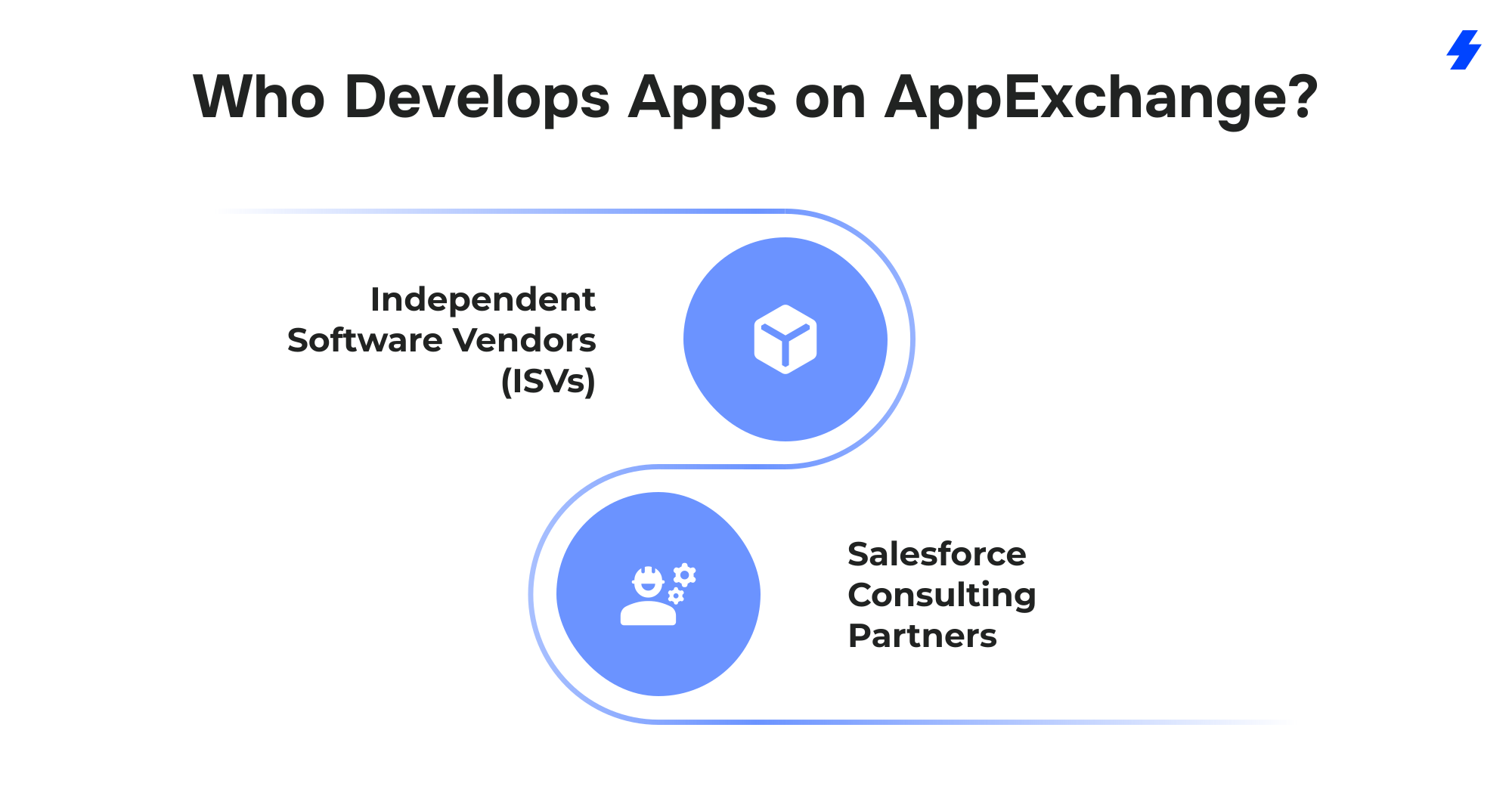
Apps on AppExchange are owned and listed by ISVs. Many ISVs build them with a development partner, often a Salesforce consulting partner that specializes in product development.
Independent Software Vendors (ISVs)
ISVs own the apps sold on AppExchange. They create ready-to-install apps that help businesses extend their Salesforce platform, with solutions for everything from automation to industry-specific functionality.
ISVs provide plug-and-play solutions that cut development time for their customers and integrate directly with Salesforce CRM. That makes them a good fit for businesses that need specialized tools but lack the team to build them in-house.
ISVs often focus on specific business functions or industries. Their apps can range from lead generation tools to custom analytics, depending on the needs of the business.
Salesforce places each ISV in a tier that "aligns to their stage in their partner journey," and it reviews those tiers quarterly, according to Salesforce Help. The stages are Exploration, Build, Select, and Summit, moving from early conversations about a first paid app to strategic partnerships.
Salesforce Consulting Partners
Salesforce consulting partners are certified companies that provide custom solutions, including Salesforce development services, for businesses that want to tailor Salesforce to their needs.
An AppExchange development partner guides ISVs through the entire process, from initial planning and design to development, security review, listing, and post-launch support. Under the FY27 consulting partner program, these partners fall into 2 tiers, Select and Summit, according to the Salesforce FY27 Consulting Partner Program brochure.
Salesforce also recognizes partners that specialize in building commercial apps as Product Development Outsourcers (PDOs). According to Salesforce Help, PDOs help ISVs "build their commercial apps as well as to provide other valuable services like training, support, marketing." There are 2 levels:
You can browse PDOs in the AgentExchange PDO collection. Treat PDO status as one useful signal alongside tier, live apps, and reviews.
Key Factors to Consider When Choosing an AppExchange Development Company
Selecting the right AppExchange development company shapes the success of your product. The right partner makes sure your app works reliably inside Salesforce and also provides long-term support, compliance guidance, and technical expertise. Below are the 10 factors to check before you sign.
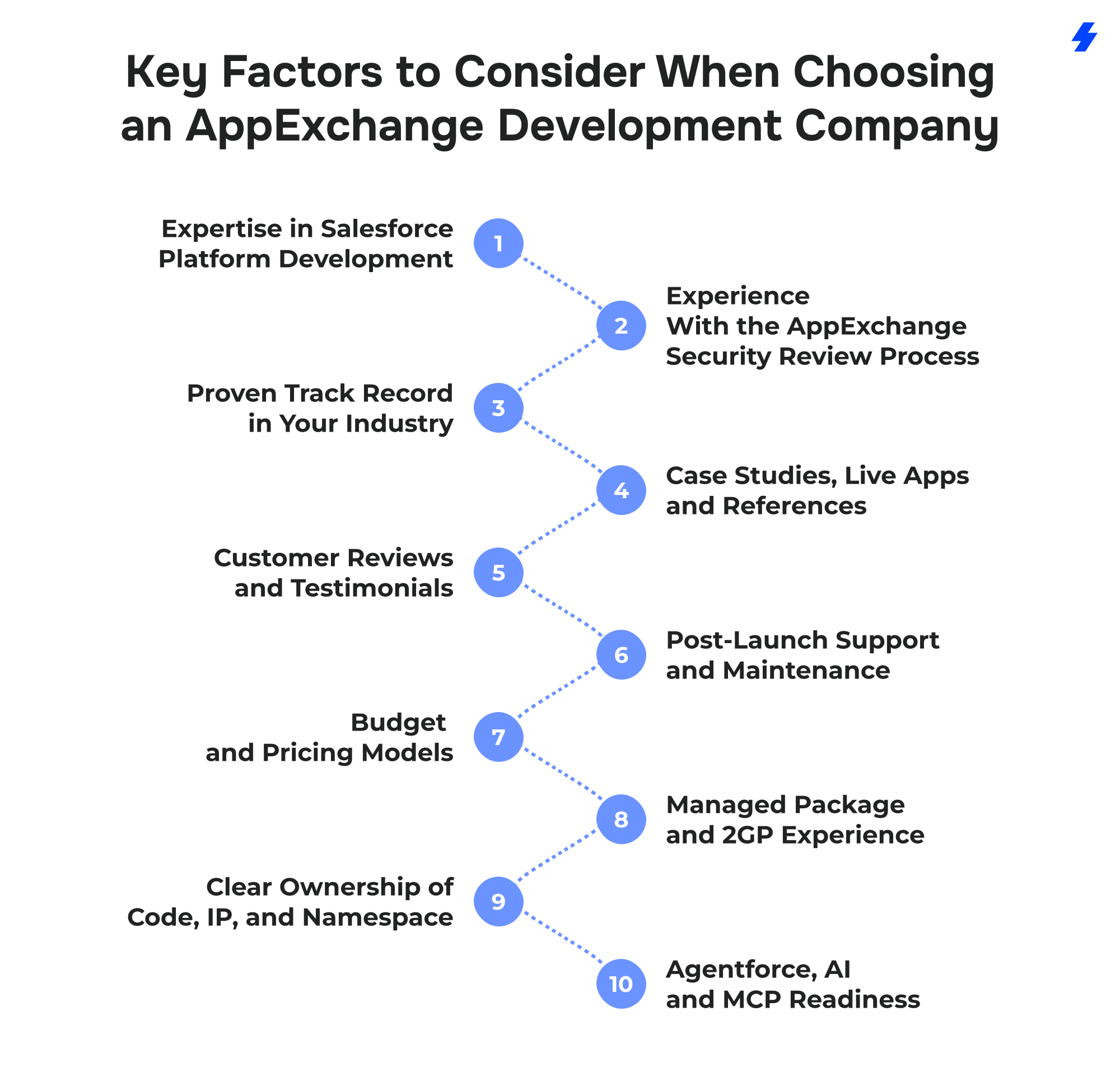
1. Expertise in Salesforce Platform Development
Every AppExchange application rests on a deep understanding of the Salesforce platform. Beyond writing code, AppExchange development requires a solid grasp of Salesforce's architecture, programming languages, governor limits, and the specific tools available within the platform.
When you evaluate a development company, assess their expertise in these areas:
Apex Proficiency
Apex is Salesforce's proprietary programming language, essential for building custom business logic and backend operations in Salesforce apps. A company's ability to use Apex well means your app will run efficiently and work reliably with Salesforce CRM.
Experience With Lightning Web Components
Lightning Web Components (LWC) is Salesforce's modern framework for building fast, responsive user interfaces, and it should be the default for new AppExchange apps. Visualforce still appears in older packages, so a good partner can maintain it and modernize it step by step.
Working with Ascent Solutions, we designed 2 new calendar components for its rental and sales packages and applied Lightning styles to existing Visualforce pages, giving customers a more modern interface in the existing package. Our guide on how to build an app for AppExchange explains when each UI framework fits.
Integration Capabilities
Salesforce is often part of a larger IT ecosystem, so your app may need to connect with ERP systems, marketing platforms, and data warehouses through Salesforce's REST API, SOAP API, or integration tools like MuleSoft. Your development partner should have experience with these Salesforce integrations so your app communicates reliably with other systems.
MagicFuse connects Salesforce with ERPs, commerce platforms, payment systems, and marketing tools. For Limio, we built a managed package that brings B2B and B2C commerce management into Salesforce, with integrations to Limio Commerce and third-party payment systems.
2. Experience With the AppExchange Security Review Process
Every app listed on AppExchange must pass Salesforce's security review. The review checks that apps meet Salesforce's standards for data protection and security, which matters most when an app handles sensitive customer data.
The review has a direct cost. Salesforce asks for "a $999 fee payment for the initial submission and for any subsequent attempts" for every paid solution, according to Trailhead. Security reviews for free apps currently carry no fee, as our AppExchange cost guide explains. A partner who passes on the first attempt saves you both money and launch time.
Ask every candidate for their first-pass rate. Working with Elements.cloud, we built a managed package that passed every security review it went through.
An experienced AppExchange development partner will:
Ensure Data Security and Compliance
The partner should apply best practices for data encryption, secure coding, and compliance with Salesforce's security policies. This is especially important for apps in regulated industries such as healthcare and finance.
Prepare Your App for Review Before You Submit
A company familiar with the security review knows how to prepare the required materials and fix potential issues before submission. That reduces the risk of delays and helps your app pass sooner. Our Salesforce security review services cover code analysis, data protection checks, penetration testing, and documentation.
Provide Comprehensive Documentation
Salesforce requires specific materials for each submission. According to Trailhead, these include usage documentation, documentation of data flows between the Salesforce org and any external components, Salesforce Code Analyzer scan reports for managed packages, and access to a test environment. An experienced partner prepares all of it and makes sure it meets Salesforce's requirements. For a step-by-step walkthrough, see our AppExchange security review guide.
3. Proven Track Record in Your Industry
Salesforce expertise is critical, and industry experience gives you a significant advantage on top of it. A development company that understands your industry's challenges, regulations, and business processes can build a product that fits how your customers actually work.
Healthcare Industry
In healthcare, the regulatory environment is particularly complex, with strict requirements for how patient data is handled, shared, and stored.
If your Salesforce app involves patient information, it must comply with HIPAA (Health Insurance Portability and Accountability Act) regulations in the United States or similar healthcare standards in your region.
Companies with healthcare app experience on Salesforce know the details of data encryption, secure communications, and auditable logs. They also understand how to integrate securely with Electronic Health Records (EHR) systems, patient management systems, and other third-party healthcare applications.
A development partner with healthcare experience makes sure your app meets legal requirements and supports the workflows, decisions, and patient care processes that healthcare organizations depend on.
Financial Services Industry
The financial services industry faces some of the strictest data security rules, including PCI DSS (Payment Card Industry Data Security Standard) and GDPR (General Data Protection Regulation).
If your Salesforce app is designed for financial services, it must apply best practices for protecting sensitive financial data such as credit card information, transaction records, and personal financial information.
A partner experienced in financial services understands these compliance and security standards and how to design apps that meet them. They'll also understand workflows specific to financial institutions, such as automated risk assessments, client onboarding, and regulatory reporting.
For ID-Pal, we built a managed package that brings real-time identity verification into Salesforce, with bidirectional authorization between Salesforce and ID-Pal and a secure interface for reviewing documents that contain personal data.
4. Case Studies, Live Apps, and References
Reviewing a partner's past work is one of the most effective ways to evaluate them. Case studies and client references show how well the company has handled similar projects and whether it has solved complex technical challenges.
Start with the most important question: which commercial apps has the partner built and still supports? Building a product for AppExchange is a lot like designing an apartment building. Every tenant's space is different, and your package has to install and upgrade cleanly in every one of them.
MagicFuse has supported 15+ ISV products and built 3 proprietary AppExchange products of our own. That means we know the ISV side of the table, from security review to customer support.
Here are the key aspects to look for in a partner's case studies:
Problem-Solving Skills
How did the company approach specific business challenges in previous projects? Did they use Salesforce's features effectively, or did they struggle during development? A company with a strong track record can show how it overcame technical hurdles such as third-party integrations, complex automation, or customizations unique to the client.
Technology Use
What tools and technologies did the company use to deliver its solutions? Did it keep up with current Salesforce technology such as Lightning Web Components, Apex, Salesforce APIs, and Agentforce? A strong development company builds your app with current methods and tools.
Results Achieved
Case studies should clearly outline the results of past projects. These can include fewer manual tasks, more efficient customer service, or more sales from better lead management. Look for measurable outcomes that show how the company's work affected the client's business.
Client References
Speaking directly with past clients is one of the most valuable steps in your evaluation. A reputable company will have satisfied clients who can confirm its ability to deliver high-quality work within the agreed budget. References also show how the company communicates, manages timelines, and collaborates.
5. Customer Reviews and Testimonials
Client reviews and testimonials give you candid feedback on how a development company operates, what working with them is like, and the quality of their service. Check the partner's rating and reviews on its AgentExchange consulting listing, and verify individual consultants' certifications with Trailhead's credential verification tool.
Here's what to look for in customer reviews:
Project Management
Effective project management is a key indicator of a development company's ability to deliver predictable results. Reviews should mention how the company managed scope, handled deadlines, and kept clients informed throughout the project.
Communication and Responsiveness
Customer testimonials often highlight how responsive a company is during development. Communication is essential for addressing concerns, sharing updates, and adapting to changes in scope. Look for companies that make clear, transparent communication a priority so you're involved at every stage.
Customer Satisfaction
Reviews should show a high level of customer satisfaction. Look for feedback on whether the company met or exceeded expectations. Positive reviews typically describe how the company's work helped a business improve operations, customer service, or growth.
6. Post-Launch Support and Maintenance
Launching your app on AppExchange is just the beginning. Ongoing technical support keeps your app working as Salesforce changes. Your development partner should offer:
Updates for Every Salesforce Release
Salesforce ships 3 major releases a year: Spring, Summer, and Winter. Your app must stay compatible with each one. A good partner tests your package against every release in advance, plans new features around the Salesforce roadmap, and prepares you for periodic security re-reviews.
Bug Fixes and Performance Improvements
Even with careful testing, bugs can appear after launch. A reliable partner offers timely bug fixes and performance improvements based on user feedback. Fixing issues quickly keeps your app running smoothly and protects your reviews.
Scalability
As your customer base grows, your app has to grow with it. A good partner builds your app to handle more users, more data, and new requirements, and adds features as your roadmap evolves.
For Atamis, a procurement software provider on the Salesforce platform, a dedicated MagicFuse developer reviewed and optimized the codebase, added new features and test coverage, and prepared the product for security review. The app went on to earn excellent AppExchange reviews.
7. Budget and Pricing Models
Cost is an important factor when you choose an AppExchange development partner. Evaluate each pricing model by the long-term value it offers. Here are the main models to consider:
Fixed-Price Projects
Fixed-price contracts work best for projects with clearly defined requirements. You know the cost upfront, which helps with budgeting. It's a good option for a well-scoped first version with clear deliverables.
Hourly Rate Models
If your scope is likely to evolve, hourly rates give you flexibility. This model works well for ongoing projects or when you expect changes or additions to the original app. It does require careful management to keep costs within budget.
Dedicated Team
A dedicated team works on your product continuously and follows your roadmap release after release. You can hire dedicated Salesforce developers or add a Salesforce architect to lead technical design. This model suits ISVs with a long-term product plan who want the same specialists to own the codebase over time.
Value for Money
Initial savings are appealing, but long-term value matters more. A partner that offers ongoing support, scalability, and consistent updates gives you better value over your app's lifespan. For budget ranges by project type, see our guide to AppExchange app development cost.
8. Managed Package and 2GP Experience
Your partner should know how to build, version, and upgrade managed packages. That includes registering a namespace, managing package versions, and pushing upgrades to customers without breaking their orgs.
Second-generation managed packaging (2GP) is Salesforce's source-driven packaging model. Since Summer '25, Salesforce's Package Migrations feature "fully automates the process of converting 1GP packages to 2GP" and moves customers with installed packages to 2GP. If you have an older package, ask whether the partner has handled that migration.
For Riptide, we delivered the product as a 2GP managed package with multiple successful releases.
9. Clear Ownership of Code, IP, and Namespace
Before development starts, agree in writing on who owns what. The namespace, source code repositories, Partner Business Org, and License Management App should all belong to you, the ISV.
This is the factor buyers most often skip. If the partner registers the namespace in its own org, moving your product to another team later becomes difficult and expensive.
10. Agentforce, AI, and MCP Readiness
Agents are now part of the AppExchange marketplace, so your partner should know how to build for them. Look for experience with custom Agentforce actions, MCP tools, and AI features that respect Salesforce's security and data rules.
AI coding assistants also change how apps get built. Salesforce's Summer '26 release introduced Agentforce Vibes 2.0, which generates code from natural language and wireframes. These tools speed up development, and experienced engineers still need to review every change before it goes into a package that faces security review.
For Riptide, we also built Riptide Instant Agent, a generative AI agent that orchestrates live chat conversations inside Salesforce. See our Agentforce consulting services for more on how we approach agent projects.
12 Questions to Ask an AppExchange Development Company
Use these questions on your first call to compare AppExchange development companies side by side:
- Which commercial AppExchange apps have you built, and which do you still support?
- What share of your security review submissions pass on the first attempt?
- Which scanning tools do you run before submission, including Salesforce Code Analyzer?
- Will the namespace, repositories, and Partner Business Org be registered in our name?
- Do you build with second-generation managed packages, and have you migrated a 1GP package to 2GP?
- Is Lightning Web Components your default UI framework?
- Have you built Agentforce actions or MCP tools for an ISV product?
- How do you test our package before each Salesforce release?
- Who exactly will work on our product, and how do you keep the same team over time?
- What is your partner tier, and do you hold PDO status or relevant competencies?
- Can we speak with 2 ISV clients whose products you've built?
- What does post-launch support include, and how are fixes prioritized?
Why MagicFuse Is a Trusted AppExchange Development Partner
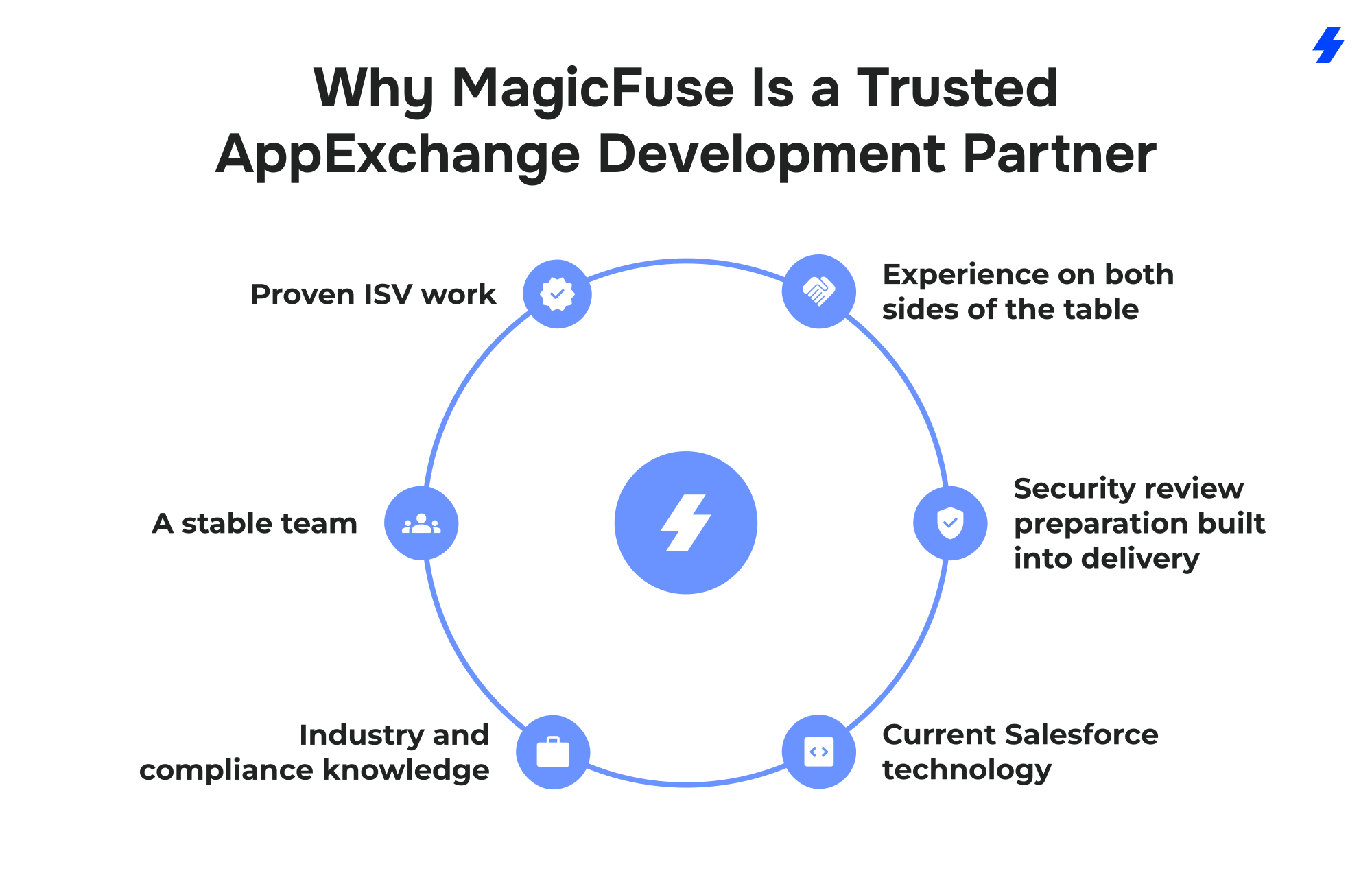
MagicFuse is a Salesforce Summit consulting partner with 12+ years in the Salesforce ecosystem, 450+ employees, and 270+ Salesforce certifications across the team. Here's what that means for your product:
- Experience on both sides of the table. We've built 3 proprietary AppExchange products and supported 15+ ISV products, so we know what it takes to build, list, and run a commercial app.
- Security review preparation built into delivery. We plan for the review from the first sprint, with code scanning, documentation, and test environments prepared along the way.
- Current Salesforce technology. Our engineers build with Apex, Lightning Web Components, 2GP managed packages, and Agentforce.
- Industry and compliance knowledge. We've built apps that handle identity verification, personal data, and GDPR requirements.
- A stable team. Our annual turnover is 6.37%, and only 2.65% is voluntary, so the people who build your product are likely to be the ones who support it.
- Proven ISV work. Our clients include Elements.cloud, Limio, ID-Pal, Riptide, and Atamis.
Conclusion
Choosing the right AppExchange development company decides whether your app passes security review, installs cleanly, and keeps working through every Salesforce release. Focus on platform expertise, security review experience, industry knowledge, clear ownership, and long-term support, and you'll give your product a strong start on AgentExchange.
Remember the app from the start of this article, stuck in review with its launch date slipping. The right partner prepares for that review from the first sprint, so your launch day stays on the calendar.
Get a security review readiness check for your AppExchange app, or talk to our ISV team about your product roadmap.
FAQs
- What should I look for in a Salesforce AppExchange development company?
Look for live commercial apps the partner has built, a strong first-pass security review record, and experience with Apex, Lightning Web Components, 2GP managed packages, and Agentforce. Confirm that you'll own the namespace and code, and check the partner's tier, reviews, and post-launch support terms.
- How long does it take to develop and launch a custom AppExchange app?
It depends on your app's scope, the number of integrations, how ready your app is for security review, and team availability. A partner should give you an estimate only after a discovery phase. Contact MagicFuse to get a scoped estimate for your app.
- What kind of support is available after the app is live on AppExchange?
After launch, your app needs testing before each of Salesforce's 3 annual releases, bug fixes, performance improvements, and preparation for periodic security re-reviews. The best AppExchange partners also add features and scale the app as your customer base grows.
- Is AppExchange now called AgentExchange?
Yes. In April 2026, Salesforce unified AppExchange, Slack Marketplace, and the Agentforce ecosystem into a single marketplace called AgentExchange. Salesforce apps, Slack apps, agents, and MCP tools are now listed in one place.
- How much does the AppExchange security review cost?
Salesforce charges $999 for the initial security review submission of a paid app and $999 for each subsequent attempt, according to Trailhead. Security reviews for free apps currently carry no fee.
- What is a Salesforce Product Development Outsourcer (PDO)?
A PDO is a Salesforce partner that builds commercial apps for ISVs and supports them with services such as training, support, and marketing. Salesforce recognizes 2 levels, Specialist PDO and Cloud Expert PDO, based on credentialed team members, completed projects, and customer satisfaction scores.
- Who should own the namespace and source code of an AppExchange app?
You, the ISV, should own the namespace, source code repositories, Partner Business Org, and License Management App. Agree on this in writing before development starts, so you can change development partners later without rebuilding your package.